‘Let’s do it ourselves!’
With
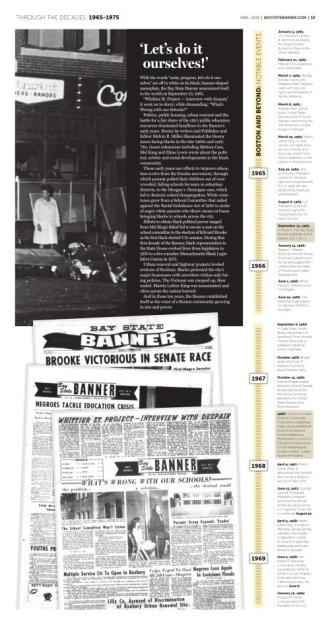
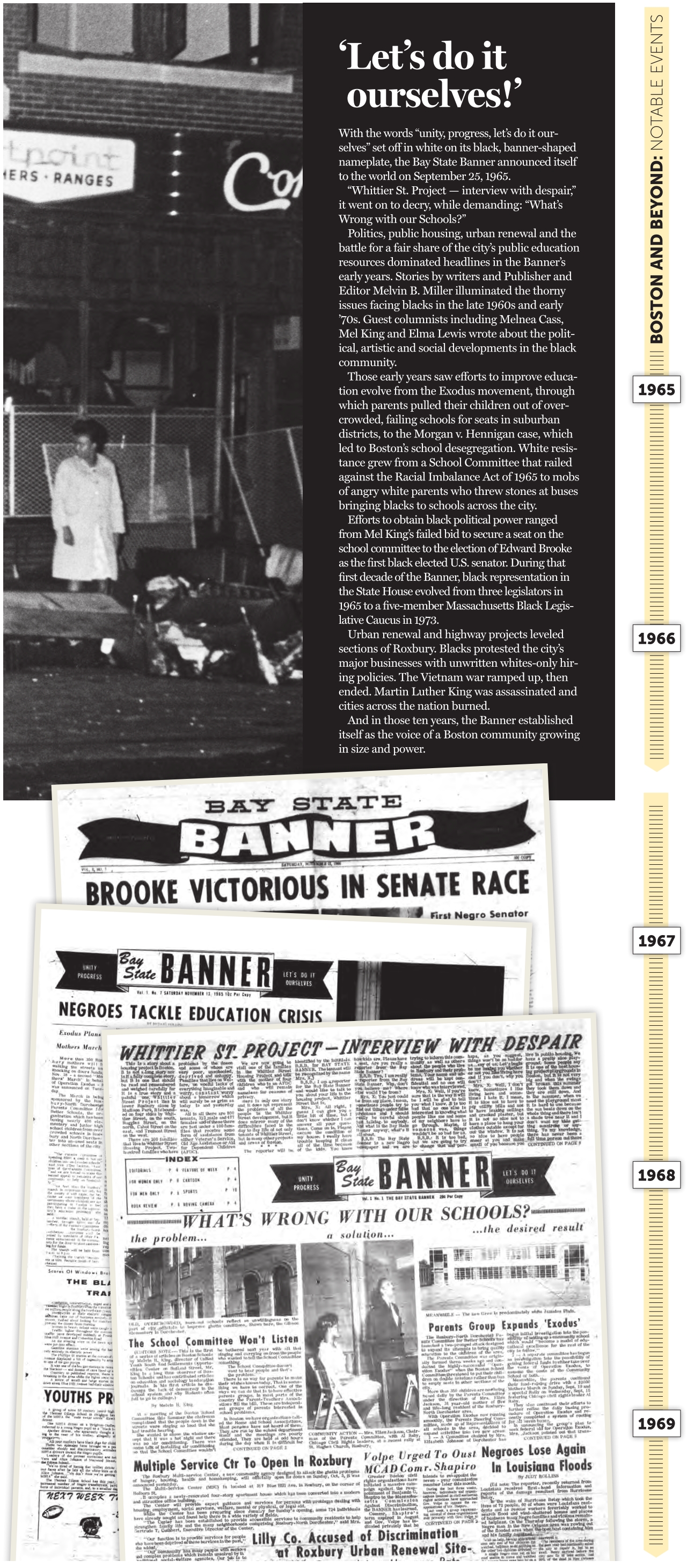
the words “unity, progress, let’s do it ourselves” set off in white on
its black, banner-shaped nameplate, the Bay State Banner announced
itself to the world on September 25, 1965.
“Whittier St. Project — interview with despair,” it went on to decry, while demanding: “What’s Wrong with our Schools?”
Politics,
public housing, urban renewal and the battle for a fair share of the
city’s public education resources dominated headlines in the Banner’s
early years. Stories by writers and Publisher and Editor Melvin B.
Miller illuminated the thorny issues facing blacks in the late 1960s and
early ’70s. Guest columnists including Melnea Cass, Mel King and Elma
Lewis wrote about the political, artistic and social developments in the
black community.
Those
early years saw efforts to improve education evolve from the Exodus
movement, through which parents pulled their children out of
overcrowded, failing schools for seats in suburban districts, to the
Morgan v. Hennigan case, which led to Boston’s school desegregation.
White resistance grew from a School Committee that railed against the
Racial Imbalance Act of 1965 to mobs of angry white parents who threw
stones at buses bringing blacks to schools across the city.
Efforts
to obtain black political power ranged from Mel King’s failed bid to
secure a seat on the school committee to the election of Edward Brooke
as the first black elected U.S. senator. During that first decade of the
Banner, black representation in the State House evolved from three
legislators in 1965 to a five-member Massachusetts Black Legislative
Caucus in 1973.
Urban
renewal and highway projects leveled sections of Roxbury. Blacks
protested the city’s major businesses with unwritten whites-only hiring
policies. The Vietnam war ramped up, then ended. Martin Luther King was
assassinated and cities across the nation burned.
And in those ten years, the Banner established itself as the voice of a Boston community growing in size and power.
January 4, 1965: U.S. President Lyndon B. Johnson proclaims his “Great Society” during his State of the Union Address.
February 21, 1965: Malcolm X is assassinated in Manhattan.
March 7, 1965: Bloody Sunday: Some 200 Alabama State Troopers clash with 525 civil rights demonstrators in Selma, Alabama.
March 8, 1965: Vietnam War: Some 3,500 United States Marines arrive in South Vietnam, becoming the first American combat troops in Vietnam.
March 25, 1965:
Martin Luther King, Jr. and 25,000 civil rights activists successfully
end the 4-day march from Selma, Alabama, to the capitol in Montgomery.
July 30, 1965: War on Poverty: President Lyndon B. Johnson signs the Social Security Act of 1965 into law, establishing Medicare and Medicaid.
August 6, 1965: U.S. President Lyndon B. Johnson signs the Voting Rights Act of 1965 into law.
September 25, 1965: In Boston: The Bay State Banner publishes its first edition: Vol. 1, No. 1
January 13, 1966: Robert
C. Weaver becomes the first African American Cabinet member by being
appointed United States Secretary of Housing and Urban Development.
June 1, 1966: White House Conference on Civil Rights.
June 30, 1966: The National Organization for Women (NOW) is founded.
September 6, 1966: In
Cape Town, South Africa, the architect of Apartheid, Prime Minister
Hendrik Verwoerd, is stabbed to death by Dimitri Tsafendas.
October 1966: Bobby Seale and Huey P. Newton found the Black Panther Party.
October 15, 1966:
Former Massachusetts Attorney General Edward Brooke becomes the first
African American elected to the United States Senate since
Reconstruction.
1966: In Boston:
Lower Roxbury Community Corporation established; Haley House
established; South End Historical Society established; Metropolitan
Council for Educational Opportunity school desegregation program begins;
Copley Square remodeled.
April 4, 1967: Martin Luther King, Jr. denounces the Vietnam War during a religious service in New York.
June 13, 1967:
Solicitor General Thurgood Marshall is nominated as the first African
American justice of the U.S. Supreme Court. He is confirmed August 30.
April 4, 1968:
Martin Luther King, Jr. is slain in Memphis. James Earl Ray, indicted
in the murder, is captured in London on June 8. In 1969, Ray pleads
guilty and is sentenced to 99 years.
June 5, 1968:
Sen. Robert F. Kennedy is shot and critically wounded by Sirhan B.
Sirhan in a Los Angeles hotel after winning California primary. He dies
on June 6.
January 20, 1969: Richard M. Nixon is inaugurated 37th President of the U.S.