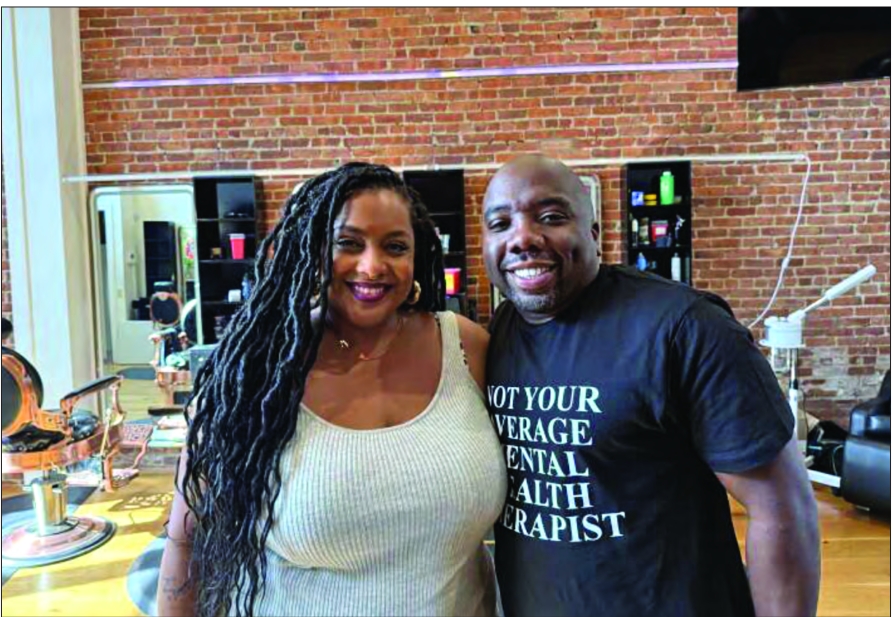
Vania Arroyo and Rob Badgett run The Barbershop Clinic. 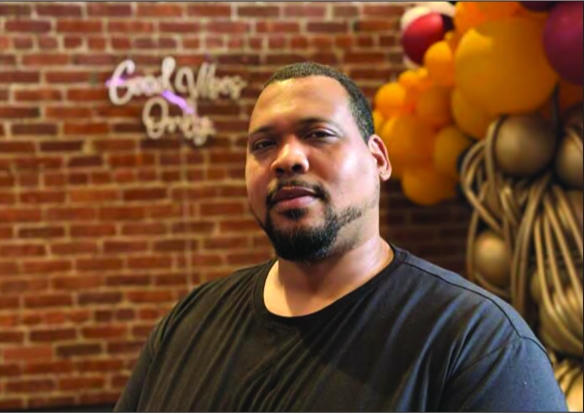
Matt Parker has participated in therapy sessions at In the Cut barbershop.
When a 28-year old Boston artist and entrepreneur who goes by HAAWWS went looking for therapy earlier this year, he found it in a barbershop.
Barbershops have long been known as places where Black men go for fellowship and support, as well as informal therapy. But through the mental health initiative The Barbershop Clinic, a Nubian Square barbershop is the gathering place for formal group therapy sessions.
On his first visit, HAAWWS says, he wept.
“When I broke down in tears, I felt like I needed that. I felt I was harboring a lot and it needed to be released,” he said.
Vania Arroyo launched The Barbershop Clinic in February after several trial runs over the past couple of years. She had hosted a successful event around women’s healing in Lynn, and said men were starting to ask “Does something like this exist for me?”
Initially, the idea was to include haircuts, but they soon discovered most men were loyal to their own barbers. Still, the men said they would come to the barbershop for group therapy.
Over the past seven months, The Barbershop Clinic has hosted three cohorts, bringing together groups of 10 men to talk openly and heal collectively through the sessions, at no charge.
For Matt Parker, a Roxbury resident and youth organizer, joining the program was transformative.
“It just felt like a place where once you enter, once the talking begins, you feel like you’re supposed to be there,” Parker said.
“Now I know — ‘Hey, therapy might be an option for me.’ And that’s a big deal because often enough, the stigma attached to therapy, especially for Black and brown men, is still very tough, relatively taboo.”
Parker
says the group gave him a sense of accountability and a safe space to
share opinions in a healthy way. In the group, they often reference the
mantra “the hardest part is showing up.”
“Having those moments of showing up and knowing that’s part of the work, it was impactful,” he said.
Boston
native Tre Walton owns a brand called Never Stop, Never Lose and shares
motivational messages through his social platforms.
He went to The Barbershop Clinic eager to find a comfortable space to express vulnerability.
Walton’s dad is a barber, so he already understood the importance of the familiar environment.
“The
barbershop was a very monumental place for the Black community,
especially for the men, for us to really be able to come together from
different places,” Walton said.
The
clinic is led by Rob Badgett, a licensed therapist, for three hours
weekly over the course of a five weeks. The first session is in-person
at In the Cut barbershop, while the following ones are virtual. Once
completed, clients get a list of resources to continue their mental
health journeys.
“One of the challenges
within group therapy is, first, getting over all of the ideas, the
dispositions, the stereotypes, the narratives as it relates to therapy,”
Badgett said.
Badgett
said that when he was looking for a therapist for himself, he realized
there were not many professionals who were also Black. But he knows
first-hand that it’s important for Black people to have access to
“someone from the culture who could connect to the culture in ways that
only we would understand.”
Arroyo
and Badgett say they are planning to expand The Barbership Clinic to
more locations, including other cities along the East Coast.
“This
is 100% a community effort. This will not happen without the help of
the community and people investing in this vision,” Arroyo said. “Our
goal is to transform barbershops into safe spaces where men can connect
with therapists.”
Badgett
says he can see the effect of that safe space on the men in the program
— like at the recent session when HAAWWS broke down in tears and other
men rushed in to support him, exchange numbers and offer to be a
listening ear. Badgett says HAAWWS’ experience speaks to the power of
this program.
“If the
environment was not like that, I highly doubt he would have felt safe
enough to express even that level of emotion,” Badgett said. “But it was
created, it was cultivated, and he was able to do that.”
For HAAWWS, the program has been life-changing.
“The
program provided a safe space to really be vulnerable and open up a
side that I feel like I had been closing off for some time,” he said.
This article originally appeared on GBH News. Magdiela Matta is the Community Producer for the Equity and Justice Unit.