King’s Chapel Memorial Sculpture “Unbound” by artist Harmonia Rosales 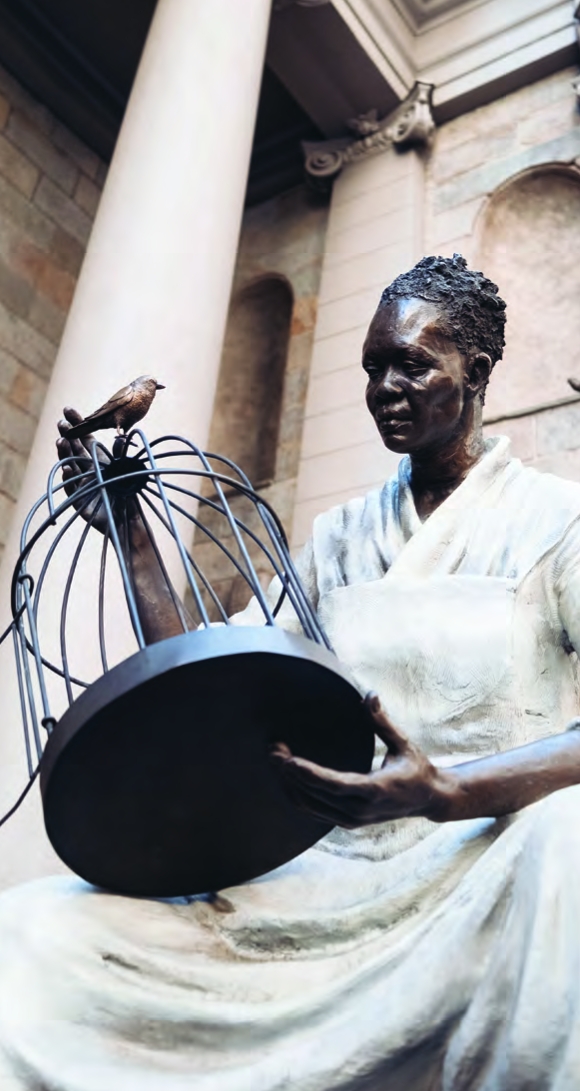
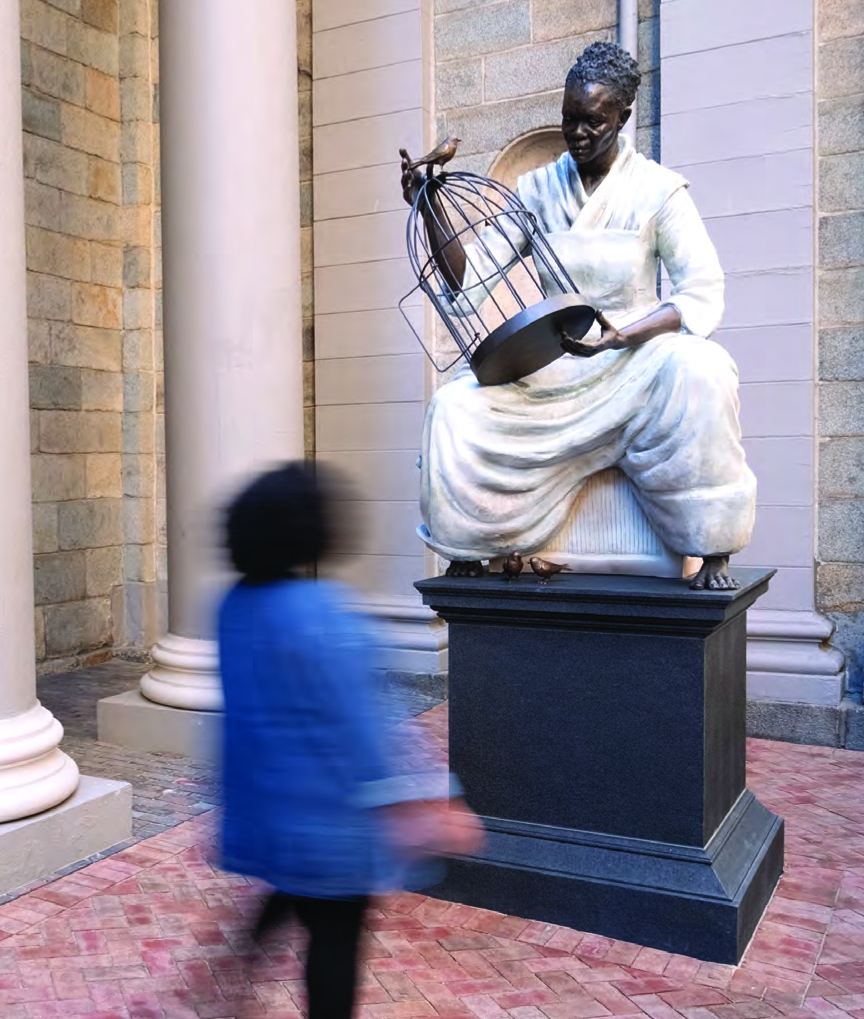
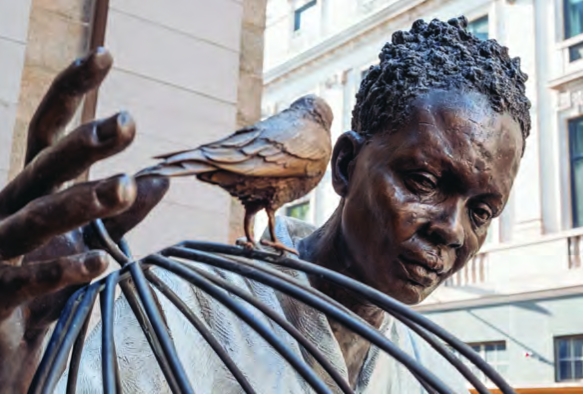
King’s Chapel has stood on the corner of Tremont and School streets since 1686. It’s one of the oldest churches in Boston and one of the 16 official stops on the Freedom Trail. But as of Sept. 14, the facade of the imposing stone church will look a little different. On its south terrace, passersby will now spot a larger-than-life statue of a Black woman. Draped in regal white, she sits on a pedestal holding a metal cage and from that cage, birds fly free.
This monument, titled “Unbound” and crafted by artist Harmonia Rosales in partnership with MASS Design Group, was 10 years in the making. The powerful bronze figure honors the 219 people known to have been enslaved by past church members and ministers.
In 2015, the King’s Chapel historian began to uncover the existence of the enslaved people who had not been included in the story of the church. Their names are listed on the King’s Chapel website. From there, the church leadership and the congregation began the process of reconciling with this history and determining how to honor these individuals both publicly and within the church community.
Dean Denniston has been chair of the memorial committee since its inception and a member of the King’s Chapel congregation for 30 years.
“We were telling some parts of our history, but we weren’t telling all of the parts of our history,” said Denniston. “Massachusetts was the first state to legalize slavery initially; that’s one of the firsts we don’t talk about.”
Once the congregation decided to move forward with a memorial, it brought in the non-profit architecture and design firm MASS Design Group. Through many conversations with the congregation, Jha D Amazi, principal at MASS Design Group and director of the public memory and memorials lab, helped focus the project. It became clear that the monument would serve several purposes, including fostering the continual internal repair work of the congregation and starting dialogues about this history in the larger Boston community and with visitors to the city.
MASS Design Group recommended Harmonia Rosales, who submitted several design proposals including the sculpture and a mural on the ceiling of the chapel. The mural, to be painted close to the upper balcony where the enslaved people sat during services, will depict Black and Indigenous figures looking down from above, framing a brilliant blue sky where birds fly free.
“That entire meaning of the word ‘unbound’ is we’re not tied to the past,” said Rosales. “Our past is not just of bondage, it’s not just of enslavement, that’s not where our history begins. It’s only one chapter. We’ve always had wings.”
The church chose to do both projects. The sculpture and the mural, which will be painted at a later date, are in conversation but they are also individual artworks that function independently.
The
physical monument and the future mural are just one piece of the
twofold project. The other is a living memorial, spearheaded by Roeshana
Moore-Evans, a specialist in reparative justice and living memory. The
living memorial will include public programming, listening sessions and
monetary investment in restorative justice efforts.
There
is no way to ever fully repair or reconcile the atrocities of slavery.
But this is an opportunity to work on the process of community healing.
Moore-Evans has been making connections among the chapel and Black
churches, Boston Public Schools and other community organizations.
“My
hope, and I believe the hope of the committee and the church, is to
really start to bring people together around this work to create a space
for healing,” Moore-Evans said.
King’s
Chapel is seizing an opportunity to serve as an example to other
historical organizations around the city. It is actively working to
uncover and repair the violent and damaging elements of the church’s
history. The placement a 14-foot sculpture of a Black woman directly on
the Freedom Trail is a way to say she was here, too.
“This
memorial is an act of remembrance and a call to action,” said Rev. Joy
K. Fallon, senior minister at King’s Chapel. “We honor the dignity and
legacy of those whose names were long erased, and we commit to walking a
path of truth, faith and repair.”
ON THE WEB
Learn more at memorial.kings-chapel.org