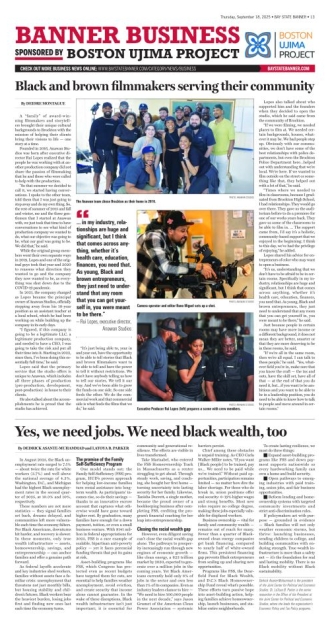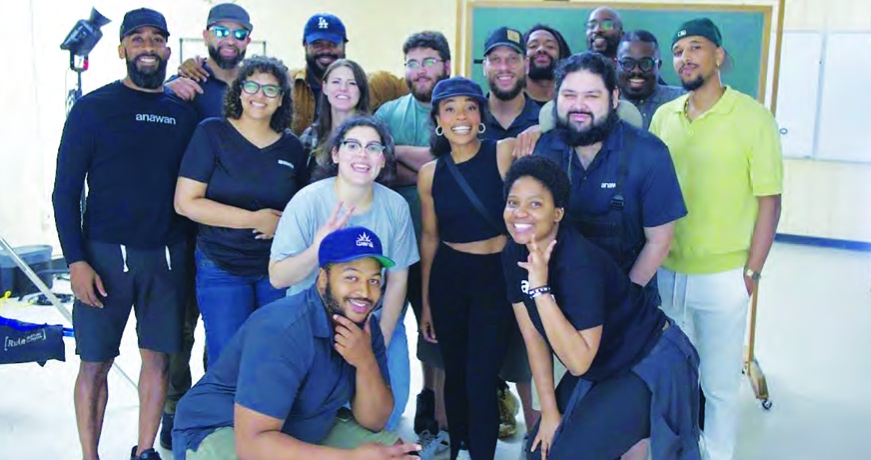
The Anawan team chose Brockton as their home in 2016.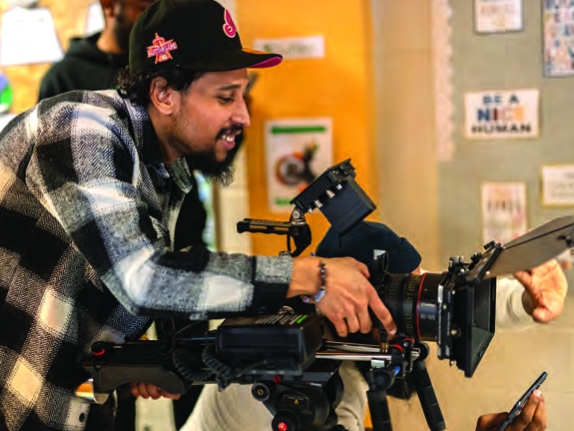
Camera operator and editor Nuno Miguel sets up a shot.
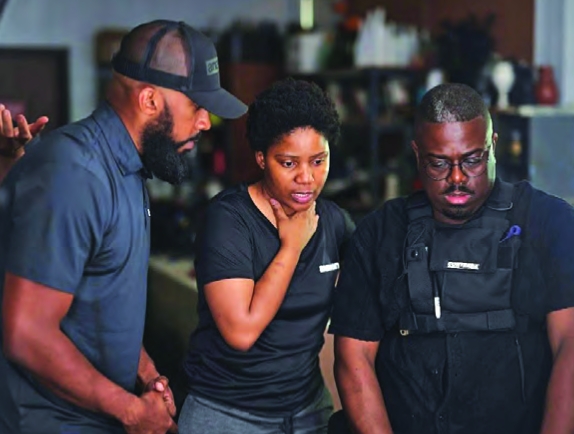
Executive Producer Rui Lopes (left) prepares a scene with crew members.A “family” of award-winning filmmakers and storytellers brought their unique cultural backgrounds to Brockton with the mission of helping their clients bring their visions to life — one story at a time.
Founded in 2016, Anawan Studios was born after executive director Rui Lopes realized that the people he was working with at another production company did not share the passion of filmmaking that he and those who were called to help with the production.
“So that summer we decided to call it, we started having conversations. I spoke to the other team, told them that I was just going to step away and do my own thing. So, the rest of summer of 2015 and fall and winter, me and the three gentlemen that I started at Anawan with, we just took that time to have conversations to see what kind of production company we wanted to do, what our objective was going to be, what our goal was going to be. We did that,” he said.
While the original group members went their own separate ways in 2019, Lopes and one of the original guys took that year and 2020 to reassess what direction they wanted to go and the company they now wanted to be, as everything was shut down due to the COVID-19 pandemic.
In 2021, the company changed as Lopes became the principal owner of Anawan Studios, officially stepping away from his 10-year position as an assistant teacher at a local school, which he had been working on while building up the company in its early days.
“I figured, if this company is going to be a legitimate LLC, a legitimate production company, and needed to have a CEO, I was going to take the risk and put all their time into it. Starting in 2022, since then, I’ve been doing this essentially full time,” he said.
Lopes said that the primary service that the studio offers is unique to Anawan, which includes all three phases of production (pre-production, development, post-production) in house to their clients.
He also talked about the accomplishments he is proud that the studio has achieved.
“It’s just being able to, year in and year out, have the opportunity to be able to tell stories that Black and brown filmmakers want to be able to tell and have the power to tell it without restrictions. We don’t have anybody telling us how to tell our stories. We tell it our way. And we’ve been able to grow the funds on one side. So one side feeds the other. We do the commercial work and that commercial side is what feeds the films that we do,” he said.
Lopes also talked about who supported him and the founders when they decided to open the studio, which he said came from the community of Brockton.
“If we were filming, we needed places to film at. We needed certain backgrounds, houses, whatever it may be. We had people step up. Obviously with our communities, we don’t have some of the best relationships with police departments, but even the Brockton Police Department here…helped out with understanding that we’re local. We’re here. If we wanted to film outside on the street or something like that, they helped out with a lot of that,” he said.
“Times where we needed to film in classrooms, because I graduated from Brockton High School, I had relationships. They would go over there. They gave us the auditorium before to do a premiere for one of our works years back. They gave us some of the classrooms to be able to film in. … The support came from, I’d say it’s a holistic, community-based support that we enjoyed in the beginning; I think to this day, we’ve had the privilege of enjoying,” he added.
Lopes shared his advice for entrepreneurs of color who may want to open a business.
“It’s us, understanding that we don’t have to be afraid to be in certain rooms. Specifically in my industry, relationships are huge and significant, but I think that comes across anything, whether it’s health care, education, finances, you need that. As young, Black and brown entrepreneurs, they just need to understand that any room that you can get yourself in, you were meant to be there,” he said.
Just because people in certain rooms may have more income or a different background, it does not mean they are better, smarter or that they are more deserving to be in these rooms, he said.
“If we’re all in the same room, then we’re all equal. I can talk to these people,” he said. “Yes, whatever field you’re in, make sure that you know the craft — the ins and outs, have the skill set, have all of that — at the end of that you do need it, but…if you want to be ambitious and you want to be able to be in a leadership position, you do need to be able to know how to talk to people and move around in certain rooms.”