
Band leader Wima Clouden leads masqueraders in the Clouden Productions presentation, Hawaiian Fantasy 2025.
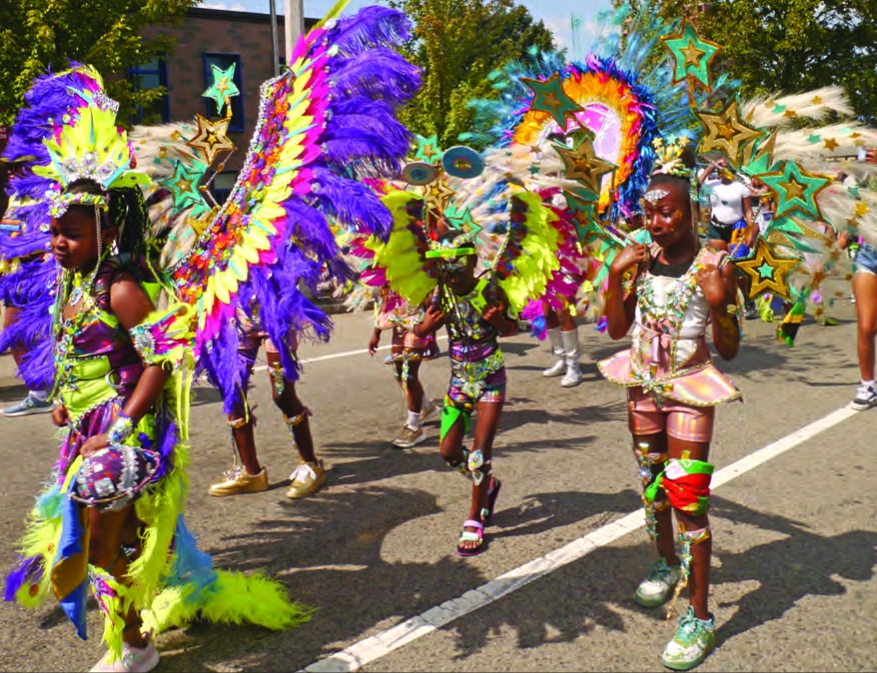
(Above)
The Soca and Associates children’s presentation, Futuristic Fantasy.
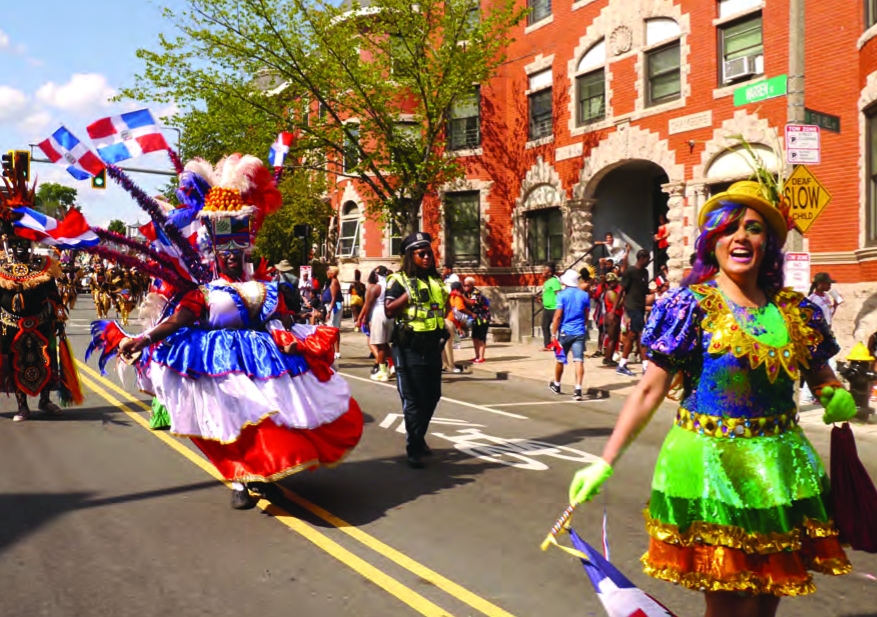
(Below) Members of the Dominican masquerade band, Tribu Cimbao on Warren
Street.
Fewer costumes in this year’s Carnival, but no lack of enthusiasm
There was no army of masqueraders behind Ken Douglas as he danced along Warren Street toward the Caribbean Carnival judging stand by Franklin Park. There were a dozen or so costumed dancers with his masquerade band, Suave.
In some ways Douglas appeared to be swimming against the current, as he lugged his massive wheeled, 12-foothigh presentation along the up-hill parade route amid a procession of sound trucks leading T-shirt-wearing revelers. Costume bands like Douglas’ have declined precipitously in Boston’s Carnival from the days when a dozen or so of them competed with upwards of 120 masqueraders in tow. But Douglas is not giving up on Carnival.
“I’ve been doing this for years,” he said. “I’m going to keep at it until it builds back up to what it used to be.”
There are several reasons for the decline in masquerade bands — the dwindling number of people in the community
with the space and the resources to host a masquerade “camp” where the
costumes are assembled and, not the least, the decades-long struggle
between some masqueraders and the leadership of the Boston Caribbean
Carnival Committee.
“We need change,” said Michael Smith, who has in years past organized events around Carnival.
“Every other carnival is doing well. But here in Boston, under this leadership, it’s gotten worse and worse.”
Robert
George, a member of the Caribbean American Carnival Association of
Boston, places the blame squarely on the costs of materials.
“It’s
a direct result of the escalating costs of costume bands,” he said.
“Especially with tariffs with China, it’s gotten a lot more expensive.”
But
Smith compares Boston’s carnival to that in Toronto, where the city
helps fund the masquerade bands and promotes carnival to tourists. Here
in Boston, Smith says, the tourists who used to swell the ranks of the
masqueraders and spectators have largely stopped coming.
Whatever
the cause, the absence of the large bands that used to play masquerade
in Boston’s Carnival — D’Midas International, D’Horizon, Dynasty
Productions, the TnT Social Club — has left a void that has made
Carnival far less colorful and much shorter than in years past.
Stepping
into that void this year were three Haitian presentations that brought
up the rear of the parade with unparalleled energy. Freda Rara, a band
of long, welltuned bamboo horns paired with a rhythm section of drums,
maracas and other percussive instruments, made its debut this year with a
couple dozen members skilled in Haitian rara music.
“This
is our introduction to the community,” said bandleader Wan Pierre,
yelling over the din of his musicians and the massive sound trucks that
bookmarked his band.
The larger of the two sound trucks featured major Haitian acts — Michael Brun, Tony Mix, J. Perry and Jessie Woo.
Also
new to Carnival was the Dominican masquerade band, Tribu Cibao, which
featured well-rendered colorful costumes among two dozen or so revelers.
The rest of the Carnival was made up of T-shirt bands — large sound
trucks where revelers by the scores buy a T-shirt to dance behind to
high-decibel soca tunes.
Amid
the change, Ken Douglas said he’s determined to keep the uniquely
Trinidadian tradition of Carnival masquerade bands and soca music alive.
His band used the former D’Midas International camp at the corner of
Seaver and Erie Streets — a 4,000-square-foot expanse of asphalt that
comes with a shed that’s perfect for assembling and storing costumes.
“We’re not letting it go,” Douglas said. “We’re going to keep it going.”
This story originally appeared on flipsidenews.net.


