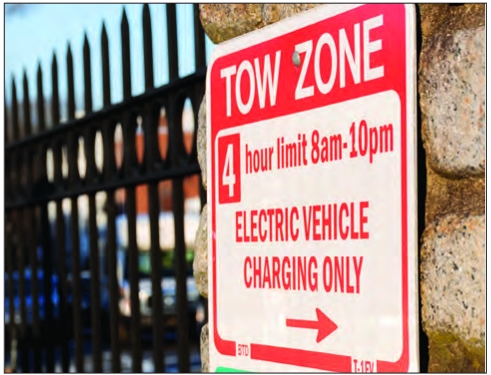
A
sign marks an electric vehicle charging station at a municipal lot off
Mattapan Sq. in March, 2024. The state’s Electric Vehicle Infrastructure
Coordinating Council released a new assessment, paired with $46
million, to support expansion of chargers for electric buses, trucks and
vans across the state.A new state report identified goals around how and where to increase Massachusetts’ electric vehicle charging infrastructure.
That document, the second biennial assessment from the state’s Electric Vehicle Infrastructure Coordinating Council, was released Aug. 12 and focused on introducing more infrastructure for larger electric vehicles and expanding a charging network to parts of the state, like in the central and western regions, that currently have limited access.
Along with the assessment, the Massachusetts Department of Environmental Protection announced $46 million in allocations through the 2027 fiscal year to take a stab at some of those goals.
“Our goal with the funding side is simple: It’s to take this EVICC assessment and start making it happen,” said MassDEP Commissioner Bonnie Heiple.
The assessment and new funding have a focus on expanding infrastructure for charging medium- and heavy-duty electric vehicles — everything from local delivery trucks and shuttles to buses and freight trucks.
“We know that these are the most polluting vehicles on our roads,” Heiple said. “This is the diesel smog; this is the particulate.”
When it comes to reducing transportation emissions, tackling those larger vehicles could make a dent.
According to a report from
the Union of Concerned Scientists, published in February, across the
country medium- and high-duty vehicles make up about 13% of vehicles on
the road, but account for about 30% of climate warming emissions. That
report identified medium- and heavy-duty vehicles as the largest source
of nitrogen oxides, one kind of greenhouse gas.
State
officials said they hope the emissions reductions that will come with
electrifying those larger vehicles will especially benefit
communities of color and other environmental justice communities, which are exposed to toxic air at a higher rate.
A
2021 article in the journal Geophysical Research Letters, found that
low-income communities of color in the United States are exposed to 28%
nitrogen dioxide, which can lead to cardiovascular disease, asthma and
other respiratory ailments, compared to their wealthier white
counterparts.
In
Boston, neighborhoods like Nubian Square have a history of standing up
against air pollution from a high quantity of diesel-powered buses.
For Massachusetts, those
gains represent an important step toward reaching state-established
goals for vehicle electrification. The state’s Clean Energy and Climate
Plans for 2030 and 2050 established a goal of reducing transportation
emissions of 34% below 1990 by the end of the decade and by 86% by 2050.
The
report “gets a lot right,” said Samantha Houston, a senior manager for
the Union of Concerned Scientists Clean Transportation program, pointing
to elements like the focus on medium- and heavy-duty chargers, as well
as the shifts in the electrical grid that will be required and a focus
on best practices surrounding equity.
The
focus on increasing charging infrastructure for larger vehicles stems
from concerns the state heard around its efforts to push for the switch
to electric medium- and heavy-duty electric vehicles, Heiple said.
“That
was largely premised on the notion that there’s no charging for these
vehicles,” Heiple said. “How can you force a switch when states are not
ready in terms of the infrastructure that you’ve built out? So we’re
being really thoughtful about that in Massachusetts.”
Of
the total $46 million in DEP funding announced by the state, $30
million is slated to go toward supporting charging infrastructure for
medium- and heavyduty vehicles, alongside chargers on secondary
corridors — high-traffic roadways that are not already covered by other
state plans for electrification.
The
remaining $16 million will support the installation of EV chargers
through the state’s electric vehicle incentive program through the DEP.
That program supports installation of charging stations, including costs
like buying the infrastructure and the labor required to install it.
Previously,
the program supported the installation of chargers at locations like
school campuses, at multiunit housing complexes and workplaces.
Houston
said charging for larger vehicles is, in many ways, similar to charging
so-called “light vehicles” — think a personal car — though some
elements like the energy needs differ. According to the Great Plains
Institute,
a nonprofit working on accelerating the transition to netzero
emissions, medium- to heavy-duty electric vehicles can use 0.5 kWh to
5.2 kWh per mile. Light-duty EVs use 0.2 to 0.4 kWh per mile.
That greater energy usage means bigger batteries that can cost more and require longer charge times.
Like
personal electric vehicles, medium- and heavy-duty EVs can charge “at
home,” wherever they sit overnight — for example at a truck depot — as
well as at truck stops along their routes. But Houston said that
vehicles like trucks might have additional moments to charge, like when
they’re loading and unloading.
The
assessment also identified a need to expand the deployment of EV
chargers — it estimated that the state needs to triple its pace — even
as across the country the expansion of electric vehicles faces backlash
from the federal government under the Trump administration, which is set
to end federal tax credits for new electric vehicle purchases through
its budget reconciliation act, formerly called the One Big Beautiful
Bill.
And,
in February, the administration froze funding for the federal National
Electric Vehicle Infrastructure program, which provides money to states
to install chargers. A coalition of about a dozen states sued in
response, and on Aug. 15, the administration reopened the program.
But
the report was heartening, Houston said, as an indicator of continued
state support, even as the federal government pulls back on electric
vehicles.
“That’s not
what we wanted to see, especially in this moment, when we had started to
see some acceleration of progress on those fronts — progress which, I
should say, we desperately need to address global warming as well as
local air pollution issues,” Houston said.
State officials dismissed the federal pullback on electric vehicles.
“We
have solid science on this; we know about the threats to public health
from pollutants emitted from the transportation sector; we have a way to
address it,” Heiple said. “To ignore this entire market sector, to
basically attempt to put it on ice and just roll back the clock and roll
back the standards to earlier times that have gotten us in a really bad
situation, is tremendously unhelpful.”
While
the reduction in federal support may slow the uptake of vehicles and
the installation of charging infrastructure, Houston said she doesn’t
expect to see action around electric vehicles stop fully.
“It
really is devastating to see the brakes being put on this progress at
the federal level, but it’s a global market,” Houston said. “And action
from states like Massachusetts can also help continue to move us
forward.”
According to
Cox Automotive, as of April, electric vehicle sales continued to grow
in the first part of the year. In a market insight report for the first
quarter of 2025, Cox reported the sale of nearly 300,000 electric
vehicles. At the same time in 2024, Cox reported the sale of 268,909 new
EVs.
“The fact that
we’re continuing to see adoption at similar rates, I think, makes the
point that … EVs are really here to stay,” said Josh Ryor, assistant
secretary of energy for the Executive Office of Energy and Environmental
Affairs and chair of the EVICC.
Actions
by individual states, like the funding and report from Massachusetts’
EVICC, will also help support the profusion of EVs, she said.
The
pullback could, however, complicate the state’s vehicle electrification
goals, Houston said, even if it may not make it impossible.
State officials said that the federal shifts pose a challenge, but don’t change the state’s goals.
“The
pullback on these policies certainly doesn’t help,” Ryor said. “But we
are committed to really making sure that we are focused on what we can
control, having the biggest impact we can and making sure that our
dollars are going as far as possible.”
Houston
said that if a federal pullback keeps Massachusetts from meeting its
electrification goals, any benefits around climate and emissions will
still be worthwhile.
“If
we miss them by a hair, you know, all that progress we made still goes a
long way to reducing greenhouse gas emissions and contributing to
reducing local air pollution,” Houston said.


