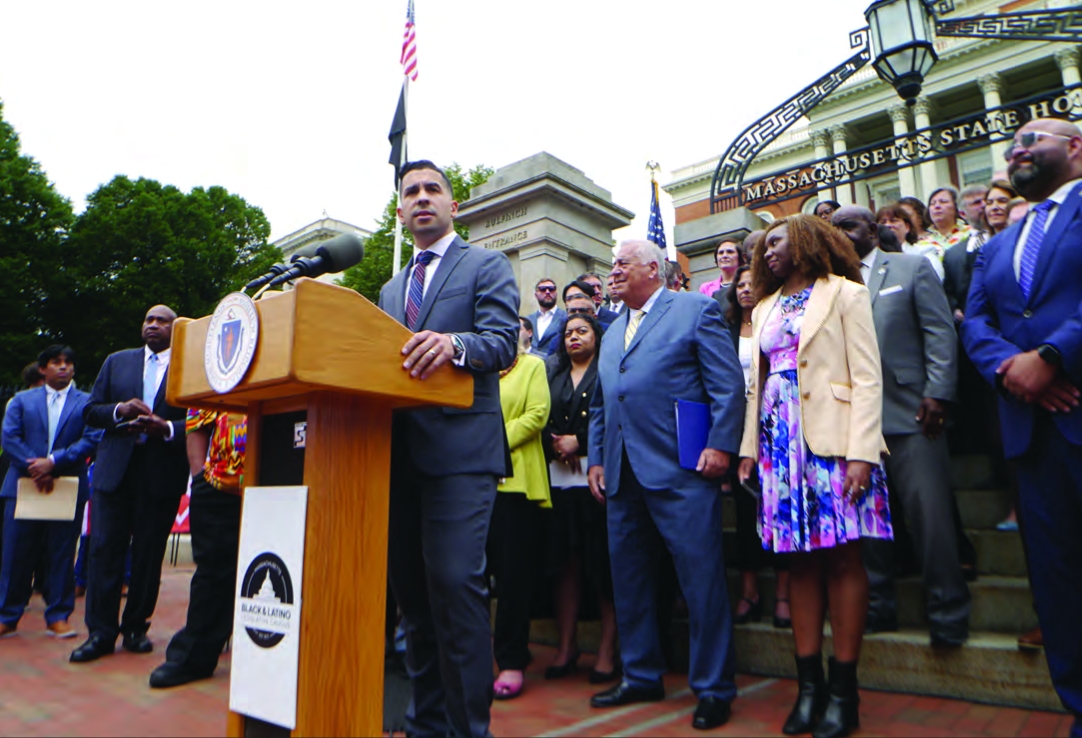
Massachusetts Black and Latino Caucus Chairman Rep. Andy Vargas addresses a Juneteenth gathering at the State House. (front row, from left) Executive Director Tomås O’Brien, Rep. Russell Holmes, Vargas, Sen. Liz Miranda, House Speaker Ron Mariano, Rep. Brandy Fluker-Reid, Sen. Adam Gomez.“If feels like we’re back in action. Things are moving, and it feels great.”
— State Rep. Chris Worrell, Mass. Black and Latino Caucus member —
The Massachusetts Black and Latino Caucus is larger and more diverse than ever, with 26 members representing communities as far flung as Barnstable, Berkshire County, Wrentham and Haverhill.
Equally diverse are the issues confronting the caucus members’ constituencies including access to liquor licenses in Boston, housing discrimination in communities across the state, ICE raids, juvenile justice reform, income inequality. This year, caucus members laid out an ambitious agenda and met with Gov. Maura Healey, constitutional office holders and legislative leadership to advance bills aimed at tackling the issues confronting their constituencies.
“I think there are a lot of commonalities across our districts, and I think a lot of commonalities across our identities,” said Rep. Andy Vargas, a Haverhill representative who assumed the chairmanship of the Caucus in January. “And I think the through line is that every member understands that whether you’re Black, whether you’re Latino, whether you come from a gateway city or you’re from Boston, the people in our families, the people that we deeply know have to encounter a system that wasn’t set up for us, a system that has socio-economic pitfalls at every corner, and the thing that unites us is that we have to tackle those pitfalls.”
Vargas
took the reins of the caucus after a four-year period of relative
instability for the 52-year-old organization during which meetings with
legislative leadership were irregular, the executive director’s position
was left vacant and members worked without an agreed-on agenda. He
began the year with a retreat for the members at Harvard University,
where he is completing a mid-career master’s in public administration.
When Vargas was first seated in 2017, the body had 17 members and was
primarily Black and Latino. Now there are 26 members — 10 Black, 13
Latino and three Brazilian.
After
a period of relative inactivity, Vargas says it was important to help
restore working relationships between members and agreeing on new
processes and structures. For starters, Vargas took aim at the system of
rotating chairmanships that the caucus has relied on since 1973. While
the system once ensured power sharing among the seven original members,
it was clear that the structure would no longer serve that objective.
Before
he was seated as chair, Vargas made a motion to change the system to
one of elected chairmanships, then was elected to a two-year term. Under
the body’s current bylaws, no member can serve more than two
consecutive terms. Vargas also hired Tomás O’Brien, a former associate
at the public affairs consulting firm Dewey Square Group, to fill the
long-vacant executive director position.
So far, Vargas’ moves have earned him high marks with his colleagues.
“If feels like we’re back in action,” said Dorchester-based state Rep. Chris Worrell. “Things are moving, and it feels great.”
Worrell
says he is looking forward to advancing a pharmacy desert bill that
would require drug stores to give 60-days’ notice to the municipality in
which they’re located before they close and mandate meetings with
community members, $1 million in funding for the New Commonwealth Fund
and a lifting of the $1 million cap in compensation for people who were
wrongfully convicted of crimes.
Other items in the caucus agenda include a bill that would change the way auto insurers assess premiums — putting less
emphasis on the ZIP codes of policy holders, a bill raising the age of
at which one can be charged as an adult to 19 and ensuring automatic
sealing of criminal records for juvenile offenses.
Vargas
says the caucus members were able to discuss their agenda in meetings
with House Speaker Ron Mariano and Senate President Karen Spilka that he
says were encouraging.
“I
think we’re in a good place to continue to advance the agenda,” Vargas
said. “We got several of our pieces done last session, and we know that
with the turbulent times that we’re in right now, we’re going to have to
really play an active role and make sure we’re at the table.”
The caucus vice chair, Sen. Liz Miranda, says she’s hoping the body can advance the Safe Communities Act,
legislation that would bar law enforcement in the state from entering
into cooperation agreements with federal immigration enforcement
agencies, bar local and state police from undertaking immigration
enforcement work and bar police from asking people their immigration
status.
“The
immigrants being rounded up by ICE are our brothers and sisters,” she
said. “These are people who work with us. What the federal government is
doing is not arresting violent criminals.”
Vargas
has prioritized parole reform, taking aim at the menu of requirements
placed on parolees regardless of the offense for which they served time.
“If you’re coming out on parole, you get this set list of these conditions, no matter if they’re relevant to your particular
circumstance or crime or not,” he said. “If you’re coming out and you
had nothing to do with substance use issues, why can’t you drink? Or why
do you have to come and pee in a cup every couple months? It had
nothing to do with the crime that you committed. And so why is that a
standard condition that’s placed on everybody? We want to have the
requirements that are placed on people who are coming out to be relevant
and science-based and backed by some sort of body of evidence that says
that this has some positive effect on the rehabilitation of the person
who’s coming out.”
Vargas
says he’s also hoping to pass legislation that would lessen the zoning
and parking restrictions on new housing development and secure more
funding for the Commonwealth Builders program which makes grants and
forgivable loans for the construction of homes affordable to
moderate-income families.
For
each caucus members’ priorities, they’re starting with a bloc of 26
votes backing them in a legislature with 160 house members and 40
senators.
Miranda says she’s hopeful the caucus can move its members’ legislation forward this year.
“Vargas’
leadership has been refreshing,” she said. “He’s very organized and
very thoughtful. He keeps us working together. He works with everybody’s
strengths.”
While
there’s strength in numbers, it hasn’t always been easy for the caucus
to work together. During the last four years of relative
disorganization, some Latino members of the caucus briefly considered
forming a separate body.
Earlier
this year, Vargas brought in Cornell University Professor Paul Ortiz,
author of the book “An African American and Latinx History of the United
States,” to speak with the caucus about the history of the two
communities.
“I had
him come in to talk to us as a caucus to talk about how our struggles
were always parallel, and oftentimes codependent, and co-beneficiaries
of each other’s movements,” Vargas said. “That doesn’t mean that there
aren’t differences at times. In any group of people, in any big family,
there’s going to be different opinions, perspectives, agendas,
priorities. But the bottom line is that we are stronger together, and
the more numbers that you have, the more of a voice that you can speak
with.”


