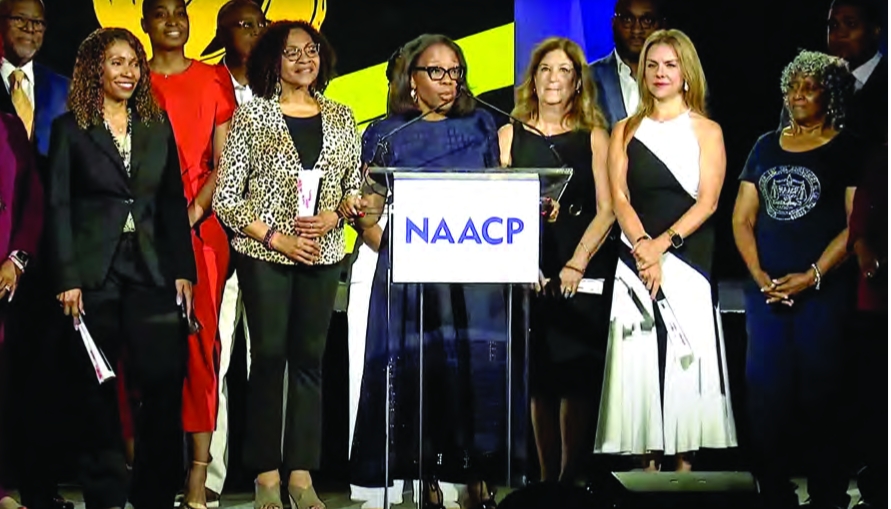
Members gather at the 116th national NAACP convention in Charlotte, N.C.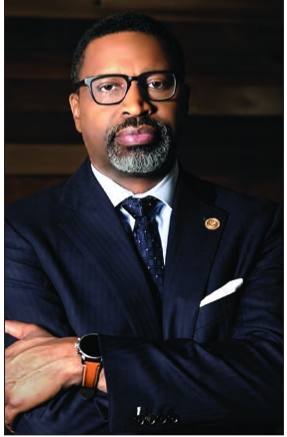
Derek Johnson
As NAACP members gathered from across the country, the efforts of the second administration of President Donald Trump loomed over their 116th national convention, held in Charlotte, North Carolina, July 12 through 16.
But while attendees showed up with high anxiety and a sense of disappointment in democracy, by the end of the five-day event, they left with a sense of determination, said Michael Curry, a member of the NAACP’s national board of directors.
“People came with heavy hearts and left empowered and informed and equipped with what they need to go back and fight on the ground in cities and towns across the country,” said Curry, who serves locally as the president and CEO of the Massachusetts League of Community Health Centers.
It was an outlook that was reflected in the official theme of the convention: “The Fierce Urgency of Now.”
That federal landscape hung over the heads of attendees throughout the convention. Plenary sessions discussed voting trends, and the national body’s resolutions — measures and positions, passed by the group and once approved by the national organization’s board of directors, set to define how local branches and state chapters approach their advocacy and policy work — leaned into responding to the moment.
“The fierce urgency of now is the sobering reality that we must focus on how we leverage the next opportunity and not be distracted so we are exhausted when it’s time for us to fight,” said Derek Johnson, president and CEO of the national NAACP during remarks at the convention’s closing plenary. “The fierce urgency of now tells us we cannot let the little boy cry wolf; we need to chart out when the wolf is coming, because we know it’s coming.”
The convention also marked
the first time that the national NAACP, which is a nonpartisan
organization, opted to not offer an invitation to the sitting president
to attend, a choice that Curry said was based on the sense that Trump’s
positions are “anti all things that this organization believes in and
fights for.”
“Embedded in our work to
fight for justice and opportunity for Black Americans is a commitment to
democracy, to the true ideals of what a democratic government can
provide for everyone — not just for Black people, but for everyone,”
Curry said.
In a
statement ahead of the convention, Johnson said that he believes Trump
and his administration “believes more in the fascist playbook than in
the U.S. Constitution,” and that it would have been “unacceptable” and a
waste of time to use the convention to give a platform to fascism.
“The
NAACP Convention has always been a place where people across the
country come together to map out our advocacy and mobilization
strategies to advance civil rights and democracy for all,” Johnson wrote
in his statement. “Our annual convention is meant to be a safe space
for all people — regardless of political ideology — who believe in
multiracial democracy and the ideal of building a more perfect union.”
In
response, Trump alleged the NAACP is advancing “hate and division,”
according to a statement by a White House spokesperson, published by
National Public Radio.
While he was not in attendance, Trump’s policies had their own gravity at the convention.
The
administration’s push against diversity, equity and inclusion programs
was countered with panels on supporting Black entrepreneurship, taking
steps around activism and how to focus efforts on buying Black.
For
Royal Smith, president of the Boston branch of the NAACP, top of mind
was Trump’s efforts to dismantle the U.S. Department of Education, and
the steps that the branch can, locally, take to support young people.
“What tools can we give them?
Even
though this time may be murky, what tools or time or motivations, or
even just mentorship, can we give them to equip them for tomorrow?”
Smith asked.
During
the convention’s run, in Washington, the Supreme Court removed a lower
court’s prohibition that had halted Trump’s efforts to dismantle the
department.
And as
Trump moves to shutter the Environmental Protection Agency’s scientific
research arm, which provides expertise for environmental policies, and
cut the agency’s staff by 23%, environmental justice was also on the
docket at the convention.
A
panel in the HUB — the convention’s take on an exhibition hall, with
demonstrations and cultural programming — discussed the future of
environmental justice funding amid federal cuts. Another session covered
renewable energy solutions as a measure for climate justice.
Those
efforts should be a priority, said Tanisha Sullivan, president of the
NAACP New England Area Conference. She pointed to issues like poor air
quality and high asthma rates in the greater Springfield area, as well
as efforts — like an initiative from the NAACP branch in Manchester, New
Hampshire to collect and monitor air quality data — that can be pursued
even as federal funding support wanes.
“The
environmental justice movement is a continuation of the civil rights
struggle — fighting for the right to not only survive but to thrive in healthy, safe, and just environments,” Sullivan said in a statement.
More
broadly, Curry said that one charge the convention left attendees with
was showing the link between the administration’s policies and the
impact they’re having on communities across the country.
In
one presentation during the closing plenary, Terrance Woodbury, founder
and partner at HIT Strategies, a public opinion research company
focused on underrepresented voters, highlighted the trends among Black
voters.
Woodbury,
based on polling from the group, said he believes the 2024 election as
well as future elections hinge on younger Black
voters who either weren’t aware they missed voting in an election or who
have opted not to vote because they feel like their votes don’t have an
impact.
According to
data in Woodbury’s presentation, almost half of Black voters — a trend
that largely mirrored the country at large — said the actions of the
Trump administration have neither hurt nor harmed them.
“We
cannot activate a resistance, we cannot activate a resistance, we
cannot fight back if we don’t think that what he’s doing is hurting us,”
Woodbury said in his presentation. “This is the part here where we have
to start connecting the dots between the actions that they’re taking.”
For the NAACP, which has filed a number of lawsuits against the Trump
administration since January, that idea of “connecting the dots” is a
necessary step to activate some of those voters and push back on the
administration’s policies they view as harmful.
“We
have to somehow convey that to our own communities where we come from,
and make sure that the people are sort of in line and in step,” Smith
said.
Beyond the
federal landscape, other flashpoints in the current landscape featured
prominently at the convention. Artificial intelligence, as well as how
to work to make sure its use doesn’t reflect historical biases, was a
topic covered in both sessions throughout the convention, and
resolutions passed by the group.
One resolution targeted algorithms used in clinical settings that Curry said
proved a barrier to Black and brown patients getting kidney transplants.
And sessions covered what AI is, how it works and how it can be used.
“There’s good AI; there’s bad AI, and sometimes it’s hard to tell the difference,” said Smith.
Education around artificial intelligence also requires a push to overcome existing digital divides, he said.
ACT-SO competion
But
the convention also saw a spark of positivity to balance out a
challenging federal landscape, in the form of the culmination of this
year’s ACT-SO competition. That competition — the Afro-Academic,
Cultural, Technological and Scientific Olympics — lets young people from
NAACP branches across the country
practice and prepare to compete in skills from the visual and
performing arts to science and technology and arenas like cooking and
hospitality.
Local
youth saw a host of wins at this year’s competition. In three
competitions, Boston won silver medals — original essay writing, modern
dance and contemporary dance. Overall, five Boston students competed
across nine competitions.
Fatima
Ali-Salaam, Boston’s ACT-SO chair, said the three silver medals made
her feel elation and pride as a reflection of the hard work the students
did.
“The work … took them a year to do,” she said. “It wasn’t something that was done overnight; it was work that came from them.”
Other students from New England also brought home
medals. A Brockton student won gold in the earth and space sciences
competition; another Brockton student scored silver in the ballet
competition and gold in modern dance.
That dedication was noticeable in all the competitors, she said.
“Each
student who comes, no matter what state it is, they’re all bringing
their best efforts forward and you can see it,” Ali-Salaam said.
The
competitions, which saw competitors go head-tohead across 33
categories, was an important balance to challenges the NAACP opposes
under the Trump administration.
“It
just reminded me that no matter what the struggle is going on outside,
we can rise and do our best by our students,” Ali-Salaam said.


