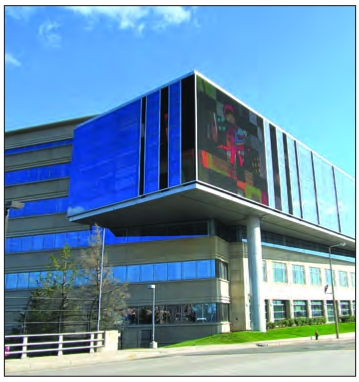
GBH headquarters at 1 Guest St., Boston In a major victory for President Trump, Congress has approved a rescission package clawing back $9 billion in federal funds for priorities he deemed wasteful, including $8 billion allocated for foreign aid and $1.1 billion previously appropriated for the Corporation for Public Broadcasting, which helps fund PBS and NPR and member stations like GBH.
“I’m incredibly disappointed and think it was a very shortsighted decision for the United States,” said Susan Goldberg, GBH’s president and CEO.
While Goldberg noted that
some member stations might have to shut down due to significant funding
losses, particularly smaller stations in rural areas, she stressed that
GBH will continue operating, albeit in a significantly changed media
landscape.
“GBH is
going to survive,” Goldberg said. “I’m not saying that it’s going to be
exactly the way it is now, but we are going to survive.
“Sometimes
hard times push innovation, and people can find in adversity the
determination to speed along some of the innovation that needed to
happen all along,” she added. “We’re creative people. We’ve been on the
cutting edge of innovation for 75 years at GBH. And that muscle memory
and those reflexes will serve us well at this moment.”
GBH
was slated to receive about 8% of its budget from the CPB in Fiscal
Year 2026, which begins in October. That money — which amounts to $18
million dollars — will now be gone.
That
number alone doesn’t fully capture how disruptive the rescission will
be to GBH’s operations, though. Goldberg noted that GBH is one of just a
few PBS affiliates that produce content for the entire system. PBS
provides GBH with funding to make shows like FRONTLINE, NOVA, American
Experience, Antiques Roadshow and Masterpiece. That funding, in turn, comes from dues paid to PBS by member stations, some of which may now cease to exist.
“This
is such a seismic event that we really need to consider everything —
what we’re making, how we’re making it, how frequently we’re making it,
and what platforms we’re making it for,” Goldberg said.
GBH cut 54 workers this year and laid off 31 employees in 2024, when the organization was facing a $7 million budget gap.
Asked if more layoffs would
be forthcoming now that the rescission package has been approved,
Goldberg said, “We’re going to have to figure out how to be more
efficient — what work we’re absolutely doubling down on or, on the other
hand, are there some things that we’re doing that when you have to
prioritize a bit, you have to say, ‘Maybe we shouldn’t do that anymore?’
“That
is the discussion that we’re going to be having here. And the sad part
is, this is the discussion that is going to go on in every single
community in this country, because every community in this country is
served by public media.
“Public media reaches like
99% of the population, and it offers information for free, for people of
all ages and stages and ZIP Codes and economic class[es] — it doesn’t
discriminate against anybody,” she said.
Before the rescission
package passed, the Trump administration had already canceled grants
that GBH used to develop educational children’s programming, Goldberg
said, a move she described as having massive implications for children
across the United States.
“Half
the kids in the country do not get to go to pre-K, so they kind of
start out in a hole on that first day of kindergarten,” she said. “And
it’s watching shows like ‘Arthur’and ‘Work It Out Wombats!’ and ‘Molly
of Denali’ that help them with social and emotional skills and
computational thinking and literacy. The money to develop that kind of
content has gone away. That’s what I’m worried about.”
This
story was reported by Adam Reilly and edited by Senior Assignment
Editor Matt Baskin and Senior Politics Editor Azita Ghahramani.


