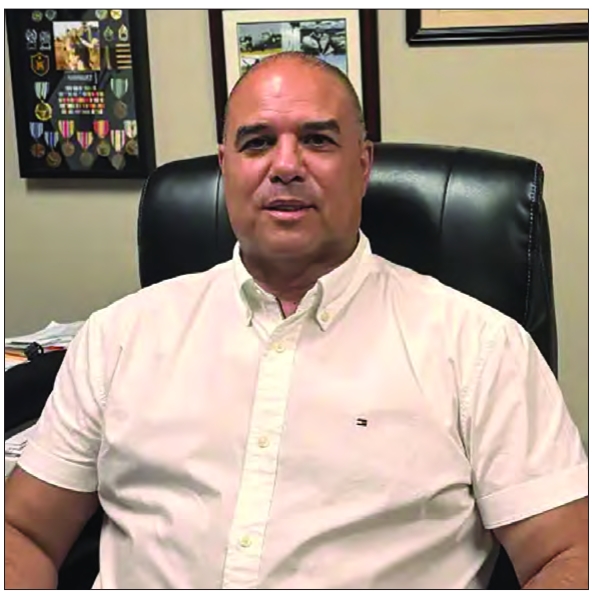
Jorge
Rodriguez sitting at his desk in his Lawrence office on June 30, 2025.
He started his own company, Steri-Tech Medical Innovations, after 28
years in the U.S. Army. Every year since 2015, Massachusetts has pledged to boost the value of state contracts going to veteran-owned businesses. The goal is 3% of state agency discretionary budgets. But every year since 2015, the state has fallen far short of that pledge.
In 2024, that figure would have been $231 million. But a new annual report issued by the state’s Supplier Diversity Office found that state agencies spent only $47 million with veteran-owned businesses that year.
It’s a pattern that has been repeated year after year. Over the last 10 years, reports from the Supplier Diversity Office show state agencies have spent a total of $324 million with veteran-owned businesses, which is about $1.3 billion less than the annual goal was meant to achieve.
“Either they don’t know that we exist or don’t care. Or the money’s … not being correctly allocated,” said Jorge Rodriguez, a Lawrence-based business owner and U.S. Army veteran.
Rodriguez started Steri-Tech Medical Innovations in 2019, which offers medical equipment to health care providers.
After 28 years of military service, Rodriguez says he was ready to pursue his American dream of owning a home and starting a business. But the lack of revenue from state contracts led him to take out a loan against his home to keep the business afloat.
“Unfortunately,
I haven’t been able to earn enough business from the state to say I’ve
met the second part of my dream,” Rodriguez said.
He
currently has four government contracts, including two with Lemuel
Shattuck Hospital in Jamaica Plain, for medical supplies and equipment.
The contracts designate Steri-Tech as an approved provider, but he only
gets paid when a government agency orders supplies from him under those
contracts.
He says that since 2022, he has received a few orders, but none from Shattuck. He said that unless real money starts to come in, he won’t reapply for these state contracts.
“As
excited as I was when I won the contract, here I am three years later
and it’s downhill. [I’m] demoralized completely,” Rodriguez said. “I
don’t even bother with the contract and in fact, I have an email that I
sent out … asking how can I cancel the contracts that I won at Lemuel
Shattuck.
“I think
it’s unfair that they would award my company and just brag that they
awarded a veteran with no intentions of buying from my company,” he
added.
Lisa Ducharme, the executive director of the Massachusetts Veterans Chamber of Commerce, echoed that sentiment.
“I
can’t comprehend, nor can the Supplier Diversity Office explain to me …
why somebody gets a contract and yet they get no money?” she said.
The
Supplier Diversity Office told GBH News that many state contracts are
awarded to multiple vendors and state agencies then solicit quotes from
those vendors.
The
Supplier Diversity Office isn’t an awarding agency for large statewide
contracts or construction opportunities. State agencies sign contracts
with vendors and the Supplier Diversity Office is charged with pushing
those agencies to meet various diversity goals set by the government.
The Supplier Diversity Office also certifies diverse businesses and
provides a bridge between those businesses and state contracts.
Bonnie
Borch-Rote, executive director of the Supplier Diversity Office, said
that there is a commitment from her office and the Healey-Driscoll
administration to support small and diverse businesses. In January 2024,
Gov. Healey signed a formal agreement with the National Veteran-Owned
Business Association to help veterans’ businesses throughout the process
of bidding on state contracts.
But
Borch-Rote acknowledged that of all the diversity-based benchmarks set
by the Supplier Diversity Office, the one for veteran-owned businesses
is the most challenging. “There is a significantly smaller number of
these businesses compared to other diverse business categories,”
Borch-Rote said in an emailed statement to GBH News.
In
2024 there were 445 veteran-owned businesses in Massachusetts. That’s a
slight increase from 409 in 2022. By contrast, there were 2,060
certified minority-owned businesses in 2024.
“It is very likely that some of this money is going to veteran-owned businesses
that have yet to be certified,” Borch- Rote said in her statement. She
said that veteran-owned businesses often aren’t aware of state contract
opportunities.
“Our
goal is to collaborate to reach more veteran businesses, both for
certification and for contracting opportunities,” Borch-Rote said.
Ducharme,
a retired Air Force veteran, has her own personal coaching company. She
meets the Supplier Diversity Office’s qualifications to be identified
as a veteran-owned business, but she is not seeking state contracts.
“For me, it’s not worth the hassle,” she said. “I want nothing to do
with contracting because it hurts my head, because there’s so much to
it.”
Ducharme said it is not up to the Supplier Diversity Office to secure contracts for businesses.
“Their job is not to get our veterans jobs,” Ducharme said. “It’s our veteran businesses’ jobs to get contracts.”
She also pointed out that the state target is not binding. “It’s not a requirement, it’s what their goal is.”
Former
Marine Lamont Davis started Anvil Steel Engineering, which has been a
subcontractor for larger companies working on state projects.
Davis
said he’s not aggressively pursuing state contracts because “there’s
always some catch on the backside” which can become “disheartening and
discouraging” for veteran business owners.
“It’s a loophole,” Davis said.
“Fundraisers have goals. You can just clap your hands and walk away from it because it’s just a goal, not a requirement.”
Rodriguez
said he has simply decided to focus on commercial clients instead of
government customers. In the first quarter of 2025, he made half of what
he made last year.
“Unless
the state shows some action on their end that incentivizes agencies to
meet that benchmark, we’re not getting anywhere,” he said.
Trajan Warren is a reporter with the GBH News Equity & Justice unit.


