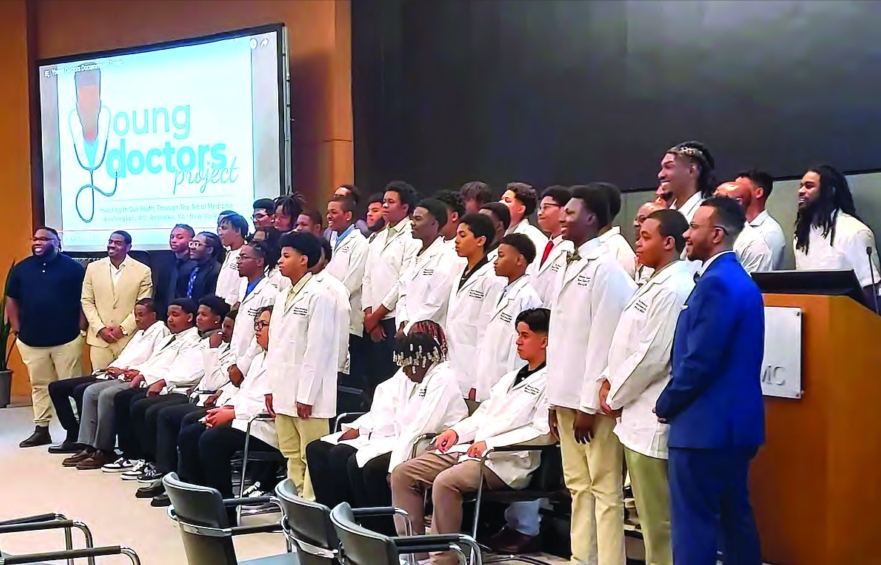
Founded
in 2012, the Young Doctors Project was born out of a concern about
health disparities and a vested interest in mentoring young Black men.
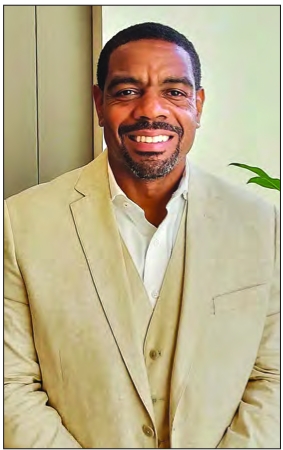
Dr. Malcolm Woodland, co-founder of Young Doctors Project
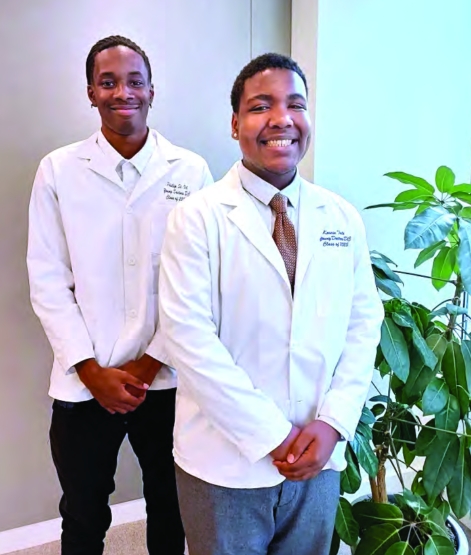
Young Doctors Phillip St. Vil Jr. and Kasein Tate proudly don their white coats as participants of the Young Doctors Project.
The Young Doctors Project is empowering Black youth to pursue careers in health and medicine
This summer on Howard University’s campus, there is a group of high school-aged Black youth from the DMV, Roanoke, Va., and New York City who are settling into one of the dorms for the next six weeks to learn, serve, and bond as part of a very special brotherhood.
While the program they are part of introduces these young men to careers in health and medicine, many will also pursue paths outside the medical field. What brought them all here is a vision that was set in motion 13 years ago.
Founded in 2012 in Washington, D.C., by Dr. Malcolm Woodland and Dr. Torian Easterling, the Young Doctors Project (YDP) was born out of a concern about health disparities in their communities, as well as a vested interest in mentoring young Black men. These two doctors understood the importance of having role models to show these youth pathways to futures they may have never considered.
“Did you know that the number one predictor of whether someone gets into medical school is if their parents are doctors? So for us, this program is about having someone in your corner who’s walked that walk,” shares Woodland. “When you have someone who has done it and can show you the pathway, life becomes so much easier. We want to expand that access for our young people and be a part of their community.”
Woodland, a licensed psychologist and graduate of Howard University, was inspired to start the program after seeing how connected the children and youth in his Anacostia community were to their elders.
“I
got to thinking, our greatest asset is these children that everybody
loves and knows, right? What if we turn them into health ambassadors in
their neighborhoods?” he questioned.
His
mission: instead of a school-to-prison pipeline, Young Doctors is
creating a pipeline to education, a pipeline to medicine, a pipeline for
these young people to give back to the community. Medicine is the hook,
but brotherhood and service are at the heart of the mission.
“I certainly know that we can put hundreds of millions of
dollars into the juvenile legal system and the criminal justice
system,” he continued. “I think that money would be much better spent on
organizations like the Young Doctors Project, organizations that are
out here doing the work.”
Transforming Black lives
Supported
by Howard University’s Department of Psychology and its Colleges of
Dentistry and Medicine — along with other key partners — the program
includes a sixweek summer institute, Saturday academies during the
school year, community health clinics led by YDP doctors, and college
tours that expose students to medical schools and other educational
pathways.
Kasein Tate,
a graduating senior from D.C. who is headed to Morehouse College in
Atlanta in the fall to fulfill his dream of becoming a cardiologist,
joined the program in his freshman year of high school. His journey is a
reflection of exactly what YDP was designed to do.
“I
found out about the program when Dr. Woodland visited my school,” he
told The Informer. “At the time, I wasn’t really sure what I wanted to
do after high school. So I was like, medicine: that’s a good idea
because I always liked science and math.”
Although
Kasein joined the program, he was initially hesitant to open up to the
other young men and mentors — something he attributes to lingering
post-COVID anxiety. He credits the care, love, and support of everyone
in the program with helping to bring him out of his shell and build his
confidence.
That
transformation came full circle on June 23 at the organization’s 13th
Annual White Coat Ceremony, held at the Association of American Medical
Colleges D.C. headquarters, where he was honored with the “Young Doc of
the Year” Award — an accolade voted on by both his peers and mentors.
As
YDP co-founder and director of education, Easterling said his
commitment to the organization is renewed and deepened by what he sees
during the White Coat Ceremony.
“The
ceremony sells the program for everyone who comes. When we are donning
the white coat on our Young Docs, folks see it. The students see it and
are like ‘Oh wow. I’m going to sit up a little taller, my shoulders a
bit higher.’ You see the parents as tears run down their faces,”
Easterling told The Informer. “And then people will ask, ‘How do I get
connected to the program?
How can I be a part of it? I love what you all are doing.’”
A ripple effect
For
rising high school senior, Phillip St. Vil Jr., participating in the
Young Doctors Project offers appreciation from others and a heightened
sense of self.
“When
we go to the health fairs and they see us with our white coats on, they
treat us like we’re celebrities or something,” he said. “They clap for
us and come up to us asking for pictures and stuff like that. It makes
me feel like I’m important.”
In addition to empowering the students, the program has an impressive 91% college enrollment rate among its participants.
Yet, despite YDP’s success, Woodland still worries about the ones who don’t make it to college.
“If
I’m being honest, that 9% really bothers me. How are we showing up for
that 9%? The more resources we have, the more we can meet the needs of
that 9% of kids who we’re still trying to work for. You know, I would
love it if we said 100% of our kids. That’s what I want.”
For
now, to ensure that cost would never be a barrier to opportunity, the
leadership has worked hard to raise the funds needed so that the entire
program is free of charge to every young man who participates. This
includes covering all supplies, travel, housing, and meals.
Further,
the program has attracted a dedicated group of professionals who have
been inspired by its mission and the young men it serves. A native
Washingtonian and board-certified cardiologist, Dr. Raymond Young joined
the organization as a mentor after hearing Woodland in a radio
interview.
“I’m
in traffic and I hear about this program that mentors young minorities
in the DMV. I heard about the activities they did: college tours as well
as health fairs, and giving back to the community,” Young told The
Informer. “At that point, it was almost a crime not to be affiliated,
supportive, or in some way associated with the program.”
The future of Young Doctors
As
the program continues to build up the next generation of Black male
health professionals and changemakers, Woodland said he still has major
dreams for the Young Doctors Project.
“I
want it to be an institution. I want it to be a true pipeline. I want
it to operate without me when I’m long gone. I want there to be a Young
Doctors Project in multiple cities,” Woodland said. “It’s about
brotherhood. It’s about support.
It’s about creating spaces for the safe intellectual development of Black boys.”
With
chapters in D.C., New York, and Roanoke, Va. — and plans underway to
launch a new chapter in Seattle, Washington—that vision is becoming a
reality. At this year’s White Coat Ceremony, graduates returned not just
to celebrate their achievements but to give back, mentoring the next
generation of Young Doctors.
As
young men pursuing careers in medicine, Young Doctors Phillip and
Kasein shared their final thoughts on the program and the men who have
poured into them over the years.
“Thank
you isn’t even enough to show the gratitude because I feel lucky to be a
part of this program,” said Phillip. “There’s no other program like
this in the world. I know they sacrifice a lot for this program, so it’s
just a blessing.”
Kasein also lauded the work of Woodland, Easterling and other volunteers who pour into the young men through the program.
“They
don’t get paid for this, and they still take time out of their summer
vacation. That just shows the love and intention that they put behind
the program, and that this space is somewhere safe,” Kasein said. “It’s
not just people who do this because they get paid or just because it’s
their job. People do it because they care about us. I’m really thankful
for the intentionality they put into everything they do for us.”
To learn more about the Young Doctors Program and how you can support its mission, visit youngdoctorsdc.org.
This post appeared first on The Washington Informer.


