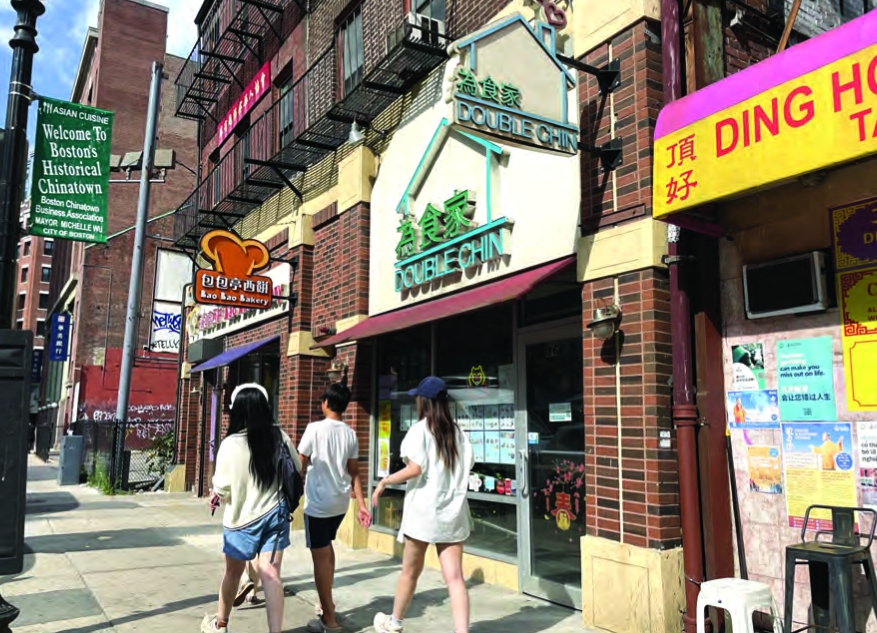
Commercial
and residential tenants at 84 and 86 Harrison Avenue say they fear
their landlord will sell the buildings to a developer if the city’s
planned zoning changes allow increased building heights.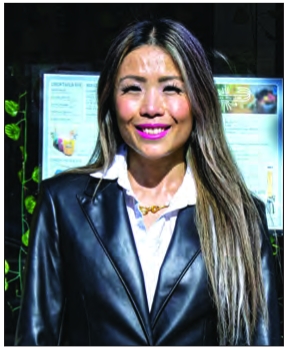
Gloria Chin, co-owner of the Double Chin restaurant and Bao Bao Bakery at 84 and 86 Harrison Avenue.
In Boston’s Chinatown, community members are worried about losing their homes and businesses to displacement.
Late last month, a meeting was convened in the office of the Chinese Progressive Association by Lydia Lowe, executive director of the Chinatown Community Land Trust to discuss the proposed rezoning in Chinatown.
At the meeting, Lowe and Chinatown residents discussed their concerns about the city’s plans to allow higher building heights in the community and the effects of upzoning on rents. Property owners, anticipating higher land values as higher heights are allowed, are seeking to sell their properties for higher prices.
In Chinatown’s business district, where the draft plan calls for a limit of 80 feet, the owner of the four- and five-story buildings at 84 and 86 Harrison Avenue and the adjacent parcel at the corner of Kneeland and Harrison has a purchase and sale agreement to sell for $9 million, according to Lowe, who says the buildings are worth $4.5 million.
“They’re counting on that upzoning to pay two times what the property is worth,” Lowe said.
The owner of the buildings could not be reached for comment.
Tenants say the owner is already demanding higher rents.
Gloria Chin, who co-owns Bao Bao Bakery and the Double Chin Restaurant with sister Emily Chin at 84 and 86 Harrison Avenue says she’s facing eviction, with her landlord demanding a rent increase from $14,000 a month to $25,000.
“When you think about who can afford these rents it’s the chains, the Starbucks. That’s not what Chinatown is about.”
Lowe echoed this sentiment, saying, “We really think that the character of Chinatown as a working-class neighborhood and a small family business community, is something that we really want to preserve.”
Xiaohua
Qiu and other tenants of the upper floor apartments at 86 Harrison say
they fear they will be displaced when the owner sells the building.
“I have very limited English proficiency,” Qiu said, speaking through a translator. “I have to live in Chinatown.”
Lowe
says the fears of rent increases and displacement are pervasive in
Chinatown and will only get worse if the neighborhood is upzoned to
allow greater heights, a move she says would increase property values
and rents beyond the reach of most commercial and residential tenants.
Lowe
said that the city has been trying to find a compromise between
Chinatown residents and developers while crafting the zoning proposal.
“The city is saying we need to bring the two sides together to reach an agreement,” said Lowe at the meeting.
In
an email response from the BPDA, they said, “We have been actively
engaged in dialogue with Chinatown community members since the release
of the draft zoning. Their feedback has been instrumental in shaping the
draft zoning and will be reflected in an updated version.”
Upzoning has sparked controversy among housing advocates.
While
many advocates say the greater density it allows will help alleviate
housing scarcity, critics say up-zoning increases land values and drives
up rents and displacement.
In
an interview with The Flipside, Lowe said that the city has convened
many meetings with the community as a part of this zoning process. She
said that the original zoning proposal that
the city released late last year responded to a lot of community
concerns, like lowering the proposed height limits for new buildings and
addressing displacement and rent speculation.
Lowe, however, said that the city’s proposal to allow increased heights in the commercial district is “very alarming to us.”
“That
area actually has some really key locations where tenants and small
businesses are at very immediate risk of displacement,” said Lowe.
In
response to a question about community members’ concerns that higher
building heights will lead to displacement, the BPDA said, “As initially
proposed in the November 2024 Draft Rezoning Amendment, additional
height is essential to enabling more housing units, specifically
affordable housing. Additionally, this updated zoning removes hurdles
for many small businesses, including small restaurants, to receive
zoning permission or expand.”
Lowe
said she hopes that the city does not give in to the lobbying by
developers, who she believes are more focused on profit than
affordability.
City
Councilor Ed Flynn, who represents Chinatown, said that he believes it
is important that the voices of the Chinatown are heard, especially
immigrants.
“I have
heard directly from Chinatown residents and I have met with the
Chinatown Residents Association about this proposal. I have been engaged
on this subject and I support the residents and their concern about the
future of Chinatown,” said Flynn.
Chin said that corporate bubble tea and hotpot chains are proliferating as local restaurants fold.
“I’m
just worried about the landscape of Chinatown,” said Chin. “What it
will look like. I think it will be very tragic for the community. Local
restaurants will be hit the hardest. With more hotels in the area, it
will have less of a community feel. I think it will be harder and harder
for community businesses to exist.”
This story originally appeared on flipsidenews.net.


