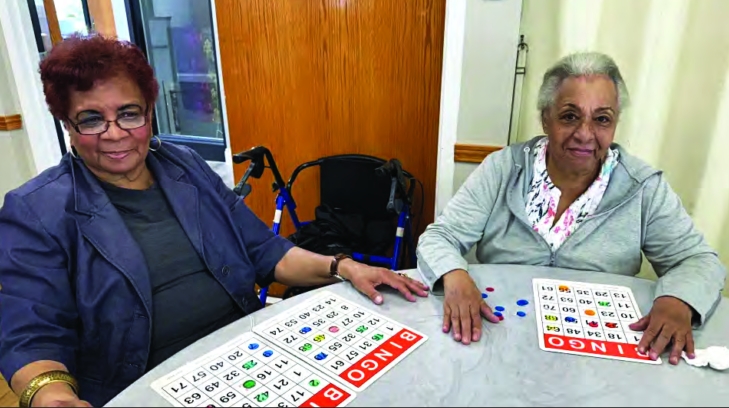
Romana
Da Silva, left, and Isaura Galvao play bingo at the Massachusetts
Alliance of Portuguese Speakers senior center on June 16, 2025. 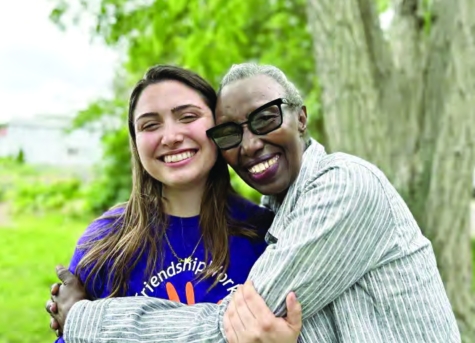
Musabwase Mugemana, right, and Ellen Duncan together in Boston on Tuesday, June 17, 2025.
Groups across Mass. are stepping up
Every day, the senior center at the Massachusetts Alliance of Portuguese Speakers in Cambridge offers an assortment of activities. About 40 participants play dominoes, color in coloring books, take exercise and dance classes and eat lunch together every day.
On a recent Monday morning, it was bingo. Maria Assuncao de Sousa, originally from Portugal, wasn’t winning but she was still having fun.
“Not for me, no luck for me,” she said and laughed. Many of the older adults who come to the senior center have been in the U.S. for decades, mainly from Portugal, Brazil and Cape Verde.
The most important benefit of the senior center, aside from the fun and food, is the opportunity to connect with people around a shared culture and language, and combat loneliness, according to Elen Freitas, the center’s coordinator.
“They feel lonely, and they don’t do anything once they are home, you know, just watching TV, lying down. And here? No,” she said, greeting each of them with a warm hug. “They [are] obligated to have a social life, talk to others [who are] having the same kind of experience.”
While social isolation among older adults is not a new problem, experts say the COVID pandemic exacerbated the challenge.
New data shows that older
adults are still feeling the effects. In UMass Boston’s recent Healthy
Aging Data report released this spring, researchers found increased
rates of depression across New England since their last report in 2018 —
up four points to a 35% rate across Massachusetts, and as high as 54%
in some towns.
But the
pandemic also opened up more conversation about mental health and the
importance of social connection. Organizations and policy makers
recognize that having an active social life is critical for long-term
health and well-being as we age.
Since
2020, addressing isolation has been a bigger focus of programs across
the state, like the volunteer-led Massachusetts Coalition to Build
Community & End Loneliness, which is bringing together more than 100
nonprofits, local governments and academic institutions to advocate
stronger community connections across the state.
Caitlin Coyle, director of the Center for Social and
Demographic Research on Aging at UMass Boston’s Gerontology Institute,
recently conducted dozens of listening sessions around the city to hear
what older adults need. In 2016, she did a similar study and heard
mostly about housing and transportation. This year, she said, isolation
was on everyone’s mind.
“We
heard a lot about third spaces and wanting to connect, and the idea of
meeting new people,” Coyle said. “Having almost more of these informal …
meetups and dinners and just places to be in community with other
people.”
Idimaura De
Assis, from Angola, said that’s one of the reasons she comes to the
senior center. “To be with my friends … everybody.”
Isolation’s impact on physical health
Older
adults were told to stay home and isolate during COVID. Betsy Connell,
executive director of the group that supports local Councils on Aging
across the state, said she heard about “seriously concerning” impacts.
“The
Councils on Aging saw individuals who …. may have had moderate
cognitive challenges, they became major in a matter of a year, year and a
half,” Connell said.
In
2023, the U.S. Surgeon General released an advisory warning about the
impact of isolation on health, linking loneliness to a greater risk for
conditions like cardiovascular disease, dementia, stroke, depression and
anxiety.
“Social isolation is more dangerous than smoking a pack of cigarettes a day,” Connell said.
Family
structures are evolving, she noted, meaning more adults may be aging
solo. “The concept of ‘nuclear family’ is just so different than it was
50, 75 years ago,” she said.
Coyle
said there is now a growing focus on social health. And, like physical
health, it gets harder when you stop, like going to the gym.
Most
of the older adults who come to the Mass. Alliance of Portuguese
Speakers senior center come every day. The staff says that if they miss
some days or weeks, they notice a change in their mental health.
Freitas
cares for each of them like they are her own family. She started the
job after caring for her mother for four years in Brazil.
“They
just need somebody [to] be patient with them, give attention, love,
that’s all,” she said. “So that’s what we do, we make sure they feel
like home.”
Finding connection online
While
some older adults bond in person, some are connecting online — and that
can be a big advantage, especially for people who are LGBT+.
David
Aronstein started OUTstanding Life in 2023 as a virtual gathering space
for LGBT+ older adults across the state. The free online platform now
has more than 500 members, with grant support from the Massachusetts
Healthy Aging Fund.
They host a range of programs on Zoom like finance classes, book clubs and flower arranging workshops.
Carla
Morrisey, who is transgender, lives in Worcester and joined the group
about a year and a half ago. She transitioned at age 70 after living
what she calls an “unauthentic life,” and says the platform has helped
her find a sense of belonging.
“They’re
so supportive, they’re so friendly,” she said. She hopes more
transgender people can realize the importance of finding community. The
platform recently launched a monthly support group for transgender
adults.
“It was great because … I haven’t found many supports for older trans folks,” she said.
Aronstein
says that many older LGBT+ adults grew up in a time that was “quite
homophobic,” and they may not always feel welcome at other programs.
“A
lot of us don’t feel comfortable going to the local town senior center
because they don’t know what kind of reception they’re going to get,” he
said, and some people feel they have to hide their identity when they
move into nursing homes or assisted living facilities.
Older
LGBT+ adults may also be estranged from their family or not have their
own biological kids, leading to more isolation. “That sort of natural
care network isn’t necessarily there,” he said.
Intergenerational friendship and small steps
Some
older adults are turning to younger generations for companionship and
friendship, like Musabwase Mugemana and Ellen Duncan, friends with a
50-year age gap. FriendshipWorks, a nonprofit that aims to reduce elder
isolation, brought them together through their friendly visitor program.
Mugemana
reached out to the program after experiencing a violent attack outside
her home. PTSD and depression left her feeling isolated and alone for
more than two years.
“Isolation
is the worst thing ... we are social human beings,” she said at a
recent meeting with Duncan in Roslindale. “When you’re isolated, it
makes you more depressed, you [are] cut off, I mean, you die, it’s a
slow death.”
She
credits her friendship with Duncan with helping her recover. They meet
once a week, to go grocery shopping, clean their closets or do
watercolor painting.
“I really needed it, it’s like lifesaving for me,” she said.
Coyle
said it doesn’t require a large organization or a big time commitment
to make a difference in the life of an older adult. Small personal
gestures, like complimenting a stranger at a grocery store, waving at
your neighbor or offering to take someone’s picture at a restaurant, can
make a big impact.
“[They
are] reminders that … we have this social contract with each other,”
she said. “These sort of just small things that make people feel seen.”
Meghan Smith is a reporter for GBH News. Magdiela Matta, also of GBH News, contributed to this report.


