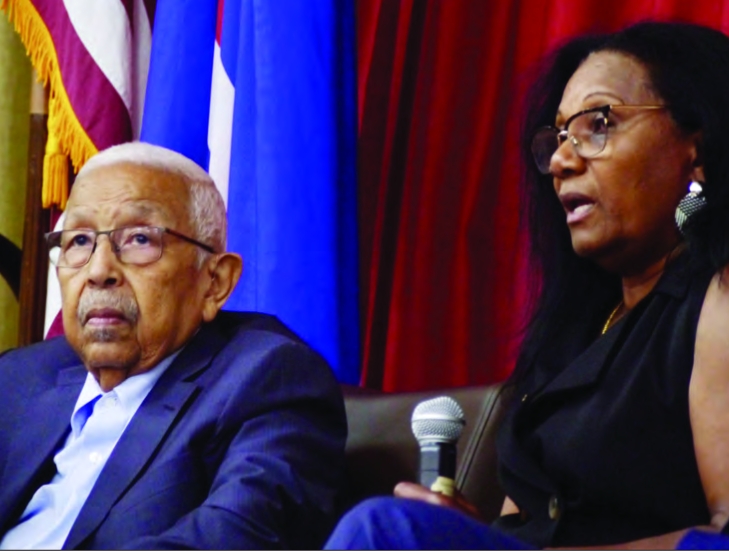
Gunga
Tavares translates for former Cape Verdean President Pedro Pires during
a June 30 appearance at Bridgewater State University.
Gunga Tavares remembers July 5, 1975, as an unusually hot day when thousands of Cape Verdeans made their way through the streets of the capitol city of Praia to the Estádio da Várzea to celebrate independence from 500 years of Portuguese colonial rule.
“The streets were decorated with banners in the color of our flag,” she recalls 50 years later.
Tavares remembers the first flag of the newly independent republic well. The red, green, black and yellow banner was designed for the African Party for the Independence of Guinea and Cape Verde by her brother, Luis Tolentino. She, her mother and her sister stayed up until early morning sewing the flag that would fly in the stadium.
“We didn’t sleep that night,” she said.
On the streets, people wore tee shirts with the black star from the flag, which represented Africa, the continent Cape Verdeans now look to for solidarity. Inside the stadium, a youth choir, decorated in blue uniforms with yellow scarves, rose to sing the nation’s new national anthem.
“I remember the moment when the national anthem was sung and the flag was raised,” Tavares said. “It was everything we were waiting for. People were screaming and embracing each other. The excitement of knowing you were in a free country — that stays with you.”
Two weeks with the guerrillas
Tavares was just 16 when she traveled to a guerrilla camp in Guinea-Bissau in the year before independence to visit her brother, who had set up and maintained radio communications for the African Party for the Independence of Guinea and Cape Verde (PAIGC).
“There were a few barracks made of concrete, but most of the accommodations were in tents,” she recalled.
She spent two weeks in the forest with her brother, Nicolau “Taka” Tolentino. While in Cape Verde, there was limited armed conflict, owing to the lack of tree cover and relative geographical isolation of the 10 islands in the archipelago. Many Cape Verdeans fought the Portuguese in Guinea as part of a coordinated liberation struggle among Lusophone African nations, which included Angola, Mozambique and Sao Tome and Principe. Her other brother Luis had been imprisoned by the Portuguese colonial authorities in Angola.
But
1974 was a pivotal year for Lusophone Africa. In Portugal, many were
weary from years of armed struggle with the colonies in Africa and East
Timor. On April 25 of that year, a group of military officers staged a
coup, overthrowing the Portuguese government. By the end of 1974, the
Portuguese withdrew from Guinea-Bissau, where the PAIGC controlled most
of the territory.
Cape Verde was next.
A battle for hearts and minds
Nezi
Brito was a university student in Lisbon when the April 25 coup
overthrew the Portuguese government. Brito, like many of the African
students studying in Lisbon, was well versed in the anti-colonial
struggles that were gripping Portugal’s colonies. Her course of action
was clear.
“We all decided to go back and fight for our respective countries,” she said.
When
Brito arrived in Praia in the spring of ’74, PAIGC leaders told her to
return to her home island of Fogo with other comrades. There, she
connected with Joao Jose Lopes Silva, a military commander known in
Guinea-Bissau by the nickname “Jota Jota.” Silva later became her
husband.
“Our sole objective was to fight for our independence,” Brito said of her mission in Fogo.
But unlike the bloody battles on the continent, the battle in Cape Verde was a battle of ideas.
“It
was a political fight,” Brito said. “It was not just a fight to have
our own administration. It was for us to become who we are. It was a
resurrection of our identity. We have our own way to live and be in the
world. It was a fight for cultural, spiritual and political autonomy.”
Under
colonial rule, the Portuguese suppressed Cape Verde’s Kriolu language
and identity, even banning indigenous music forms such as funaná, batuku
and tabanka. Although the war in Guinea-Bissau was over, the Portuguese
colonial administration of Cape Verde was ongoing and the PAIGC wanted
them out.
“We held demonstrations,” Brito recalled. “We held elections for representatives to our new national assembly.”
Local resistance
In
Fogo, Brito’s work wasn’t always easy. Many of the island’s people
considered themselves whiter than those in the rest of Cape Verde. And
as was the case throughout Cape Verde pre-independence, literacy rates
were low in Fogo.
News of independence in Lusophone Africa hadn’t made it to many in Cape Verde.
“There
were people who were patriotic toward Portugal,” Brito commented. “For
many people, everything they knew they had heard from the colonizers. We
had to deconstruct 500 years of ideology that led people to feel like
they weren’t African. That was the main problem.”
But the PAIGC was up for the task, after more than 13 years of armed struggle against the Portuguese.
Amilcar
Cabral, the Cape Verdean leader of the guerrilla movement in Guinea,
insisted that insurgents understood that they were African, not
Portuguese.
“Amilcar
Cabral didn’t fight with just an army,” Brito said. “It was a holistic
struggle. He created schools for fighters. He sent soldiers to other
African countries. He was building a nation.”
In
Fogo, as on other islands, PAIGC members used an event called a sarau,
an informal gathering publicized by word of mouth to inspire patriotism
for the nascent Cape Verdean nation.
“It
was mostly young people like myself,” Taveres remembers of the
gatherings in Praia. “We’d gather for an hour or two and listen to music
and poetry and would end with calls for liberation. It was a movement
of people getting information and education.”
While
the movement for independence was mostly peaceful, Tavares recalls an
incident where she and other high school students resorted to the threat
of violence. The radio station in Praia was still broadcasting
propaganda against independence. Students, backed by adults, marched on
the station.
“We didn’t have any
firearms,” Tavares said. “We gathered the people who were producers and
sent them home. We were guarding the building with sticks and brooms
while we broadcasted massages about independence.”
In
the end, the Portuguese saw that holding on to the Cape Verdean
archipelago was untenable. In December 1974, the PAIGC negotiated for a
transitional government run by Portuguese and Cape Verdeans.
On June 30, 1975, the PAIGC elected its first national assembly, paving the way for independence on July 5.
After liberation
After
independence, Tavares took classes with Paulo Friere, the famed
Brazilian educator and philosopher who came to the islands as part of a
movement to boost literacy there.
“I became interested in education,” Tavares said. “I taught middle school for two years.”
Brito, too, became involved in adult literacy, before moving on to teaching school in Cape Verde.
“Independence
is a process,” she said. “It’s one thing to become independent with a
constitution. It’s another to create your identity as a nation. It’s an
ongoing process.”
Brito continued her education in the United States, where Cape Verdeans began settling in New England in the 19th century.
She has taught Kriolu language courses at Harvard, Bridgewater State University and UMass Boston.
While
Portuguese is still the language of instruction in Cape Verdean
schools, Brito has played a key role in the formalization of the Kriolu
language, helping to standardize Kriolu spelling.
By many measures, the Cape Verdean nation has made tremendous progress since independence.
Governance
there began with single-party rule by the PAIGC, which in 1980 became
The African Party for the Independence of Cape Verde, following a coup
in Guinea-Bissau that overthrew President Luis Cabral there. After 15
years in power, the PAICV ushered in multiparty elections in 1990. The
Movement for Democracy (MpD) came to power in the 1991 election,
claiming the majority of the national assembly seats and ruling for the
next 15 years before losing to the PAICV. The MpD is currently in power.
While Cape Verde earns high marks for the
integrity of its democratic system of governance, Brito cites the
evolution of the Cape Verdean identity as one of the most positive
outcomes of the revolution there.
“We
have our own language and culture,” she said. “At this stage, Cape
Verdeans are proud to be Cape Verdean. We have a broad understanding of
what it means to be Cape Verdean. What makes a nation is the values and
the culture and the heritage we share.”
After
teaching, Tavares became a reporter for Voz di Povo, Cape Verde’s
national newspaper. When the PAIGC launched the archipelago’s first
national news broadcast, Tavares became the nation’s first newscaster.
In
1985, Tavares moved to Washington, D.C., and worked for USAID’s Voice
of America broadcast. In 1994, she began serving as the cultural attaché
for the Cape Verdean Consulate in Boston, a position she held until she
retired in 2018.
Like
Brito, Tavares has spent a lifetime dedicated to advancing Cape Verdean
culture in the islands and in New England, where a population of nearly
half a million Cape Verdean descendants nearly rivals the archipelago’s
population of 593,000.
Yet
after decades in Massachusetts, for Tavares the memory of that hot July
5 in 1975 when the Cape Verdean flag rose for the first time in Estádio
da Várzea remains as vivid as if it were yesterday.
“You couldn’t reproduce that,” she said. “It was so natural and spontaneous. It was something you could only live once.”
This story originally appeared on flipsidenews.net.


