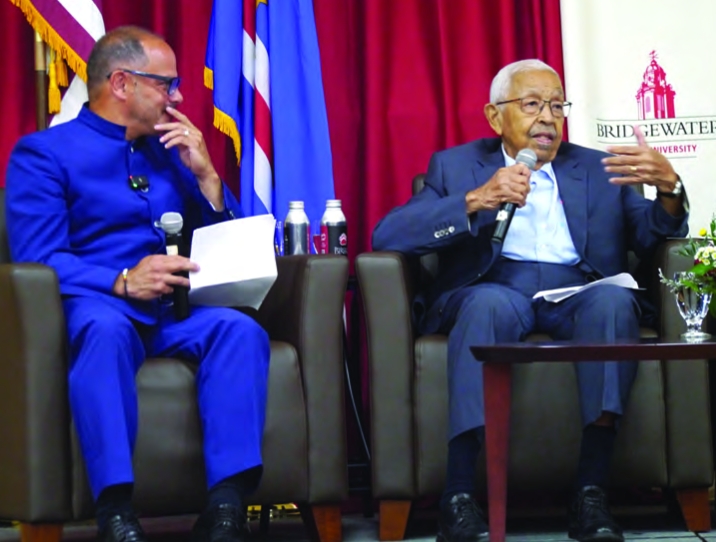
Pedro
Pires, former prime minister and president of Cape Verde, addresses an
audience at Bridgewater State University as Professor João Rosa looks
on.
As a military commander
for the African Party for the Independence of Guinee-Bissau and Cape
Verde (PAIGCV), Pedro Pires thought he understood what it meant to be a
revolutionary. He had spent time with revolutionary leaders in Algeria,
Cuba and the Soviet Union.
So
when Amilcar Cabral, the leader of the revolution against Portuguese
colonialism in Guinee Bissau and Cape Verde asked him, “Who is a
revolutionary?” Pires had a ready answer.
“I
started talking about what would be a revolutionary, and he said, ‘No,
no, no. It’s not that,’” Pires recalled, speaking through a translator.
“‘For you to be a revolutionary, you have to be honest. That’s the
simple requirement. Everything goes around this.’”
Pires,
who went on to become the first prime minister of the newly liberated
republic of Cape Verde, seems to have taken that lesson to heart. During
a political career that stretched 36 years and included six years as
prime minister and 10 as president, Pires was widely recognized for his
work in making Cape Verde an exemplary democracy ranked highly for its
leaders’ respect for individual rights and the rule of law.
Pires
was hosted at Bridgewater State University last Thursday by the Pedro
Pires Institute for Leadership, an organization which promotes scholarly
research on Cape Verde. As the nation nears the 50th anniversary of
independence on July 5, the university awarded Pires an honorary
doctorate.
Introducing
Pires before his address to a predominantly Cape Verdean audience,
Angelo Barbosa, who heads the Pedro Pires Institute, praised him as a
“living symbol of Cape Verdean independence who fought for the future of
Cape Verde.”
In his
address, Pires answered questions posed by Professor João Rosa and spoke
about the nation’s fight for independence and its decades-long quest
for good governance.
It wasn’t an easy feat.
While
Pires’ party, the PAIGCV led the armed struggle against the Portuguese,
fighting primarily in Guinee-Bissau at the same time independence
movements were engaged in armed struggle against Portugal in Angola and
Mozambique, two other parties emerged to challenge the PAIGCV in Cape
Verde.
In the end,
Pires’ party negotiated independence with Portugal in December of 1974
and formally declared independence from the European nation on July 5,
1975. The party parted ways with the Guinee Bissau movement for
independence in 1980 and became the PAICV during its more than 15 years
of single party rule in Cape Verde — a trajectory mirrored in many
anti-colonial movements around the world.
But
in 1990, under pressure from activists in Cape Verde, the PAICV ushered
in multiparty elections, paving way for the rival Movement for
Democracy (MpD) to take power. The MpD presided over a period of
neo-liberalism that was at odds with the socialist orientation of the
republic’s first 15 years.
Pires returned to government as president in 2001, when the PAICV was voted back into power.
Pires led Cape Verde with humility, a trait he learned while fighting in Guinee-Bissau.
“In
my experience during the struggle for liberation, I had a little more
education than most of my colleagues,” he said during his address at
Bridgewater State. “I had to be on the level of everyone else so I could
communicate with them. This helped me understand people. We have to
communicate with each other, but we have to be respectful with each
other.”
During
the armed struggle, the PAICV faced the much-better resourced
Portuguese armed forces. Lacking an air force or navy, the insurgents
were outgunned. To this day, Pires finds their victory miraculous.
“I
ask myself ‘How was it possible — how could we do it?’” he said. “I
think we had two things we were carrying with us: inexperience and
ignorance. At some points, we had no control over the situation. Of
course you’re going to make mistakes.”
Coming out of armed struggle, the PAICV was almost entirely male-led, with no women holding positions of power. Pires
acknowledged that a culture of sexism under Portuguese colonialism in
Cape Verde and Guinee-Bissau that excluded women. That sexism was among
the factors that propelled the MpD to power in 1991.
“We
had to stop the pre-conceived notions that had in our minds that
underestimated women,” he said. “If it wasn’t for women, Cape Verde
would have failed. It is the reality.”
In
his remarks, Pires acknowledged the importance of the global Cape
Verdean diaspora in the success of Cape Verde, referring the country as a
global nation.
“For
us, the idea of a nation is more than just a territory,” he said. “It
would be very difficult to survive without its diaspora.”
The island nation has little in the way of national resources. Over its history, it has been subject to
droughts and famines. Arguably, the archipelago’s main export over the
centuries has been its people. While there are 593,000 people residing
on its nine islands, there are thought to be 500,000 Cape Verdean
immigrants and descendants living in the U.S., primarily in Boston,
southeastern Massachusetts communities such as Brockton and New Bedford
and Providence, Rhode Island. Other Cape Verdean diaspora communities
live in Portugal and other European Union countries, in Lusophone
African nations such as Angola and Mozambique and in Senegal.
The nation’s growing tourism sector and remittances from expatriate communities drive Cape Verde’s economy.
“In the beginning, we didn’t have this notion of how connected we were,” he said.
Now
as Cape Verde faces many of the same challenges confronting nations in
the developing world — climate change, increasing inequality and
disruptions in global trade, Pires says the nation should look to its
diaspora for answers.
“I
think we should all have a coming together of the general states of
Cape Verde and think about Cape Verde 25 years from now, 30 years from
now,” he said. “It’s something we should come to together. I think we
are at a crossroads with all that’s happening in the world. It’s through
reflection that we can come up with solutions. That’s how we can build a
future.”


