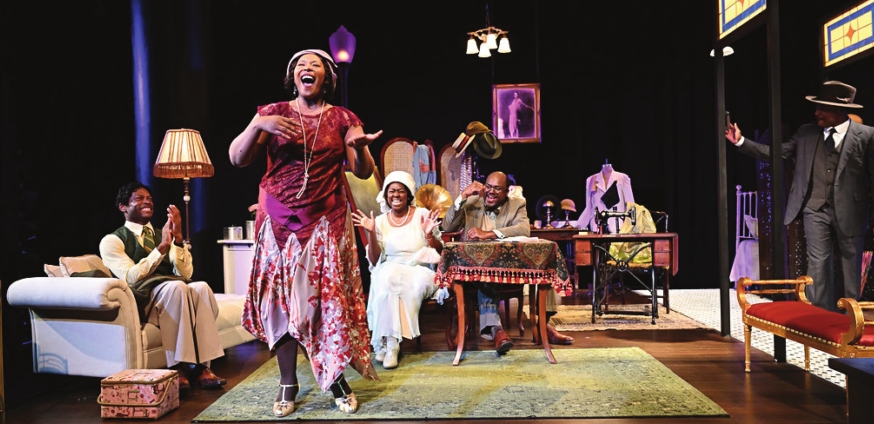
(From
left) Taavon Gamble as Guy Jacobs, Cloteal L. Horne as Angel Allen,
Meagan Dilworth as Delia Patterson, Dereks Thomas as Sam Thomas, and
Quinn West as Leland Cunningham in “Blues for an Alabama Sky.”“Blues for an Alabama Sky,” on stage at Trinity Repertory Company in Providence through June 29, is riveting from the start and never lets go.
Written by Pearl Cleage, the current Distinguished Artist in Residence at the Alliance Theatre in Atlanta, this play addresses such issues as racism, sexism, homophobia and violence among Black people through the story of five characters who are never less than searingly real. Her artistry is given its full power by Trinity Rep’s five-member cast and superlative staging. Both work in seamless harmony to render the deep emotional currents, humor, pain and warm friendships that animate Cleage’s play.
Kenny Leon staged a Huntington Theatre production of “Blues” in 1997, two years after directing its world premiere at the Alliance Theatre.
The play unfolds in a Harlem apartment in 1930, as the Great Depression began to erode the vitality of the Harlem Renaissance, which had for more than a decade elevated the cultural and civic life of African Americans. Cleage’s fictional characters speak of the era’s actual leaders, such as Reverend Adam Clayton Powell Jr. As pastor of the Abyssinian Church in Harlem, he agrees to support the plan of one character, Delia, to open a family planning clinic.
The depth of talent that Trinity Rep brings to this production reflects its strong heritage. The nation’s longest-standing resident acting company, Trinity Rep was founded in 1963 and its conservatory, which includes a master of fine arts program with Brown University, ranks among the nation’s top five for theater arts. Its home is a former vaudeville house with two performance spaces, one with 500-plus seats and another with 300 seats.
Staged
in this smaller theater, the production is directed by Jackie Davis,
whose team includes scenic designer Michael McGarty, costume designer
Amber Voner, lighting designer Erica Lauren Maholmes and sound designer
Larry D. Fowler Jr.
Even
before the play begins, McGarty’s set, an art nouveau sanctuary of
Tiffany lamps and period furniture that is the apartment of Guy (Taavon
Gamble), a costume designer, brings the audience into the story. Wafts
of jazz add to the mood of stylish hospitality. Amiably delivering the
usual message to muzzle phones and note exits is one of the actors,
Dereks Thomas, attired in a brown hat and suit.
Extending
the width of the stage, the set includes the modest apartment of
next-door neighbor Delia, a social worker (Meagan Dilworth), and friend
of Guy and his guest roommate Angel (Cloteal L. Horne, a Brown/Trinity
Rep MFA alumna). Guy, who is gay, is devoted to Angel, who has lost her
job as a nightclub singer. Nimble lighting by Maholmes casts an intimate
glow around the actors in solo and duo moments and follows them as they
bring the action into the aisles. They often cluster near the edge of
the stage and frequently engage the audience in eye contact, drawing the
audience into their circle.
Voner’s
wardrobes for Guy and Angel are fantasies of personality-driven period
elegance—his, impeccably tailored ensembles; and hers, sexy satin and
chiffon dresses.
For
Guy, the good life is beyond Harlem. A portrait of American ex-pat
Josephine Baker, whose Parisian career as a singer and dancer made her
an international star, hangs on his wall like the picture of his patron
saint. His dream is to join her in Paris as her costume designer, and to
bring Angel with him.
Every muscle in Gamble’s
face expresses Guy’s energy and determination. He is very caring toward
Angel, telling her that when they met long ago, “You let me see how
beautiful I was.”
While
Guy sips liquors from elegant decanters, Angel guzzles her drinks,
cynical about his prospects and her own. When, facing eviction and
poverty—the
only offer she turns up is to be kept by a mob boss, she meets handsome
and sincere Leland, a newcomer to Harlem from Alabama. She seizes his
offer to provide for her. She flirtatiously asks, “You gonna be my lucky
charm?” to which Leland quietly responds, “I’m gonna be your man.”
Quinn
West, a Brown/Trinity Rep MFA student, renders conservative Leland’s
vulnerability as well as his lethal unease with Angel’s friends—Guy, a
homosexual, and Sam, a doctor who delivers babies and performs
abortions. Thomas is a natural as kind and unassuming Sam. Dilworth’s
Delia is luminous when, putting her activism aside, she gently draws Sam
from friendship into love.
Horne
is spellbinding as Angel, the least sympathetic character. Unlike her
friends, she has no dreams—just a drive to survive that blinds her to
the opportunities so passionately pursued by those who love her.
ON THE WEB
Learn more at trinityrep.com