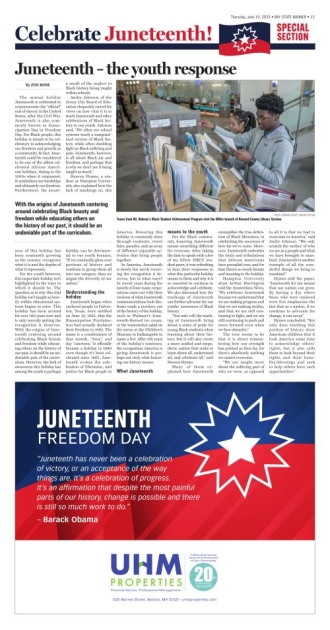
Teens from Mt. Hebron’s Black Student Achievement Program visit the Miller branch of Howard County Library System. The annual holiday Juneteenth is celebrated to commemorate the “official” end of slavery in the United States, after the Civil War. Juneteenth is also commonly known as Emancipation Day or Freedom Day. For Black people, this holiday is meant to be celebratory in acknowledging our freedom and growth as a community. In fact, Juneteenth could be considered to be one of the oldest celebrated African American holidays, dating to the 1800s when it originated. It symbolizes our hardships and ultimately our freedom. Furthermore, the awareness of this holiday has been constantly growing as the country recognizes what it is and the depths of what it represents.
For the youth however, this important holiday isn’t highlighted in the ways in which it should be. The question as to why this vital holiday isn’t taught as heavily within educational systems begins to arise. This holiday has been around for over 100 years now and is only recently getting the recognition it deserves. With the origins of Juneteenth centering around celebrating Black beauty and freedom while educating others on the history of our past, it should be an undeniable part of the curriculum. However, the lack of awareness this holiday has among the youth is perhaps a result of the neglect to Black history being taught within schools.
Andre
Johnson of the Jersey City Board of Education eloquently voiced his
views on how vital it is to teach Juneteenth and other celebrations of
Black history to our youth. Johnson said, “We often see school systems
teach a marginalized version of Black history, while often shedding
light on Black suffering and pain. Juneteenth, however, is all about
Black joy and freedom, and perhaps that is why we don’t see it being
taught as much.”
Heaven
Hymes, a student at Hampton University, also explained how the lack of
teachings on, this holiday can be detrimental to our youth because, “If
we constantly gloss over portions of history and continue to group them
all into one category, then we negate the diversity of our nation.”
Understanding the holiday
Juneteenth
began when enslaved people in Galveston, Texas, were notified on June
19, 1865, that the Emancipation Proclamation had actually declared their
freedom in 1863. The name is a combination of that month, “June,” and
day “nineteen.” It officially became a holiday in 1980 even though it’s
been celebrated since 1865. Juneteenth evokes the celebration of
liberation, and justice for Black people in America. Honoring this
holiday is commonly done through cookouts, street fairs, parades, and an
array of different enjoyable activities that bring people together.
In America, Juneteenth is slowly but surely receiving the recognition it deserves, but in what ways?
In
recent years during the month of June many corporations came out with
their versions of what Juneteenth commemorations look like. Some made a
mockery out of the history of the holiday, such as Walmart’s
Juneteenth-themed ice cream, or the watermelon salad on the menu at the
Children’s Museum in Indianapolis to name a few. After 156 years of the
holiday’s existence, the recognition America is giving Juneteenth is
perhaps not truly what honoring our history means.
What Juneteenth means to the youth
For
the Black community, honoring Juneteenth means something different for
everyone. After taking the time to speak with a few of my fellow HBCU
student peers, it was refreshing to hear their responses to what this
particular holiday means to them and why it is so essential to continue
to acknowledge and celebrate. We also discussed how the teachings of
Juneteenth can further advocate for our youths’ awareness of Black
history.
“Not only
will the teaching of Juneteenth bring about a sense of pride for young
Black students when learning about their history, but it will also
create a more unified and empathetic nation that seeks to learn about
all, understand all, and celebrate all,” said Heaven Hymes.
Many of them explained how Juneteenth exemplifies the true
definition of Black liberation, in celebrating the successes of how far
we’ve come. Moreover, Juneteenth embodies the trials and tribulations
that African Americans have prevailed over, and for that there’s so much
beauty and meaning to the holiday.
Hampton
University alum Arthur Harrington told the Amsterdam News, “We
celebrate Juneteenth because we understand that we are making progress
and that we are making strides, and that we are still continuing to
fight, and we are still continuing to push and move forward even when we
face obstacles.”
The
tone seems to be that it is about remembering how our strength has
pushed us thus far, for there’s absolutely nothing we cannot overcome.
“We are taught more about the suffering part of who we were, as opposed to all it is that we had to
overcome in America,” said Andre Johnson. “We only scratch the surface
of who we are as a people and what we have brought to mankind.
Juneteenth is another example of all the wonderful things we bring to
mankind.”
Hymes told
the paper, “Juneteenth for me means that our nation can grow. By having a
day where those who were enslaved were free emphasizes the fact that as
a nation, if we continue to advocate for change, it can occur.”
Hymes
concluded, “Not only does teaching this portion of history show
American children that it took America some time to acknowledge others’
rights, but it also calls them to look beyond their rights and their
benefits/blessings and seek to help others have such opportunities.”