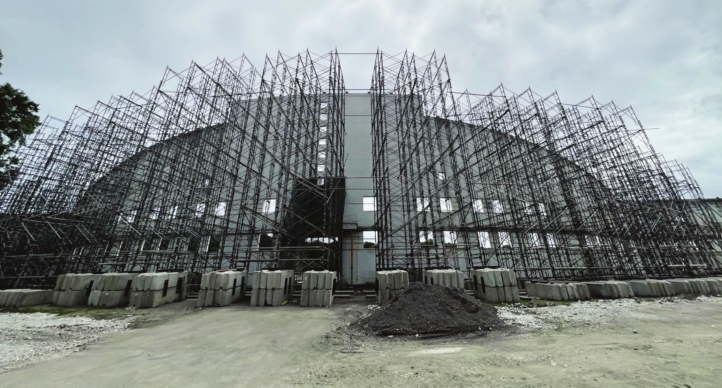
White Stadium under construction The NAACP Boston Branch is calling on the administration of Mayor Michelle Wu to halt demolition on White Stadium, citing the projects displacement of BPS students from the facility, negative community impacts on parking and traffic, what it says is the city’s failure to meet equity standards, and a lack of transparency in the community processes that led to the city’s decision to lease the stadium to a professional soccer team.
“As Boston residents and members of the NAACP Boston Branch, we support the renovation of White Stadium into a high-quality public facility that serves all Boston Public School (BPS) student-athletes and the communities surrounding Franklin Park,” branch members wrote in a press statement. “However, we have serious concerns about the current $200 million proposal to redevelop White Stadium into an 11,000-seat venue to be leased to Boston Unity Soccer Partners (BUSP), a private, for-profit entity.”
The city’s plans to lease the stadium to Boston Unity Soccer Partners sparked controversy from the beginning, with abutters and activists raising objections to what some say would be privatization of a public asset.
Under the plans for the stadium, the fire-damaged eastern grandstand was demolished to create space for a new Boston Public Schools athletic facility while the western grandstand, which was being used by BPS students and city teens for locker rooms, showers and classrooms, was demolished to make way for a new facility for the soccer team.
The cost to the city for the reconstruction is estimated to be $100 million, while the team expects to invest another $100 million for the transformation of the stadium into a professional soccer venue. While city officials say Boston Public School students can continue to use the facility, football games, which have been held in the stadium since it opened in 1949, will no longer take place there during the regular season as the players’ cleats are thought to compromise the quality of the field for soccer players.
Under
the lease the city signed with Boston Unity Soccer Partners, the team
will likely use the stadium on more than half the weekends in the
summer, potentially displacing the festivals and informal events that
commonly take place in and around Franklin Park. On game days, parking
bans in and around the stadium will take effect from 3 p.m. until 10
p.m., according to plans the city released last month.
“The
proposal lacks adequate plans for public transit access and parking,
placing the burden of traffic, air pollution, noise, and congestion on
surrounding neighborhoods,” the NAACP statement reads. “In addition,
proposed parking restrictions would require nearby residents to apply
for event permits just to host family gatherings — potentially stifling
essential community life, including cookouts and birthday celebrations.”
Asked
for a response to the NAACP’s letter, a spokesperson for the city
released a statement, but did not address any of the group’s concerns or
demands.
“After
decades of broken promises, we are delivering the state-of-the-art
facility that our Boston Public Schools students, park users and
community members deserve,” the statement read in part.
Local neighborhood residents have requested that the city conduct a traffic study of the potential impacts on the neighborhood.
The
city’s plans call for 100 shuttle bus trips from satellite parking and
MBTA stations to arrive at the stadium via Circuit Drive (opposite the
golf course) and 45 trips to arrive at the stadium via Walnut Avenue.
To date, there has been no comprehensive traffic study conducted.
Critics
of the stadium say the city rushed its plans for the renovation of the
stadium to accommodate the soccer team’s desire to begin games in 2026,
forgoing community input before it released a request for proposals for
the stadium. City officials began talks with Boston Unity Soccer
Partners in September, 2022, months before they released a request for
proposals for the redevelopment of White Stadium.
The NAACP is calling on the city to meet a set of demands before proceeding with demolition work on the stadium.
1. That the city release a fully public alternative renovation plan for the stadium that the community can review.
2.
That the city finalize comprehensive transportation, parking and
climate resilience plans in collaboration with local neighborhood
associations.
3. That
the city commit to meeting or exceeding the Boston Residents Jobs Policy
mandating a majority of construction jobs go to Boston residents and
people of color.
4. That the city improve its community engagement processes and commit to greater transparency.
“Crucially,
the City has never seriously considered a fully public renovation plan
that would preserve the stadium for student and community use without
corporate involvement,” the NAACP letter reads.


