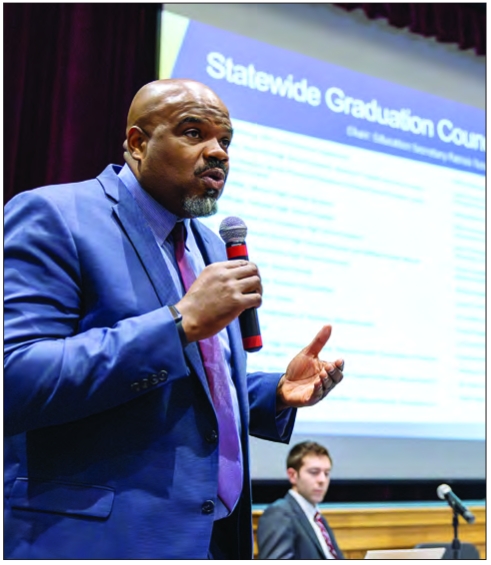
Education Secretary Patrick Tutwiler addresses educators at Barnstable High School. 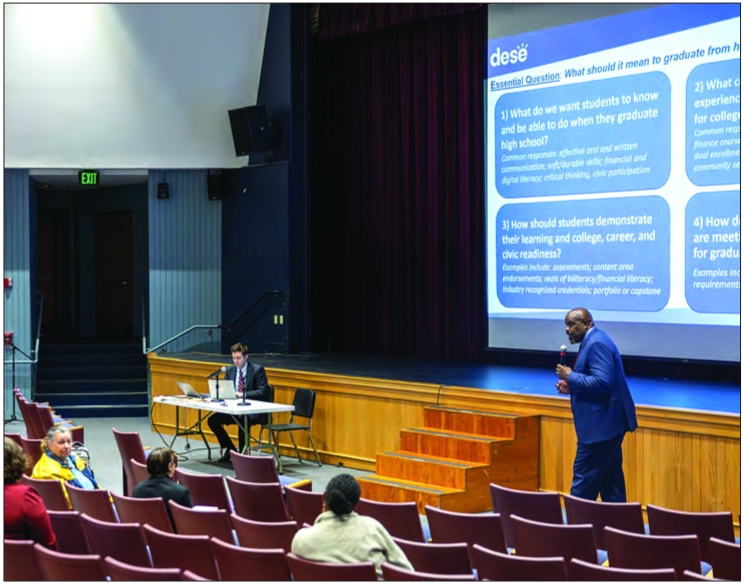
Secretary Tutwiler discusses ways students can succeed after graduation.
Policymakers have begun fashioning a course-based graduation requirement. Yet, without adequate differentiation from local graduation requirements, which mostly establish minimum course requirements through grade 12, the state’s standard will be inferior.
At a virtual hearing last week, well attended by representatives of education-related organizations, attendees asked that mandatory financial literacy, digital literacy and civics coursework be part of state requirements. A survey circulated by the Department of Elementary and Secondary Education also offers the community opportunities to recommend and rank the importance of specific coursework.
The Massachusetts Consortium for Innovative Education Assessment (MCIEA), a teachers’ consortium, wants test alternatives paired with course requirements. Nikki Holland of MCIEA proposed group work like building a wheelchair ramp in geometry class, developing a financial literacy PSA or creating a sunscreen advocacy project.
De’Shawn Washington, a fourth-grade teacher in Lexington, emphasized “the power of financial literacy.” He said a financial analyst visited his classroom to discuss running a business, as well as checking and savings accounts.
Education Secretary Patrick Tutwiler said the statewide graduation council is preparing recommendations that will be delivered to the governor and the Legislature by the end of the calendar year. He traced the set of standardized tests known as MCAS back to the 1993 Education Reform Act. The test, administered statewide by 1998, became the formal competency determination.
“In
2001 as part of No Child Left Behind,” he said, federal funding
required “a statewide test in grades three through eight, and then once
again in high school.” That hasn’t changed.
But
a ballot initiative last fall “separated… the competency determination
from the MCAS. Instead, students were required to pass coursework that
are in the same content areas that the MCAS assessed,” he said.
The voter-approved language replaced MCAS with the requirement that students master their coursework.
The history of standardized testing is intertwined
with curriculum frameworks. Neither stands alone. The framework defines
clear, high standards for all students to achieve. The curriculum is
aligned to these standards and then students are assessed against the
standards.
When
administrators analyze MCAS scores, results reveal which standards were
understood. Imperfect scores imply instructional deficiencies.
Currently,
teacher evaluation in Massachusetts includes alignment to gradelevel
standards. It is a top priority in the state plan established in the
Obama-era Every Student Succeeds Act.
An emphasis on high-standards helps explain educators’ acrimony to testing.
Functionally, test scores intermediate the teacher-administrator relationship.
Neil Sullivan, a former teacher from a family of educators, focused on the test.
“We have got to address assessment as the enemy,” he said. Sullivan leads the Boston Private Industry Council.
“We
need to attack the oppositional attitudes that have taken shape over
the past 20 years around the MCAS controversy, which has pitted people
against one another over testing,” he said.
Only then, he argued, can we “get rid of the fear of failure.”
Conceptually, curriculum frameworks are a bare minimum. They identify standards that should be common to every classroom.
Massachusetts prides itself on high academic standards, and they are numerous.
For
an eighth grade English teacher, there are 10 standards for reading
literature, 10 for reading informational texts, 10 for writing, six for
speaking and listening, as well as six for language use. These
correspond to 32 college and career readiness anchor standards, for
grades six through12.
If
taught separately, each standard would be given a few days’ attention
in a 180-day school year. Practically, each multi-week unit must address
many standards. Time spent testing, practicing skills, or lost to field
trips and pre-vacation malaise furthers the need for multitasking.
Such limitations place breadth and depth at odds.
Rick
Lest, a retired fourth-grade teacher, testified at the hearing that
such challenges can be overcome. “We do have standards, we have Common
Core standards,” he said, “and it’s the job of educators to keep these
standards at the core” of instruction.
Nonetheless, he detailed “project-based learning” wherein students enjoy learning within standards.
“We
created a radio show, we took a trip to the top of a mountain to
observe hawks. We cared for crayfish. We found our way out of the woods
using compasses and maps,” he reminisced. “I could justify every
activity as meeting a standard.”
“After
MCAS was introduced in the middle of my career, things changed,” Lest
said, “there was a single way to show learning and some students could
not do it.”
Even if
experienced teachers can thread this needle, new teachers often cannot.
Mandated minimums may exceed their maximum ability. The result is
teaching to the test: sacrificing depth to formally cover each standard.
For
Susan Pellegrino, a special education teacher in Andover, academics
need nuance. “We have the standards, we have the benchmarks,” she
recited. But, measuring “neurotypical children” and those with special
needs by “the same tool” is “never going to work.”
John
Miller, a public school graduate and parent, recognized the solutions
being discussed as “stuff we were doing pre-MCAS.” He added, “What’s old
is new again.”
Miller
worried about the subjectivity of “grade-level portfolios,” especially
for students with disabilities. He has a child on the autism spectrum.
“I could not find anything that defined standards for what the students
needed to do in their portfolios,” he said. “My son had one instance
where their portfolio was rejected by the school.”
Hope
Hanscom agreed, saying, “Students with disabilities really need to be
at the forefront.” She completed and scored the MCAS portfolios for many
years and called it “more a reflection of the teacher than the
student.”
At least two courses discussed are well underway:
financial
literacy and civics. Massachusetts developed curriculum frameworks for
financial literacy to comply with a 2018 law. Another law from the same
year spurred the creation of a grade eight civics MCAS assessment and
the test was to be administered for the first time this spring.
Andrea
Shepard Lamba, a community organizer and parent of a Taunton High
School graduate, recalled her child’s math class choices.
“My
oldest daughter was not really great in math, but she went as far as
she could before the dreaded calculus option,” she said.
The
alternative was “a personal finance class, a math applications class,”
she said. It was presented as “a class for math failures.”
Tutwiler was “disheartened” to hear that perspective. “It is a graduation requirement in 25 states,” he said.


