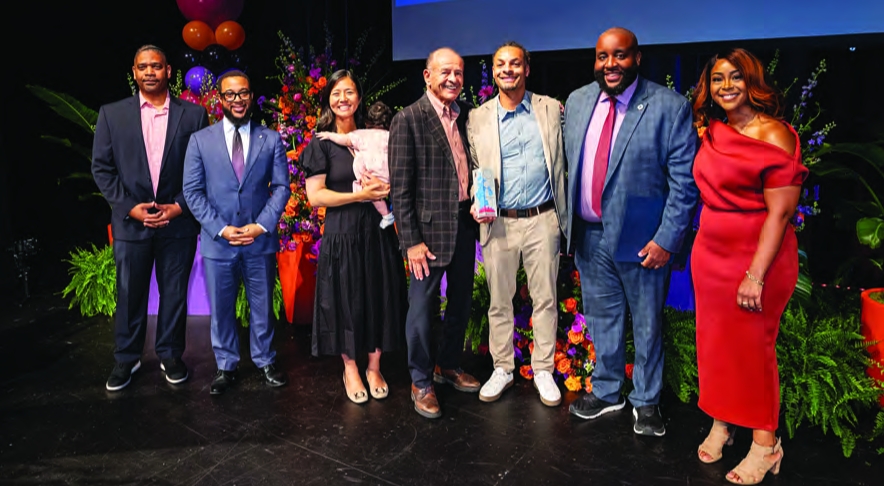
(From
left) Eric Esteves, Boston Main Streets Foundation executive director;
Segun Idowu, City of Boston chief of economic opportunity and inclusion;
Mayor Michelle Wu with daughter Mira; John Cruz and Justin Cruz of Cruz
Companies; State Rep. Chris Worrell, 5th Suffolk District; Aliesha
Porcena, City of Boston director of small businessThis month, 30 small businesses across the city of Boston celebrated their longstanding work and commitment to their communities.
The cohort of Legacy Business awardees was recognized at a public ceremony at the South End’s Calderwood Pavilion on June 3.
The program, now in its third year, was created to celebrate small businesses across Boston and honor the role they play in the community, said Aliesha Porcena, director of small business in the city’s Office of Opportunity and Inclusion.
“When we think about powering our community, businesses — and our small businesses — are really there for us,” said Porcena, who pointed to how a small business can play a role in everything from a resident’s best days to their hardest days.
That role can mean deep roots in a community.
For Hector Piña, founder of Merengue Restaurant in Roxbury, the connection to his neighbors is key. His community, Piña said, means everything to him.
Over the decades since Merengue opened in 1994, he said he has seen three generations come and stay, at the restaurant.
“When I see those families, it’s really nice to see how the community has grown throughout the years,” said Piña, who called the award “validation of the work we’ve been doing.”
Vicky Elias, owner of Rialto Barber Shop in Roslindale, which was recognized in this year’s cohort, said in a statement that a legacy business is “a place where customers become part of a huge extended family that turns a business into a home.”
When Boston Mayor Michelle Wu announced the 2025 cohort in May, she called the legacy businesses “a driving force of support, resources, and connection across our neighborhoods.”
And
the impact can be longstanding. The program highlights small businesses
across the city that have been in operation for at least 10 years — the
oldest business in this year’s cohort, Warren Tavern in Charlestown,
was founded in 1780.
The businesses are selected through an in-depth process, but one that Porcena said is rooted in the communities that they serve.
First
a list of businesses was created by community nominations — this year,
the city received 1,450 in total. That list was then narrowed as the
Office of Small Business sorted out those that didn’t qualify. From the
remaining 320, the City Council selected their top 65 and then a review
committee, made up of representatives from city departments and Boston
Main Streets, considered historical impact and community perspective to
select the finalists.
Gathering resident perspectives has been an important way to capture the value of these small businesses, Porcena said.
“It’s
the memories they provide, it’s the opportunities they provide, it’s
how they’re there, and so incorporating residents into this process has
been a really big joy,” she said.
The
spread of businesses in this year’s cohort came from across the city.
The 30 businesses called 19 of the city’s neighborhoods home — the city
officially lists 23 neighborhoods in Boston.
And
the awardees represent industries including restaurants, pharmacies,
barbershops and a dance studio. As a disclosure, the Bay State Banner
was included in this year’s cohort.
Porcena
said that wide range is important for the program, and something the
office has worked towards since the program launched.
“It’s
important that this group represents all of Boston,” she said. “We are
definitely committed to making sure that our neighborhoods are
represented as well as our industries.”
Businesses
that are recognized as a legacy establishment can access technical
support — Porcena pointed to work, based on impacts from the COVID-19
pandemic, to help businesses move online as they were forced to shutter
in-person operations — as well as grant opportunities.
City officials said that such support can be critical for the businesses that receive the award.
“I’m
thrilled we can use this award to provide much-needed support for the
entrepreneurs who power our districts,” said District 4 City Councilor
Brian Worrell, in a statement.
For Piña, from Merengue, that support is an opportunity to keep the business running strong.
“You never know everything, even though we’ve been in business for 30-plus years,” he said.
The
long roots of the business can mean that they see lots of operational
change. Piña said that when he opened the restaurant in the 1990s, it
was mostly a cash business. As it has grown — from 20 to 100 seats and a
function room — and as the times have changed, now it mostly sees
credit card purchases and more takeout orders. That landscape shifted
even more with the advent of platforms like GrubHub and DoorDash.
“The
restaurant business has evolved, and we cannot stay the same,” Peña
said. “We have to evolve with the times. Who knows what is next?”
The city supports, he said, will help them learn what is next and prepare for what is to come.
But the city’s support is also about ensuring that the businesses last for decades, even as leadership might change.
A
number of the businesses are family owned, and so planning for what’s
next, especially ahead of time, is important. Awardees also can receive
guidance around succession planning, including around employee
ownership, to help businesses that have already served their community
for at least a decade keep going.
To
support legacy businesses, the city has run workshops and started
exploring ways it can support them as they plan for their future.
“What
does business planning look like for you? What are the next three
years? What does the next five years look like?” Porcena said. “What
does your legacy look like?”
Cruz
Companies is a third-generation Black-owned business that has called
Roxbury home for more than 75 years. COO Justin Cruz appreciated the
city’s efforts to do more than just hand out awards.
“We
applaud the city of Boston for shining a light on small and
minority-owned organizations and leaders who have endured and
contributed so much to the city’s success over the span of many decades —
helping to close the racial wealth gap that many of our neighborhoods
and residents have experienced for far too long,” Cruz said.
“And
in that respect we see this as a call to action, and an opportunity for
the broader Boston community to accelerate their support of these
businesses and build Black.”