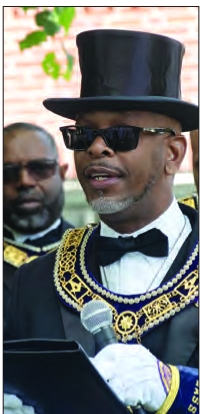
Justin Petty, Grand Master of the Prince Hall Grand Lodge of Massachusetts
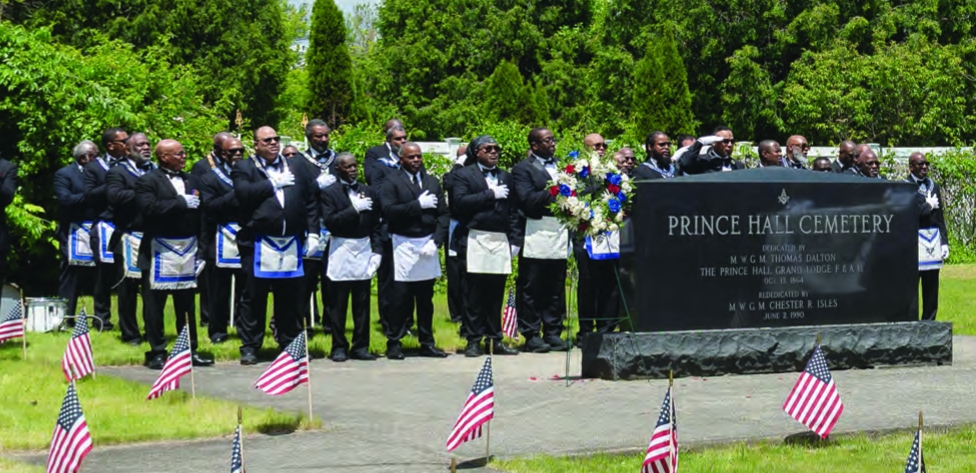
(Above)
Prince Hall Freemasons say the Pledge of Allegiance in the Prince Hall
Cemetery in Arlington during a celebration honoring the group’s
namesake. The Prince Hall Masons, often recognized as the
longest-running Black fraternal organization in the United States,
celebrated 250 years in March. (Below) Prince Hall Masons standing
regalia at the Prince Hall Cemetery in Arlington.
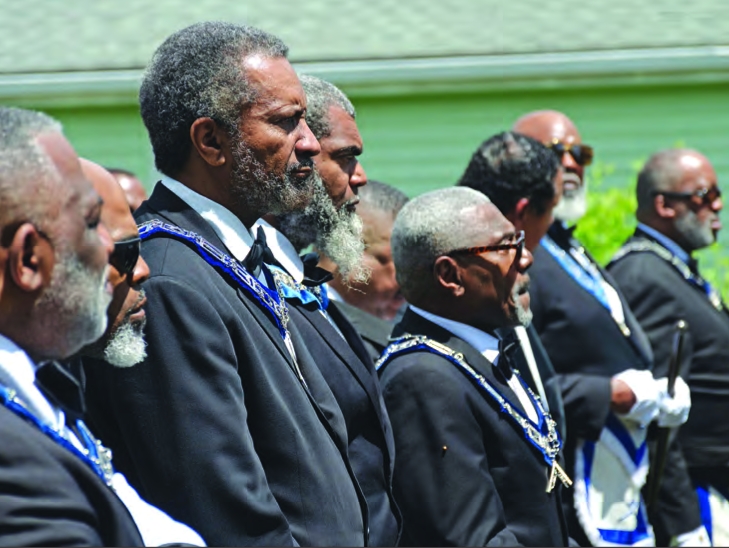
On Memorial Day, dozens of men of color wearing tuxedos, jeweled collars and white aprons, marched through the North End’s Copp’s Hill Cemetery.
The march ended at one of the grandest monuments in the hallowed ground — a broken black column, about the size of a streetlamp, etched with the name “Prince Hall.”
The men were Masons of the Prince Hall Grand Lodge of Massachusetts, and they had come to commemorate Hall, their founder and Masonic father who started the organization 250 years ago.
“He used Freemasonry as a tool or a vehicle to advance people of color and advance the community that he was living in at the time,” said Justin Petty, current Grand Master of the Prince Hall Grand Lodge of Massachusetts. “It’s very important for us to remember all those things that he worked hard for.”
Prince Hall Freemasonry, a Black branch of Masons, is an organization with long roots dug deep into the ground of Boston. Those roots have spread with 300,000 members, nearly 5,000 lodges and 47 grand lodges globally that trace their lineage back to the lodge Hall founded in Massachusetts.
Hall was born into slavery, gained his independence and became a leather craftsman. He started the branch in March 1775 after he was made a Mason — under the cover of night, as Masons describe it — by a lodge attached to a British unit.
It
was a step that he, along with 14 other men of color, saw as a step
toward the political clout and financial success they had seen from
other prominent Masons at the time — including George Washington,
Benjamin Franklin and Paul Revere — said Louis Elisa, a Master Mason in
the local Prince Hall Masons.
“The
process that they saw was that most of the people who were making
political headway or gaining in finance, they were part of the Masonic
Order,” Elisa said. “So Prince Hall thought, ‘Hey, this might be good
for Black people to have that type of access and opportunity.’”
In
the colonial era, racial barriers blocked Black men from Freemasonry.
Hall was accepted by a traveling Irish military lodge during the
Revolutionary War. That group left once the war ended, but gave Hall a
permit to meet as a lodge — a local chapter of the Masonic organization.
However, they were restricted from inducting new members.
It
wasn’t until September 1784 that the Grand Lodge of England granted
Prince Hall a charter to officially operate. With it, other Masonic
lodges for Black men sprouted in Pennsylvania and Rhode Island.
The
250-year-old organization, generally considered to be the
longest-running Black fraternal organization in the United States, has
played a pivotal role in the Black community — supporting movements like
the Underground Railroad and hyperlocal initiatives like community food
donations.
Prince
Hall Masons have advocated for the fundamental human rights of Black
people since before the formation of the United States. Historians say,
despite the organization’s success and longevity, it often isn’t granted
the level of acknowledgment that’s warranted.
“It’s
more than the regalia and the seals and the rings and the mystery,”
said Noelle Trent, president and CEO of the Museum of African American
History. “It’s the fact that they’re around and that there were members
who helped influence things throughout our history. That’s something
that at this moment, we need to hold up as valuable.”
The
accomplishments of Prince Hall Masons like Thurgood Marshall, W.E.B. Du
Bois and Booker T. Washington are widely known. But Hall’s efforts as
an abolitionist and community organizer have been mostly unsung.
During
the Revolutionary War, Hall urged enslaved men to join the Continental
Army and fight for the nation’s freedom in a bid for their own. He may
have fought at the Battle of Bunker Hill.
He
repeatedly petitioned the Massachusetts Legislature to abolish slavery,
even drafting one such request that proposed a detailed plan to return
to Africa, 130 years before Marcus Garvey became the face of the
Backto-Africa movement.
Hall
pushed for a separate public school for Boston’s Black children,
starting the African Free School in 1798 with other Black Bostonians of
means when the state didn’t provide funding.
These achievements led Cambridge and Arlington to recognize Hall as a Founding Father of the United States.
“We
can compare what the other so-called Founding Fathers are attributable
to have done and look at what Prince Hall himself did and see that
they’re on the same scale,” said Manuel Pires, special deputy to the
Grand Master.
But
Prince Hall Masons, along with their white counterparts, have also
developed a reputation of secrecy and shrouded traditions that members
say they’re looking to shift. Fundamentally, Freemasonry is about
“making good men better,” Petty said, through building community and
philanthropy.
Younger Masons are trying to expand the fraternity’s reach and reputation.
Ralik
John, a 31-year-old Jamaica Plain resident and Prince Hall Mason, said
he’d like to see more younger members join to make sure the organization
keeps its legacy going.
“We have to continue to work and show up so people can see it’s not a bunch of old guys with robes,” John said.
For
John, that means going out into the community and showing young people
who the Masons are and what they can do. In 2024, he started an effort
called the Tailored Initiative to Express Dedication charity, which
helps high-achieving high school seniors at the Albert D. Holland School
of Technology — formerly known as the Jeremiah E. Burke High School —
get tuxedos for their prom.
The
initiative is about supporting local youth, but as a Prince Hall
Freemason, it’s also about opening up to the community and inviting
younger members in.
Petty believes that’s the way to dispel those mysterious stereotypes about Freemasonry.
The
organization gave $40,000 in scholarships last year and plans to do the
same this summer. During the pandemic, the organization’s Dorchester
temple was used as a vaccination and testing site. The temple has also
been used as a food pick-up site for the surrounding area.
The
charitable work takes them beyond the “fancy costumes,” Petty said.
“We’re part of the community — we’re brothers, sisters, mothers,
daughters, fathers, uncles, grandfathers,” he said. “That’s who we are.”
In
the past, that stigma of secrecy paired with the older membership of
many Prince Hall lodges has made recruitment a challenge. But in recent
years that has started to shift, Petty said.
Lance
Adam became a Freemason in 2022 at 31 years old, following the
footsteps of his father, Lawrence Welch. But the tradition has run in
the family for generations.
His grandfather and
great-grandfather were Masons. Now, several decades later, both of Lance
and his brother are Prince Hall Freemasons, and his daughter is a
member of the Order of the Eastern Star, a Masonic-affiliated
organization open to both men and women.
“The tradition of Prince Hall masonry runs deep in my family,” Welch said. “Very deep.
The
Order of the Eastern Star was started in 1850 by a prominent Mason to
allow female relatives of Masons to share in some of the teachings and
values of Freemasonry.
Keshia
T. Bell is the current Worthy Grand Matron of Prince Hall Grand Chapter
of the Order of the Eastern Star. She remembers as a kid going to help
her mother — a member herself for more than 55 years — to help children
in need in Springfield.
As
a little girl, she just thought she was going to play with other kids
and spend some extra time with her mother. Now she realizes she was a
part of the Eastern Star’s mission of fostering unity, love and charity.
“To continue the good deeds of her legacy and of Prince Hall legacy is an honor to give to my community,” Bell said.
That
philanthropy has been a core tenet of Prince Hall Freemasonry since its
founding. In the harsh New England winters, Black Freemasons provided
firewood for the community.
Any Freemasons who fell ill or were unemployed received a weekly stipend, funded by the monthly dues of members.
Two and half centuries later, Petty said the same sentiment remains.
“We
try to make sure that we take care of our widows, our orphans, our
brothers and sisters, the family members of our brothers and sisters,”
he said. “That’s the type of thing that we will do.”
Hall
started his own sect of Freemasonry due to the racial discrimination of
the time. But he preached unity among Freemasons, regardless of race.
As Hall said in 1797, “Give the right hand of affection and fellowship
to whom it justly belongs; let their colour and complexion be what it
will, let their nation be what it may, for they are your brethren, and
it is your indispensable duty so to do.”
Today, those divisions have mostly been mended.
Each
Memorial Day, the Prince Hall Masons trek to the Prince Hall Cemetery
in Arlington. Walter Wedlock, a white Freemason with the Mystic Valley
Lodge, is usually in attendance. For him, when it comes to Prince Hall
Masons and other branches, “the message is all the same.”
As Petty puts it today, “It doesn’t matter what the color of your skin is. We have an obligation to take care of each other.”
During
the ceremony at Copp’s Hill Cemetery, Petty spoke about that March
night, 250 years ago, when Hall and 14 other Black men opened the doors
for thousands of Masonic brothers that came after.
From
the seeds that Hall planted grew an organization that stood tall and
offered community and structure to men of color “when the world often
offered none,” he said.
“Prince
Hall Freemasonry stands as a powerful symbol of what perseverance,
unity and faith in Masonic principles can achieve,” Petty said. “It is
an inspiration to Masons everywhere.”
This story was jointly reported by GBH News and the Bay State Banner.