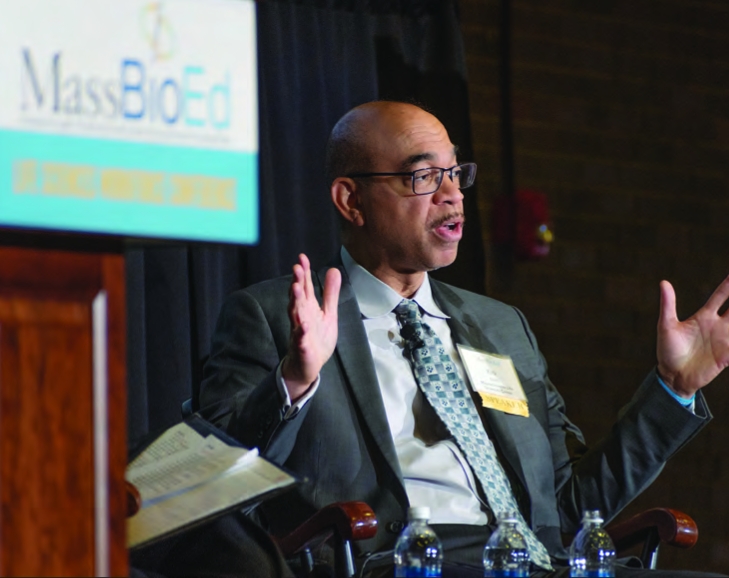
Dr.
Kirk Taylor, president and CEO of the Massachusetts Life Sciences
Center, speaks during the MassBioEd annual life science workforce
conference at Boston University, June 3. At the conference, which
focused on the impacts of artificial intelligence on the biotechnology
workforce, Taylor said that the Massachusetts Life Science Center, the
state’s quasi-public life science economic development arm, is centering
AI and health equity in all of its work.
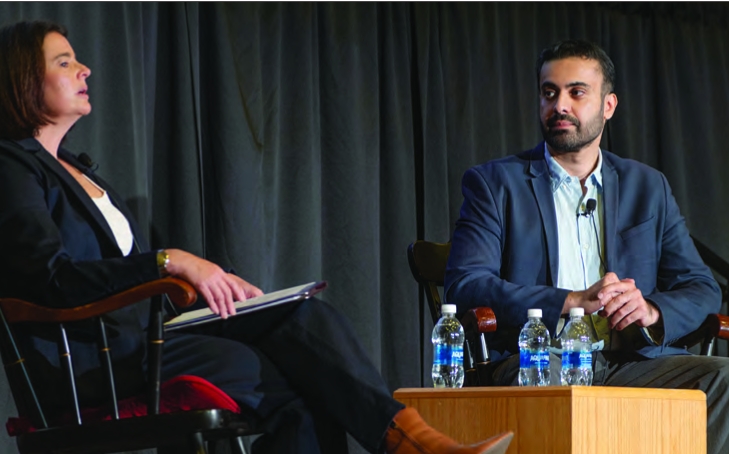
Mickey
Atwal (right), chief data and AI officer at Pioneering Intelligence,
joins Kristin Goppel, vice president of program management at Insight
Medical Consulting, during a panel on the intersection of artificial
intelligence and growing a biotechnology workforce. Atwal said the
impact of AI on the sector is unavoidable.
Artificial intelligence and its potential impacts on the life science workforce were center stage at the MassBioEd annual conference.
At the gathering, held at Boston University, June 2, over 500 workers in academia, nonprofits, government and the biotechnology industry discussed how to grow and support the life sciences workforce, including how to bring in new workers, retrain existing ones for new roles and how things like machine learning will affect all of it.
“We’re at a point where biology, technology and science are colliding in a way we’ve never seen before,” said Jaana Rask, head of people and organization for U.S. research and development at Novo Nordisk and a member of Mass- BioEd’s board of directors.
Generally, event attendees were optimistic about the potential opportunities that artificial intelligence could have in the life sciences industry.
That impact is unavoidable, according to Mickey Atwal, chief data and AI officer at Pioneering Intelligence, which is focused on using AI to support the life sciences.
“We’ve got to the point where it’s no longer a question of if AI is going to be transformative in the industry, it’s just a matter of how quickly,” he said.
Sunny Schwartz, CEO of Mass- BioEd, said she expects AI to be poised to influence “if not completely transform” the ecosystem at every stage.
Speakers at the conference pointed to current or potential uses for the technology in everything from biotech research to day-to-day operations like human resources and marketing.
It’s a push that Atwal encouraged Massachusetts biotech companies to take to avoid getting left behind.
“If you don’t actually get to play with this in your hands; if you don’t get over that activation barrier and get over this fear of embracing AI, then you’re going to miss out on the revolution,” Atwal said.
The industry is in the midst of making sure it doesn’t miss out on that revolution, speakers on the conference’s keynote panel said.
Deborah Glasser, head of specialty care at Sanofi North America, said she thinks biotech is “catching up pretty fast for an industry that is a historical laggard when it comes to new adoptions.”
In that effort, speakers said that the move toward AI should preserve focus on the beneficial work that can come from the life sciences industry.
“What’s
important is patient outcomes, scientific outcomes and using AI and
data as an enabler of them,” said Mike Tirozzi, chief information and
data officer at Alnylam Pharmaceuticals, during the keynote.
But
the use of artificial intelligence has faced concerns of bias. As a
technology that, functionally, is tasked with pattern recognition on
steroids, a machine learning model trained on biased data will produce
biased results.
Biased AI models may lead to results that don’t accurately reflect populations.
For
example, if a dataset on which a model is trained doesn’t reflect the
population a medication might treat, it could be less effective,
according to an October study published in the journal BMC Medical
Ethics.
And research
from Rutgers University, published in September, found that throughout
health care, a lack of representation in AI developers and medical
research can lead to datasets and models that can push false assumptions
about communities of color.
But
Lauren Duprey, chief human resources officer at Takeda, believes that
artificial intelligence has the potential to shift that pattern by
making it easier to monitor data and patterns.
“You
know what’s definitely biased? People, 100%,” she said during the
keynote panel. “It’s not a dispute; we know that people have biases, and
I actually see there’s a real opportunity, maybe, for these digital
tools to be bias disruptors.”
Researchers
have found ways to limit the bias of AI models. In December, a group of
MIT researchers developed a new technique that they said can reduce
bias while maintaining accuracy.
Artificial
intelligence and a changing landscape for biotech workforce development
are also on the mind of state leaders working in the space.
The
Massachusetts Life Sciences Center, the quasi-public state governmental
organization focused on economic development in the biotechnology
sector, is centering artificial intelligence and health equity in its
work, said Dr. Kirk Taylor, the center’s president and CEO.
“AI and health equity are the sinew and connective tissue of everything we
do,” said Taylor, a neurologist and biopharma executive who was tapped
to lead the Massachusetts Life Sciences Center by the Healey- Driscoll
administration in October.
He
pointed to the state’s work building an AI hub in the state. In
December, Gov. Maura Healey announced the launch of a hub aimed at
making Massachusetts a leader in artificial intelligence innovation. At
the time both the state and supporters of the hub pointed to a
connection between that work and the state’s life sciences sector.
Taylor
also pointed to efforts from the Massachusetts Life Sciences Center to
support new internships, including those in artificial intelligence and
data analytics. He said it’s “critical” that they expand and really
educate in those spaces.
Taylor
said that emphasis on expanding technologies will help the state as it
looks to continue its lead in the life sciences field. Massachusetts, he
said “can’t rest on our laurels.”
“There’s no way that we can stay number one without being innovative,” he said.
The technological shifts come amid shifting projections around what a changing life sciences industry might look like.
In
recent years, the local life sciences industry has been undergoing a
slump, with declines in stocks, over 16 million square feet of unleased
lab space and a reduction in venture capital funding.
But
according to a MassBioEd Life Sciences employment outlook report,
released at the conference, the workforce in the state remained steady
in 2024 at 143,000 jobs — growing by less than a percent from the year
before.
The steady year-to-year workforce numbers come after almost a decade and a half of steady growth in the workforce.
The report touted higher growth in the sector compared to across industries.
In Massachusetts, in all industries, employment has grown by 1.3% since 2022. Among the life sciences, that growth was 4.2%.
Changing
demand for workers may include a focus on computer and tech experts.
The report projected a 35% growth in computing and information
technology roles.
John
Brothers, senior director of workforce development strategy at
MassBioEd who presented the report, said that part of that need will
have to be filled by upskilling — or retraining — existing workers.
“Companies
are seeking agile and flexible workers who can retrain throughout their
career,” he said, pointing to demand for workers in specialized roles
like clinical operations, regulation and AI integration.
The
report also found continued support for diversity, equity and inclusion
efforts; from interviews with executives at life sciences companies
this spring, the group found that 90% of those companies expressed a
“strong commitment” to continuing those initiatives, despite efforts
from the administration of President Donald Trump to scrap the efforts.
But,
despite the changing technological and economic landscape, Schwartz
said she expects the long-term goals of MassBioEd to hold true.
“The industry has seen its ups and downs,” Schwartz said. “It’s always been critical to have a strong workforce.”