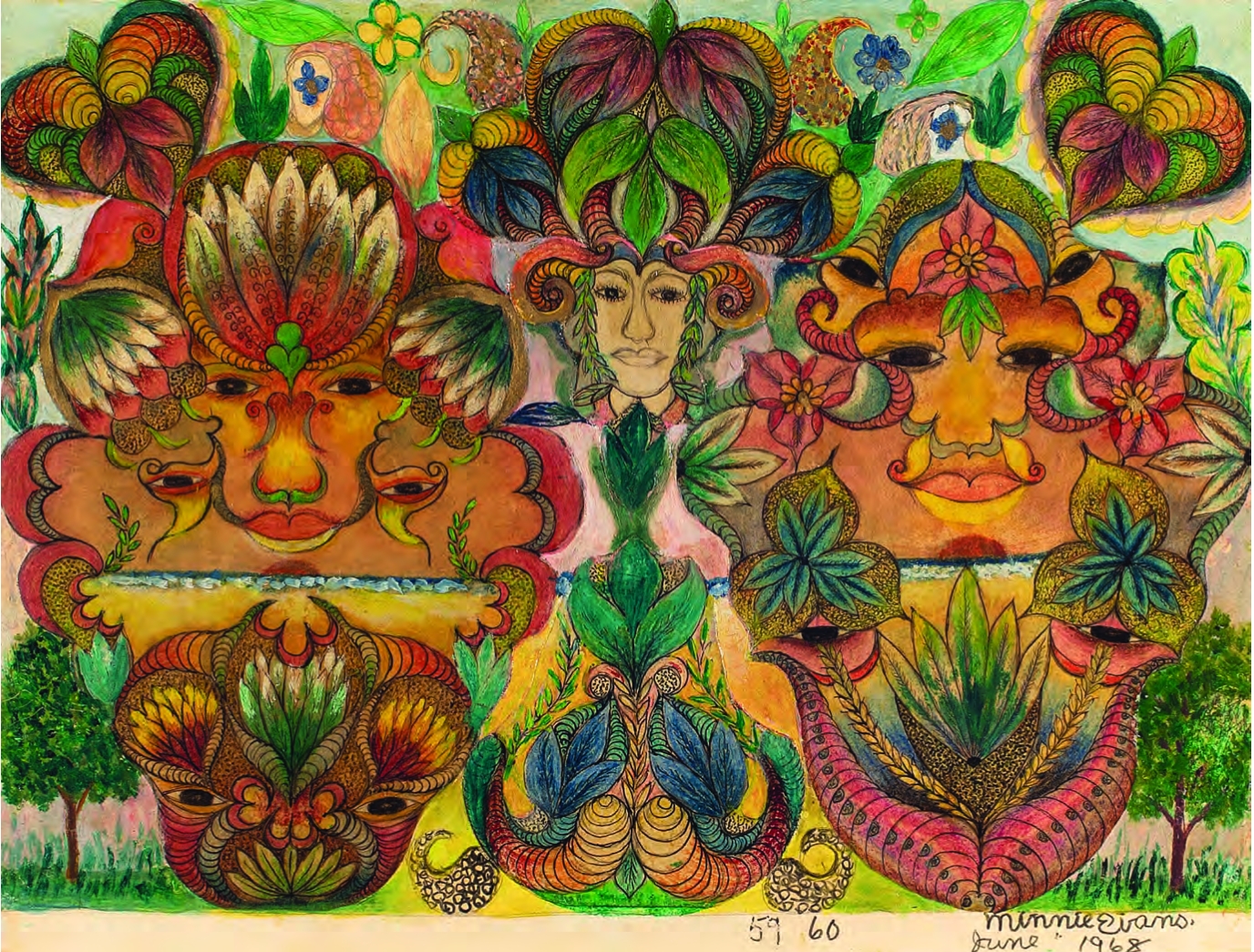
“Untitled
(Three faces divided by two sunrises over water),” Collection of
Cameron Art Museum, Wilmington, NC. © Estate of Minnie Jones Evans 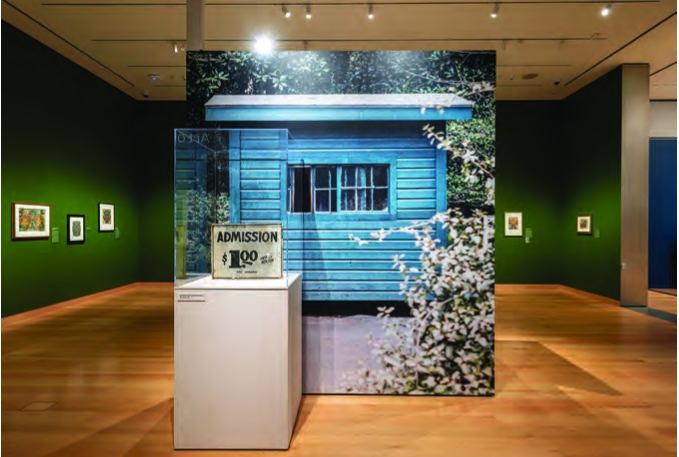
“The Visionary Art of Minnie Evans” exhibition at the Museum of Fine Arts, Boston, Edward and Nancy Roberts Family Gallery.
‘The Visionary Art of Minnie Evans’ at MFA Boston through Oct. 26
In a small wooden cube of a room — a gatehouse, painted blue — American artist Minnie Evans (1892-1987) found a studio in which, while earning 16 cents an hour from morning to dusk over her 27-year post as gatekeeper of the Airlie Gardens in Wilmington, North Carolina, she turned out thousands of visionary images. They reflect the natural splendor surrounding her as well as her vivid internal life, and she sold many to visitors for modest sums.
Sixteen of her works are on
view through Oct. 26 in a beguiling exhibition at the Museum of Fine
Arts, Boston titled “The Visionary Art of Minnie Evans.” Evocative of
Tibetan mandalas in their intricacy and jewel-like tones, they are on
loan from the Cameron Museum in Wilmington, the artist’s hometown.
Her
post at the 67-acre Airlie Gardens served as a long-term artist
residency favorable to the artist, who cultivated a steady stream of
clients as well as daily immersion in its manicured abundance of local
flora and fauna, including its renowned azaleas, magnolias and wisteria.
The garden’s original owners, Sarah Jones and Henry Walters, founder of
the Walters Art Museum in Baltimore, had first employed Evans as a
domestic worker on their estate and encouraged her interest in their
Asian art collections, early influences that later seeped into her
paintings as mythical figures and elaborate, symmetrical patterns.
The
succeeding owner of the Airlie Gardens, Walter Corbett, collected her
work and featured her in the garden’s visitor brochure. On view, the
vintage document states, “The gatekeeper at Airlie Gardens is Minnie
Evans, a granddaughter of slaves, who has received international
recognition for her primitive paintings,” and details the prestigious
venues and publications that presented her works.
The
brochure, dated from the 1970s, is among the displays that accompany
the images to evoke the setting in which Evans lived and created her
works, including a wall-size mural of weeping willows and azaleas;
letters in her handwriting addressed to collectors and gallerists;
postcards from the 1900s that show Wilmington’s downtown, beach, lake
and tree-lined avenues; and a five-minute video interview with a scene
of her singing in the choir of Wilmington’s St. Matthew’s AME Church.
The footprint of the video viewing area matches the dimensions of the
gatehouse.
Evans
worked at the behest of no less than a divine mandate. “God tells me,”
Evans would reply to interviewers asking her how she came to be an
artist. Many of her inventive, ecstatic images may be considered visual
psalms that give praise to God. A keen observer of nature, she said
“Green is God’s theme color … He has painted everything green — 600 and
some shades of green.”
A
straight line is visible in just three of the 16 images on view.
Instead, intricate curving shapes intertwine that illustrate or evoke
forms in nature. Hand-drawn and rendered in wax crayon, graphite, oil
and shimmering metallic paint, they are
populated by an array of earthly creatures—butterflies, birds and
insects—as well as celestial figures from the Bible’s Book of Revelation
as well as occult sources such as tarot cards. Details are often
iridescent—such as the shimmering wings of a peacock in a 1962 image.
A
modernist in her depiction of faces, Evans brings humans into her
images with minimalist curves that show a person’s eyes, nose and lips.
And real-world events of
African American history in Wilmington make their way into images that
show eyes peaking from behind foliage—an allusion to the 1898 white
supremist coup d’etat in Wilmington that overturned an elected
mixed-race government and killed more than 200 residents. Thousands of
Black residents had fled into the city’s surrounding woodlands for
safety.
“My work is
just as strange to me as to anyone else,” Evans once told an
interviewer. The latest work on view is an untitled drawing Evans
sketched with a marker pen while living in a long-term care facility. A
scramble of colored lines, it serves as an expression of her fidelity to
her calling that she continued to her last year of life.
ON THE WEB
Learn more at mfa.org/exhibition/the-visionary-art-of-minnie-evans


