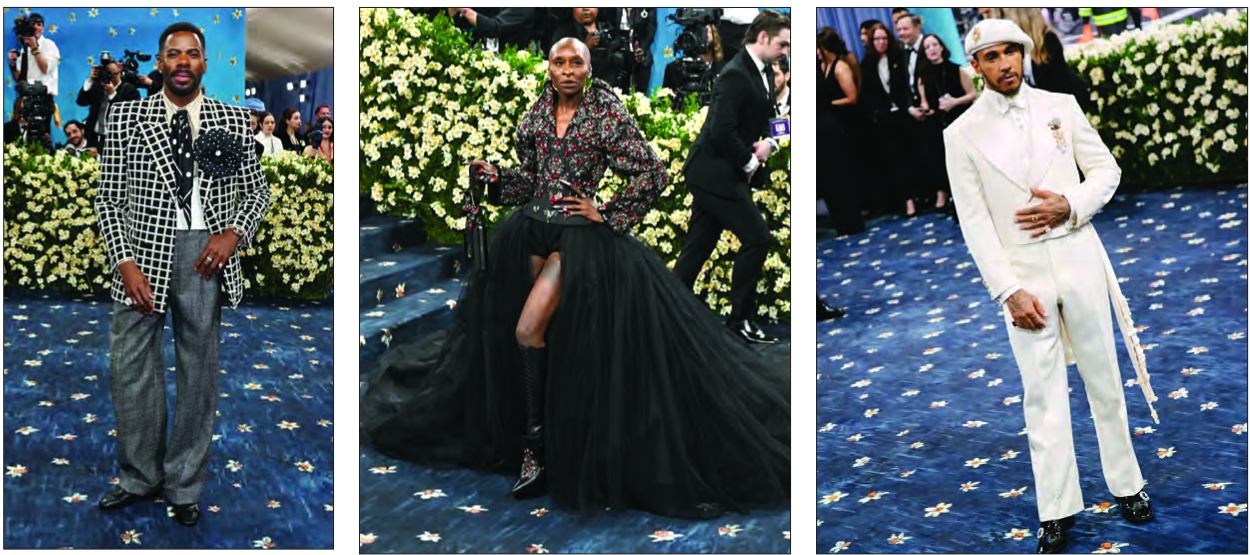
(From left) Actor Colman Domingo, Met Gala co-chair PHOTO: JOHN SHEARER, “Wicked” actress Cynthia Erivo wearing Givenchy PHOTO: JOHN SHEARER, Formula 1 Champion Lewis Hamilton, Met Gala co-chair WPHOTO: LEXIE MORELAND Met Gala raises a record $31 million amid celebration of Black excellence
There is no more coveted invitation in New York City than the studded red-carpet entrance to the Metropolitan Museum of Art on the first Monday of May. The Met Gala made history. For the first time since its founding in 1948, the Metropolitan Museum of Art’s Costume Institute centered its annual exhibition on Black culture, specifically the Black male form and the tradition of the dandy.
Titled “Superfine: Tailoring Black Style,” the exhibit explores over 300 years of Black dandyism, from 18th-century figures like Julius Soubise to the Harlem Renaissance, and into today’s fashion scene. Dandyism, once a tool of resistance and self-definition, allowed Black men to reclaim identity through style.
The inspiration for this landmark exhibition was the passing of fashion icon André Leon Talley in January 2022. For nearly three decades, he shaped the creative vision of Vogue magazine as both its creative director and editor-at-large.
In his obituary, he was aptly described as a “dandy.”
But what exactly is a dandy? According to Wikipedia, a male dandy is a man who places great emphasis on physical appearance, personal grooming, refined speech, and leisurely pursuits. He often aspires to an aristocratic lifestyle, regardless of his actual social standing.
While the term is most commonly associated with Britain in the late 18th and early 19th centuries, its legacy has far-reaching implications, particularly for Black men. It is a response to historical misrepresentation, a way to reclaim identity and agency through style.
One of the earliest figures in this tradition is Julius Soubise, an 18th-century formerly enslaved man who became a close confidant of the Duchess of Queensberry. Through clothing and comportment, Soubise negotiated both how he was perceived and how he presented himself in society.
Dressing above one’s station was often perilous, but it also opened doors to freedom and autonomy.
Consider William and Ellen Craft, an enslaved couple who executed a daring escape by disguising themselves. Ellen, lightskinned, passed as a white male plantation owner, and William, as her enslaved valet. Their carefully chosen attire became their ticket to liberty.
The
“Superfine” exhibition features everything from Frederick Douglass’
iconic tailcoat to a contemporary suit designed by modern-day dandy
Pharrell Williams, the current creative director of Louis Vuitton.
Yes,
the Black A-list showed up and showed out! This year’s exhibition gala
was backed by an impressive roster of sponsors, including Instagram,
Louis Vuitton, and filmmaker Tyler Perry. While basketball icon LeBron
James served as the event’s honorary chair, he was unable to attend due
to a knee injury. His wife, Savannah James, attended in his place.
“I
am supporting my husband here on behalf of him,” Savannah said. “But if
there is any Met Ball that I would love to be a part of it is this one.
This is more than I could have imagined.”
Guests
arriving at the museum were greeted by an ethereal display of over
7,000 faux narcissus flowers suspended from the ceiling, creating a
dreamlike entryway. The grandeur continued as attendees ascended the
staircase, where a decorated group of co-chairs awaited. Among them were
Oscar nominee Colman Domingo, rapper ASAP Rocky, Formula One star Lewis
Hamilton, and Pharrell Williams.
All
but ASAP Rocky stood at the top of the steps alongside Vogue
editor-in-chief and longtime Met Gala architect Anna Wintour, who has
helmed the event since 1999. Inside the museum’s
American Wing, guests congregated around actress Zoe Saldaña, who
stunned in a custom Thom Browne gown. She was seated beside fellow star
Kerry Washington, with both women attracting a steady stream of
admirers, including Demi Moore and rising talent Ayo Edebiri.
Reflecting
on the evening’s themes, Saldaña spoke to the deeper meaning behind the
celebration. “Dandyism and Black excellence are not things to be
celebrated only on occasion,” she said. “We celebrate every day when we
wake up and while we’re sleeping.”
The
night was a testament to style, legacy, and cultural pride and marked a
shift from mere spectacle to meaningful storytelling. While the night
dazzled with high fashion and celebrity, it also broke new ground
financially. Though the institute consistently sees a profit, helped by
ticket prices that can soar to $75,000, this year’s
gala raised a staggering $31 million. That figure not only eclipses last
year’s $26 million total but also sets a record, making it the most
successful fundraiser in the gala’s 77-year history.
Yet amid the glittering gowns and soaring numbers, a question lingers:
Where
will this historic sum go? As cultural institutions increasingly face
scrutiny over how funds are distributed, many in the art and fashion
worlds are watching closely to see whether this year’s record-breaking
generosity will translate into meaningful impact, particularly for
underrepresented voices in the arts. For now, the night stands as a
testament to creativity, cultural pride and the growing power of Black
artistry on the world stage.


