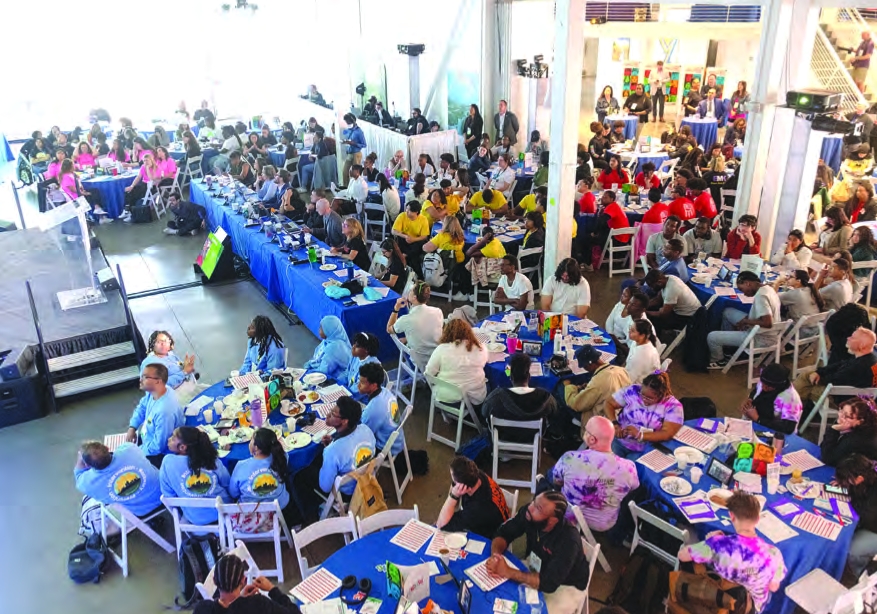
Students
gather at the Artists for Humanity building in South Boston for the
Aspen Challenge Solutions Showcase, April 29. The showcase marked the
end of a 10-week challenge in which high school students from Boston
Public Schools developed and implemented solutions to problems like gun
violence, access to green space and youth homelessness. 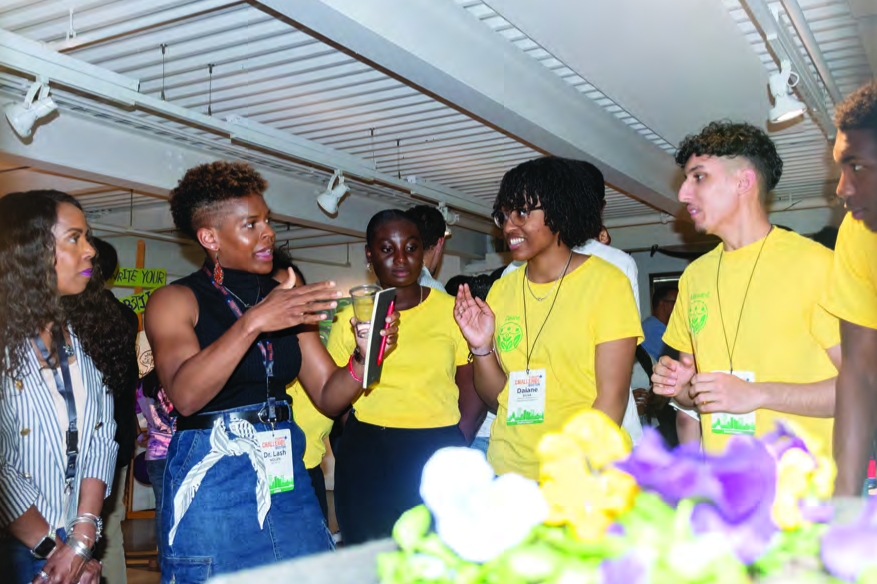
Students
from Boston International Newcomers Academy talk with judges about
their “Schoolyard for Everyone” project, which transformed an
underutilized area on their campus into a green space for students, at
the Aspen Challenge Solutions Showcase.
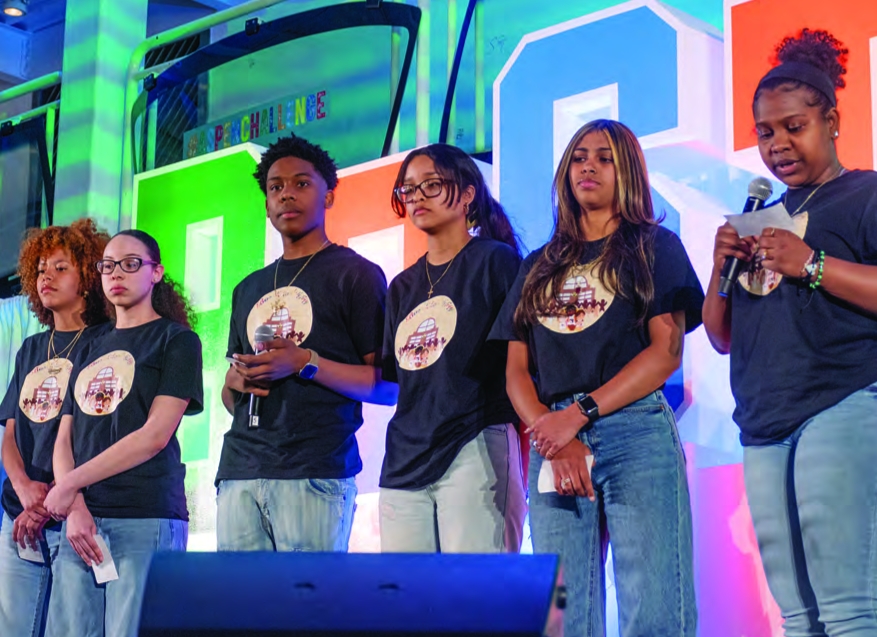
Margarita
Muñiz Academy students present their “Bos School Safety” project, an
effort that gathered officials for a panel about gun violence and
created a playbook to support other schools in running similar events.
The solution was one of three winning projects in the 10-week Aspen
Challenge Solutions Showcase.
Student-driven solutions tackle youth homelessness, green-space access, gun violence
A texting hotline to connect homeless youth to services. Turning an unused part of campus into a new green space for students. A playbook guide for hosting gun violence awareness panels.
These were some of the solutions dreamt up — and implemented — by Boston Public School students as part of the Aspen Challenge, a 10-week-long program where teams from 17 different BPS high schools worked to develop answers to some of their community’s heftiest problems.
Students presented their projects at the Aspen Challenge Solutions Showcase, at the Artists for Humanity building in South Boston, April 29.
Across the competition, students tackled five challenges that were issued in February, when this round of the challenge was launched. They included creating a media campaign to raise awareness around gun violence, turning underutilized space in the community into green space to address urban heat, supporting youth facing homelessness, creating post-secondary pathways for young people and addressing the link between substance use and social media.
Overall, students generally opted to tackle the challenges around homelessness and green space. Six of the 17 teams created solutions to support their unhoused peers and five worked to make new green space in their communities.
Members of the Aspen Challenge team and district officials commended students for
working to tackle the issues, all which center on challenges for which
adults have yet to create definitive solutions.
“You
are the change that we need. You are the brilliance that we need. And
you’ve been the diligence and the work that we need to make it happen,”
said Tom Lombardi, BPS secondary superintendent for college, career and
life readiness, at the solutions showcase.
At
the program’s launch, in February, BPS Superintendent Mary Skipper said
she believed if students embraced the challenge, it would be a
life-changing experience, something that she said came to fruition.
“You’ve
come to see the power of working on a team, of your voice and your
agency and importance, and of what it means to take on some of the most
difficult challenges that our schools
and our city and frankly, our society face,” Skipper said, during
remarks at the awards ceremony, April 30.
Three teams were selected as winners of the challenge.
The
team from Edward M. Kennedy Academy for Health Careers created what
they called “Streetlight,” a free, automated texting hotline to help
students at their school experiencing homelessness access supports. The
tool provides crisis support information, homework help options,
inspirational quotes and housing services.
In
conducting a student survey, the team realized that many of their peers
didn’t know what resources were available, though many services exist.
Their solution aimed to raise awareness about those services while
helping their peers maintain privacy.
“As young people attending a health care school, we care deeply about public health issues.
Homelessness is a prevalent health issue that touches all facets of
life for young people,” one member of the team said, during their
presentation to the judges.
Students
from Excel High School created a from-scratch music video as part of a
media campaign to raise awareness about gun violence. They paired the
video with a red chair, with a sticker that read “No seat for gun
violence. Reserved for victims,” which they’re hoping to put in schools,
and on MBTA buses and trains to raise awareness. Already, they said,
they’ve been “guerilla tagging” seats around the city with the same
sticker.
“We want
people to understand that this is going on all over,” one student said.
“The chairs in schools, in different places like that, is also to
represent that people can see that it’s actually there. People can see
that people are impacted by this.”
The
third winning team, from Margarita Muñiz Academy, also tackled the gun
violence challenge by hosting a panel with officials to spark
conversations about the topic.
“This
is real, in our daily lives, in this nation,” said one student, during
the presentation. She said that all eight members of the team had
witnessed or experienced violence in some form.
“We need to talk about this now, not after another tragedy,” she said.
Out
of that panel, they created a playbook, called “Panel for Prevention,”
aimed at helping others run similar events in other schools and
communities. The guide offers a step-by-step walkthrough, which they
emailed to all 31 high schools in Boston in both English and Spanish. At
the time of their presentation, they had heard back from two schools.
The Aspen Challenge team also presented three special awards to teams.
Boston
International Newcomers Academy was awarded the “originality award” for
their solution that turned an underutilized part of their campus into a
garden and green space for students, complete with public art.
Boston
Arts Academy received the “collaboration award” in recognition of how
they divided up responsibilities while putting together their
“Substitute the Substance” solution, encouraging young people to move
away from substance use and abuse through art and other hobbies.
The
English High School was awarded the “resilience award” for putting
together their solution — a website with resources and care packages for
homeless students — despite facing a host of challenges, like losing
three members of their team.
Katie
Fitzgerald, director of the Aspen Challenge, said the solutions
students presented were some of the most creative and innovative the
challenge has seen — which she insisted she doesn’t say lightly.
“There
is something really powerful that happened here today,” Fitzgerald said
in an interview at the showcase. “The agency that these young people
really took and transformed into implementing ideas, it was pretty
exciting and remarkable, and it’s something we’ve never seen before.”
Student
solutions often included outreach and work with city officials —
something Fitzgerald said the program has seen before, but not to the
scale that Boston students pulled off.
“What
that is, is young people literally figuring out where we need to go,
who has the power, and we’re going to go directly to the power,”
Fitzgerald said.
The
team from Margarita Muñiz Academy, as part of their winning effort to
raise awareness about gun violence, put together a panel with officials
that included at-large City Councilor Henry Santana, Suffolk County
District Attorney Kevin Hayden and representatives from the
Massachusetts Attorney General’s Office.
And
the Tech Boston Academy team, also focused on gun violence, met with
members of the Boston City Council and put together a pledge that they
got 11 of the 13 councilors to sign.
They also formed a partnership with the Boston Public Health Commission.
A handful of teams, across challenges, tapped Skipper to participate in focus groups and informational interviews.
“These partnerships and connections are really
important for our community, in order to keep that connection and
inspire growth for our students and for the victims of guns,” one
student from the Tech Boston Academy said.
The
idea of engaging with officials, Fitzgerald said, was not something
that the team organizing the Aspen Challenge or the adult coaches from
each school put into the heads of students. Rather, it was something
they took on themselves.
Some
of that might have been the culture in Boston, which she said felt more
approachable in a way that made “the mountain to climb for young
people” seem less daunting, but it’s also a mark of how the students
took initiative.
“Every
single team decided that’s what they wanted to do, and they did it,”
she said. “And that is with zero adult help and zero adult pushing.”
The three winning teams will present at the Aspen Ideas Festival in Colorado, in July.
But for all the teams, the goal is to keep the projects going.
To
support those efforts, the Aspen Challenge offered student teams a new
round of funding to continue their solutions and will be leading
“reflect and learn meetings” with the teams, as well as connecting
students with local mentors and challenge alumni.
“What
did you learn? How are you going to refine your project? How can we
continue to keep it going?” Fitzgerald said. “And then we create
pathways to partners in the Boston area for every single school.”
During their presentations, students also described an interest in keeping their work moving forward.
But,
despite new work on the horizon, the presentations and the end of the
competition also marked a moment of celebration of what Fitzgerald
described as “17 revolutions started in Boston by Boston youth.”
“We
kicked things off in February, and you shot for the stars, and you went
for it, and it was truly, truly, truly incredible,” Fitzgerald said to
students during the award ceremony. “You picked topics you were
passionate about, and you just created change. Boston is a different
place today because of you.”


