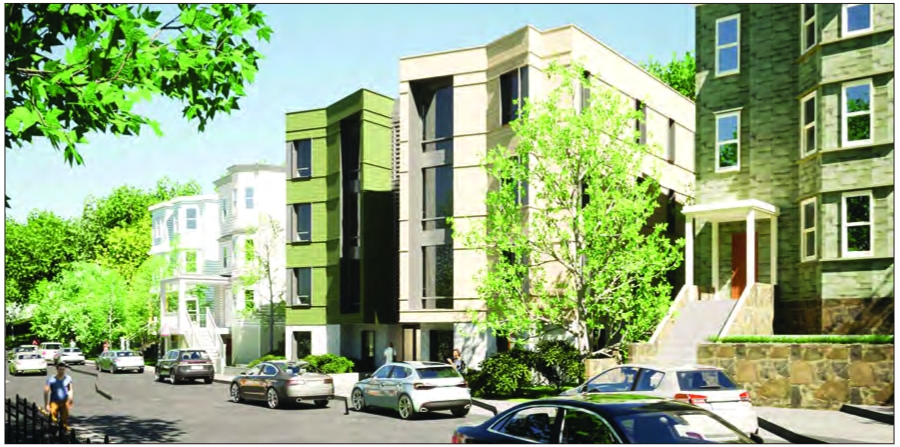
One
project that will receive funding under this round of CPA awards is a
Highland Park development that, as currently designed, will create 20
units for affordable homeownership at 75 (above) and 86 Marcella St. in
Roxbury. 
Affordable housing, historic preservation, and open space in Boston will get a $38 million boost through the approval of 52 projects to receive funding through the Community Preservation Act.
Roxbury, Dorchester and Mattapan scored big in this round, racking up nearly $21.2 million in project funding, over half of the total amount.
Those projects could mean a lot for the communities they’re in, said Sandra McCroom, president and CEO of Children’s Services of Roxbury.
“What it will mean for us, is really what it means for the community,” said McCroom.
Her organization is receiving about $1.1 million total in CPA funding for preservation efforts at the group’s historic headquarters and the creation of a green community space behind the building.
The Community Preservation Act, signed into statewide law in 2000, allows municipalities to create a local Community Preservation Fund, supported by property taxes, to pay for affordable housing, historic preservation and open space and recreation projects.
Boston voters approved the creation of its local fund in 2016, which created a 1% surcharge on residential and commercial property taxes.
One project that will receive funding under this round of CPA awards is a Highland Park development that, as currently designed, will create 20 units for affordable homeownership at 75 and 86 Marcella St.
“I think it’s a nice addition to the neighborhood because there are lots of vacant lots there. By filling these lots and creating more housing — especially affordable homeownership housing — we’re basically enhancing the quality of the neighborhood,” said Kamran Zahedi, president at Urbanica, the Roxbury-based company developing the project.
That project, which is slated to receive nearly $3 million in what he described as gap financing, is currently going through its permitting process with the city, which he said he anticipates will take about six months. Construction, he estimated, would take another 18 months or so.
For affordable housing projects, like the one on Marcella Street, the CPA is an important resource as one of a handful of state and city funding sources for this sort of work, Zahedi said.
That funding is especially important as the city and region struggle with having enough housing that residents can afford.
The Warren Group, which tracks real estate and financial data nationwide, found that, in March, the median price for a single-family home in Greater Boston was $756,000. The median price for a condo was $650,000.
“For
the workforce, for regular people that have a middle-income, it’s
really not that many choices and that many opportunities to buy their
first home,” Zahedi said.
And,
according to the 2024 Greater Boston Housing Report Card, an annual
report released by the Boston Foundation, 23% of Greater Boston
homeowners were cost-burdened — or paid more than 30% of their monthly
income on housing — in 2023. Those numbers were especially high for
Black residents, 32% of whom were cost-burdened.
The
funding is also supporting open space projects across the city. A
quarter of the funds, about $9.5 million, will support projects focused
on green space and recreation; over half of that chunk of the funding is
targeted at projects in Mattapan, Dorchester, Roxbury and Mission Hill.
That
money will support projects both improving open spaces and creating new
ones. Funds will support climate mitigation features, create increased
connections between spaces and pursue general upkeep and beautification
measures.
For
residents in Mattapan, about $161,000 of the Community Preservation Act
funding will mean the creation of a new community garden on River
Street, something Vivien Morris, a Mattapan resident and coordinator of
the nearby existing Kennedy Community Garden, said will take important
steps to bring gardening access to more residents across the city.
According
to GrowBoston, the city’s office of urban agriculture, as of last
spring, waitlists for community garden plots across the city varied
widely but reached as high as 158 people. Few had no waitlist at all.
“Making these new community gardens accessible is very important, and it’s also
showing that the city is hearing the voices of the people,” said Morris,
referring to outreach she said that Grow- Boston did last year to see
what priorities residents had.
Alongside the funding for the new Mattapan garden, the latest round of CPA funding will support two other community gardens.
Those
spaces are important for increasing access to healthy food — something
Morris said is especially important in a community like Mattapan, with
an overwhelming majority population of color and a distinct immigrant
community.
“Many of
those people are with limited financial resources. We have a large
immigrant population in our community who have faced many difficulties
in the past and have seen those difficulties rise more recently. And we
see more people looking for places where they can get more affordable
food,” said Morris, who also founded the Mattapan Food and Fitness
Coalition.
The gardens
also will help build community connections. Seven years ago, Morris and
others in her community created the Edgewater Neighborhood Association.
Much
of the community-building needed to set that organization up was
already done because of connections made through the nearby land, they
turned it
into a food forest, a space that’s open to everyone, where plants like
blueberry bushes, strawberry plants and cherry trees can be harvested by
any member of the community.
“We
were able to do that because the city made that plot of land available,
and the community members said, ‘We have a garden in our community.
What can we do that makes that healthy food available and accessible to
everyone?’” Morris said. “That’s why we built the food forest.”
And
at the Children’s Services of Roxbury headquarters, on Dudley Street,
CPA funding will provide about $751,000 to turn a parking lot behind the
building — which McCloom, the group’s president and CEO, said is
currently largely used for storage — into a community recreation space.
That
plaza will host plantings and seating and will serve as a spot for the
group to run some of its programming, as well as to welcome community
members into a green space — a resource McCloom said is much needed in a
neighborhood that often has more limited tree cover and faces worse
urban heat effects.
“Any
sort of green space that we can create, any kind of environmental area
that is safe for kids and families is a huge contributor to the
community,” she said.
That
funding is paired with another $357,000 that will support historic
preservation efforts at the building, which used to be a trolley
exchange for horse-drawn trollies connecting Dorchester and Roxbury.
The
preservation effort will work on repair and maintenance of the façade,
work McCloom described as “maybe not so sexy” but crucial.
“It’s important to preserve buildings like that because they have such a rich history,” she said.
Projects
seeking funding in the 2026 round of Community Preservation Act funding
can submit an eligibility determination form — the first step in the
process that opens up the possibility of filing a proper application —
with the city by August 29.


