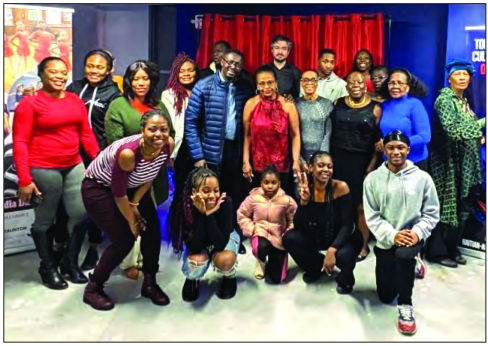
A crowd gathered at a social dance event the Toussaint L’Ouverture Cultural Center team threw last month. 
Marvin Mathelier, the
executive director of the Toussaint L’Ouverture Cultural Center, stands
next to a painting of the center’s namesake.
Local celebrations include Haitian Flag Day parade and opening of Toussaint L’Ouverture Cultural Center
Celebrations for Haitian Flag Day take place on May 18 in Boston, and all over the globe, with parades and cultural as well as culinary activities. As the focal point of May, which is Haitian Heritage Month, Flag Day marks a day of liberation. Boston’s parade starts in Mattapan Square and ends at Harambee Park on Blue Hill Avenue in Dorchester. The Haitian flag will be raised at City Hall on May 18 as part of the celebration.
Flag Day commemorates Haiti’s 1804 victory in its war of independence from France. Led by Toussaint L’Ouverture, the Haitian Revolution is the only Black revolt that eradicated European colonial enslavement. The rebellion started in 1791 and resulted in the establishment of Haiti as the first independent Black nation in the Western Hemisphere.
As of 2017, according to official municipal statistics, Haitians, “those who were born in Haiti or who identify as Haitian, make up 3.7% of Boston’s population, and are the fourth largest immigrant group in the city. Fifty percent of the community are employed in education, health and social services.”
Demonstrating the city’s commitment to the importance of Haiti,
Boston is helping to establish the Toussaint L’Ouverture Cultural
Center. The Center will open this month in coordination with Flag Day.
“Our
commitment is unwavering, especially to a vulnerable community under
attack in these times,” said Boston City Council President Ruthzee
Louijeune, who is Haitian American. “Also think that as Haitian people—
we’re used to a fight and hunkering down. We are hunkering down. … I
want to emphasize that to deport people to Haiti, which is in a state of
anarchy, would go against humanity. There’s not one person in Haiti who
doesn’t know someone affected by the gang violence there.”
Marvin
Mathelier, director of the Cultural Center, spoke with the Banner about
Flag Day, the center and the current immigration crisis.
Banner: Tell us about the Center.
Marvin Mathelier: Our grand
opening takes place on May 20. Haitian Americans United (HAU), the City
of Boston and several partners of HAU over the last 20 years are
responsible for helping to make this happen. We were also awarded
$50,000 by Related Beal to help with construction costs. About two years
ago, we established a Toussaint L’Ouverture task force, and the city of
Boston awarded us with a 2,000-square-foot space, rent free, in the
West End that will be the home of the Center: 131 Lovejoy Wharf. Right
next to the TD Garden!
That’s very much in the heart of the city.
Yes.
While the Haitian community is spread out, with many people living in
Mattapan, Brockton, Dorchester and Everett to name a few, this
opportunity enables us to become something like a Haitian cultural
embassy. This is for and from Haitians but additionally a place to
educate tourists and locals.
What is planned?
We plan to have a library of books about Haiti, and
by contemporary Haitian authors; a small café; panel discussions;
cooking classes; dance performances and an art gallery.
We’re
working with the Haitian Artists Assembly of Massachusetts on
displaying art. What’s paramount is uplifting and celebrating Haitian
success. We want to build awareness.
Tell us about yourself. How did you get involved in this position of leadership?
I’m
originally from New York, commissioned in the United States Marine
Corps. Close to a decade ago, I ended up in Boston. My parents are from
Haiti, and I wanted to remain part of the Haitian community here. I
became chair of the task force, and then executive director of the
Center.
Outside of your work in the community, how do you keep busy?
My
wife and I run Ula, a small cafe in Jamaica Plain. I’m also running for
city councilor at large in Boston. I have multiple hats.
What challenges does the Haitian community in Boston face today?
There
is a huge impact on Haitians in Boston. People here support families
financially in Haiti, and what if that is lost? I truly believe that
federal policies need more Haitian voices. Then, too, Haitians are being
forced to ask themselves: Do I have to worry about my cousin? My
father? My daughter? Think of the challenges to mental health. This is a
human rights issue.
ON THE WEB
Learn more at tlculturalcenter.org