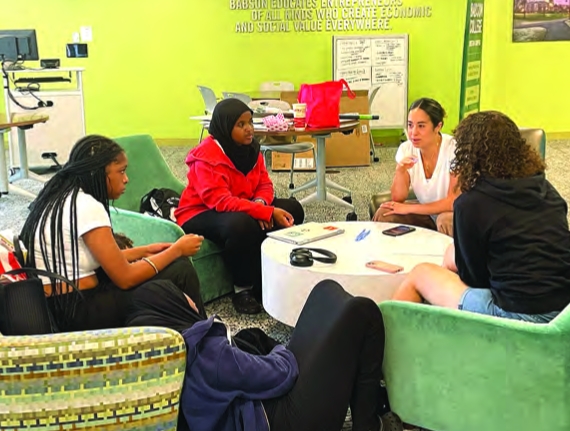
Teens in Print youth leader Marcela checks in with the PR, Events and Communications team.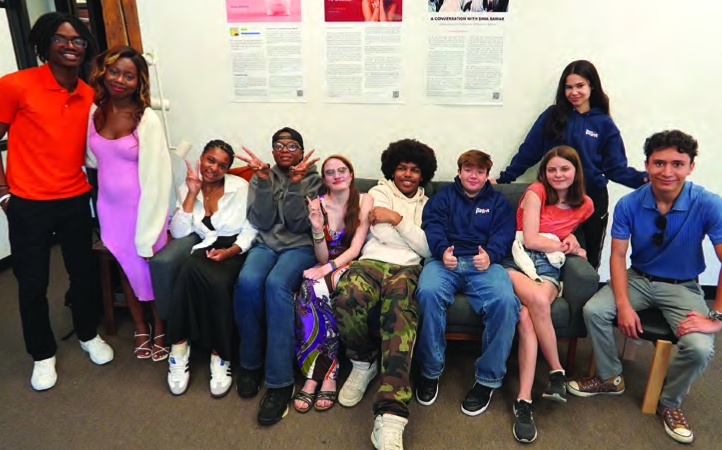
Teens in Print class of 2024.
When Carla Gualdron was a sophomore in high school, she sometimes felt like she was spinning her wheels in English class.
“I was usually the one kid in class that, by the time we were like, ‘Okay, we’re on chapter three,’ I was like, ‘Oh, I read the whole book. I’m ready to discuss it,’” Gualdron said.
At first, her teacher would give her extra books to read on the side, but then introduced her to Teens in Print, a Boston-area student journalism program run by Write- Boston, a Jamaica-Plain-based literacy nonprofit.
“I showed up and it just clicked for me,” Gualdron said. “I was like, ‘Oh, I feel really at home here.’”
The program, which is now celebrating its 20th anniversary, had such an impact on Gualdron that years later, she rejoined it as its director.
Over the years, the Teens in Print program has supported Boston students in putting out a newspaper, multimedia content like podcasts and now a threetimes-a-year magazine.
For its participants and staff, it’s a program that gives students in Boston an important outlet to come together with their peers and share their voice on topics that matter to them.
“What do teens want to say?
What do they want to contribute to the world?” said Mohamed Barrie, the program’s current director. “So in our way of thinking and model, we first try and seek their voices within, things they are curious about the world … and then use that as a way of writing articles, creating podcasts, video projects and all of these other wonderful tools we have in the journalistic space.”
That perspective is something of a shift from when it was first founded, Barrie said.
At its inception the program was an effort, supported at the time by the mayoral administration of Thomas Menino, to improve students’ writing skills, which had been impacted by the MCAS state tests. In its early days, it was sponsored by the Boston Globe and was hosted at that paper’s Dorchester offices.
Over
time, Barrie said, the program aimed less to address scores — though
students still focus on writing — but to also center the student voice
and passion.
It’s also a way for young people in Boston to have their voices heard, in a way they aren’t always.
“Growing
up as a teen in Boston, I feel as though the city isn’t really made for
us, or isn’t really made to appease teenagers, both academically and
socially,” said Gloria Ekechukwu, a former student in the program who is
often called a TiPster.
So it’s key for participants that the program centers their voices.
“It’s
bringing these voices forward of teenagers that you wouldn’t usually
hear, especially in journalism,” said Pietro Waterman, a current
TiPster. “I think that’s important because we have a lot of ideas, and I
think that it’s a really cool space for all of us to be able to speak
on what we’re passionate on and give our opinions.”
And
those passions vary widely. For Waterman, a favorite article he has
written through the program was about an open rehearsal performance by
cellist Yo-Yo Ma in 2023. Through that story, he said, he enjoyed
covering not only the event, but also learning and writing about the
history behind the music that Ma performed.
“It
was a really not only enjoyable article for me because I love the cello
and I loved being able to see him live, but also impactful in what I
was writing about and basically just what the pieces were intended for,”
said Waterman, who has also written a host of other articles covering a
span of topics from reviews of television and stage shows to news
topics like the push to open The Pryde, Boston’s first LGBTQ+ senior
housing community.
For
Blain Melaku, another TiPster, the program has offered an opportunity
to explore her passion for things like literature, painting and movies.
She said a favorite piece of writing for her was a listicle she put
together of five books to read, with music recommendations paired with
each one.
But the
program has also allowed her to explore more serious writing. During
last year’s Summer Journalism Institute, a paid, six-week program from
Teens in Print that runs from July through August, Melaku explored
opinion writing and penned an op-ed about the use of cellphones in
schools.
“With Teens
in Print, it helped me with my research and [to] understand the
perspectives already talked about with teachers and school officials,
but then how actual students felt about it, and how I felt about it,
actually experiencing it in my own school,” she said.
As
a resource, the program can be especially important for a cohort of
students who have limited access to student papers directly at their
high schools.
Gualdron
said when she was involved with the program, some of the exam schools
had their own newspapers, but otherwise the pickings were limited.
“It
wasn’t very common,” she said. “But what was cool about Teens in Print
is that we sort of served as the newspaper for all Boston Public high
schools, since the paper was distributed to every single Boston Public
high school, every library and every community center in the city.”
Participants
said that the program has had major impacts in their life. Ekechukwu,
now a freshman at the University of Massachusetts Amherst, said she
didn’t think she’d be where she is today without the program.
“At that point in my life, I was struggling academically and mentally,” she said.
“The
program changed my life; the community, they brought me up to where I
was supposed to be, and it allowed me to be where I am right now.”
Ekechukwu, who is double majoring in history and political science on a pre-law track, called the program “life changing.”
Part
of that impact, individuals involved with the program said, is the wide
array of skills it teaches the students who participate — things like
reading and writing but also verifying information and vetting sources.
“As
we live in an increasingly digital world where anyone can get on the
internet and say anything, knowing how to fact check, knowing how to ask
critical questions, these are life skills right now,” Gualdron said.
“Teens in Print is an amazing place to go and practice these life
skills.”
Neither
Waterman nor Melaku plan to pursue careers in journalism but said they
think the skills the program is teaching them will help in their future
careers. Both said they’re interested in careers in neuroscience or
medicine
“I think what
I’ve learned with Teens in Print is definitely going to help me in
anything I hope to pursue in the future, which is writing,
communication, interviewing, organizing and being in leadership
positions,” Melaku said.
The
program will celebrate its 20th anniversary at its annual Pros and
Conversation event, May 1. The event — the annual fundraiser of
WriteBoston, the parent organization of Teens in Print — will feature
conversations with authors Omo Moses and Ilyon Woo as well as activities
celebrating the voices of high schoolers across Boston.


