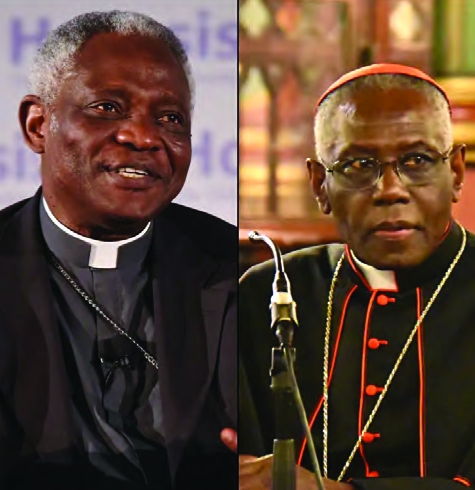
Cardinal Peter Turkson of Ghana (left) and Cardinal Robert Sarah of Guinea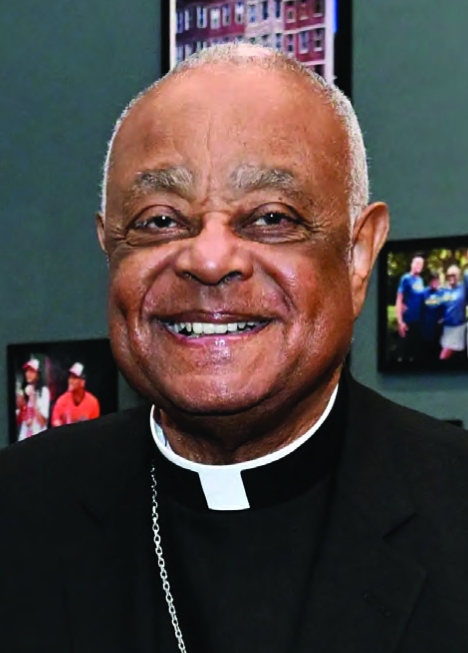
Cardinal Wilton Daniel Gregory
He installed the first Black cardinal in Washington, D.C., connected with America’s first Black president and appointed three Black men who are in contention to succeed him.
He condemned racism as a “sin,” visited poor Black communities and ministered to imprisoned Black men.
As accolades poured in from around the world after the death of Pope Francis, prominent Black Americans pointed to the pontiff’s legacy of advocating for the marginalized, including Black people. Others, however, speculated that Francis redirected church leadership in such a way that the possibility exists for the election of the first Black pope.
In a statement, President Barack Obama said Francis “shook us out of our complacency and reminded us that we are all bound by moral obligations to God and one another.”
The pope was “a great leader and an example of faithful living,” the Right Rev. Paula Clark, bishop of the Episcopal Diocese of Chicago, said in a statement Monday. “He embraced and advocated for all people and was forthright in encouraging peace everywhere.”
Throughout his life and ministry, Francis was “a witness for the Gospel and a champion for the poor and marginalized,” said the bishop, who is Black. “Especially in this season, I give thanks for his powerful advocacy on behalf of migrants and refugees.”
The
pontiff, leader of a church with 1.4 billion members worldwide,
suffered a fatal hemorrhage and heart failure not long after recovering
from double pneumonia — and mere hours after personally greeting
worshippers in Vatican Square on Easter Sunday. He was 88.
Shaping the Catholic Church long-term
Anthea
Butler, a professor of religion at the University of Pennsylvania, said
Francis’ 12-year tenure as pope was inclusive in a way that has altered
the church long-term — and could open the door for a successor from
outside of Europe.
Along
with his “charismatic” reign and willingness to battle Catholic
institutionalists, Butler says Francis “will be remembered for his
reshaping of the College of Cardinals in a way that shifted the church’s
axis of power outside of Europe.” Indeed, Axios reports that Francis
appointed some 80% of the cardinals who will choose his successor.
Growing
up in Argentina, the son of Italian refugees from the rise of fascism
in the 1940s, Francis was the first pope from the Southern Hemisphere,
circumstances that experts say helped him identify with outsiders and
the marginalized.
Although
the two disagreed on significant issues like abortion and same-sex
marriage, they bonded over social justice issues and struck up a
rapport.
The year
after Obama’s Vatican visit, Francis came to Washington. Obama become
the third president to host the leader of the Catholic Church at the
White House.
At
the same time, Francis quietly began rebuilding church leadership,
giving particular attention to Africa in selecting the cardinals who
would eventually vote to replace him. Since his death, two of the three
Black cardinals considered serious contenders to succeed him are from
Africa:
Peter Turkson of Ghana and Robert Sarah of Guinea.
The
third is Cardinal Wilton Gregory, archbishop emeritus of the Washington
archdiocese. Francis appointed him the first African American cardinal
in 2020 and just the third in the history of the Catholic Church.
Although Gregory is retired, he will still vote during the upcoming conclave to name Francis’ successor.
While
the pope gave more attention to Black people than many of his
successors, the church as an institution still has work to do when it
comes to race, experts say.
Two
years ago, the church formally repudiated the colonial-era “doctrine of
discovery” — official declarations that justified European conquests of
Africa and the Americas. Catholic churches were complicit in — and
sometimes benefited
from — the African slave trade. The church did not stand unified against
slavery during the Civil War and Jim Crow-era segregation in the pews
was common.
Francis,
however, issued several declarations and letters to bishops condemning
the “sin” of racism, and spoke out after the murder of George Floyd in
2020. He addressed the issue again in 2023, declaring that instances of
racism “continue to shame us, for they show that our supposed social
progress is not as real or definitive as we think.” In a visit to
Philadelphia in 2015, the pontiff ministered to inmates at
Curran-Fromhold Correctional Facility just outside the city.
Bill
Henry, Baltimore’s comptroller and a Black Catholic, said that Francis
perhaps “didn’t fight all of the good fights that some of us wanted him
to, but he certainly fought more than anyone else who has held his job
in my lifetime. … Requiescat in pace et in a more, papa.”
But
for Father Daniel Green, a 39-year-old priest, Francis’s push for the
marginalized is arguably the most important part of his legacy.
“Black
Catholics have always been hyper-focused on ‘the least of these,’” the
priest, who was ordained just weeks into Pope Francis’ papacy, told The
New York Times. “For many of us, we said, ‘Finally somebody is speaking
about what we are speaking about, and not just doing it as a
tangential.’”


