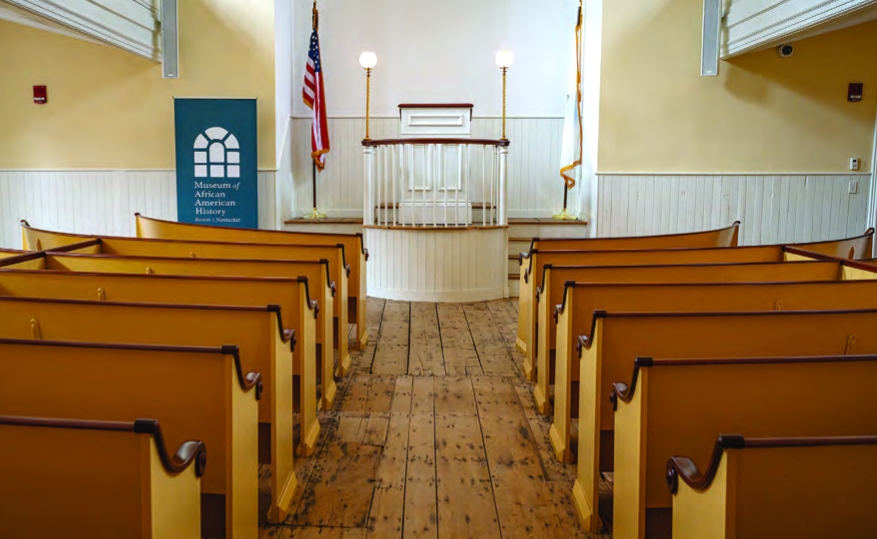
Interior of the Museum of African American History, Boston.Back in March, the
Institute of Museum and Library Services (IMLS), the government agency
responsible for funding museums and libraries across the nation was
gutted along with several other agencies by an executive order. The
agency’s entire staff was put on administrative leave shortly after.
Museums,
libraries and other cultural institutions across the country, including
here in Boston, are feeling the ripple effects of these cuts.
Mass.’s
Museum of African American History (MAAH), which has locations in both
Boston and Nantucket, had a half million-dollar grant awarded to them by
the IMLS in 2024 cancelled.
Last
June, the IMLS awarded MAAH a grant of $500,000, to be distributed this
fiscal year, to help build its organizational capacity. A small portion
of the grant was dispensed at that time. However, when IMLS staff were
placed on administrative leave, the vast majority of their grant funds
were withheld without explanation.
Dr. Noelle Trent, MAAH’s president and CEO said the organization earmarked part of the grant to hire several new staff members.
“That particular grant was an organizational capacity building grant that would give us $500,000 over three years.
It
was aimed at specifically creating museum educator positions for both
campuses, an additional marketing position to support school field trips
as well as funding for marketing those school field trips and student
and family programming. It is a significant setback,” she said.
Trent said the pain felt is not just about finances for the museum and other organizations affected by cuts like these.
“It’s
more than the loss of funding for us, the executive orders of the White
House administration have had an effect on the institution, resulting
in a decline of our facility rentals, as well as in some of our visitors
and our attendance and admissions. What those executive orders have
done is given credence to the thought of de-prioritizing and overlooking
African American history. So this move is another move to try to
silence the work that has been done here and has been going on for over
60 years,” she said.
Dr.
Vedet Coleman Robinson, president and CEO of the Association of African
American Museums, of which MAAH is a member said she had heard similar
accounts among its members.
“The
Institute of Museum and Library Service services was stripped of doing
any work. You know, all of their staff, for the most part, was placed on
admin leave. Our members were receiving termination letters for grants
that they’ve already started work on,” she said.
Coleman-Robinson
said usually the grant money is spent long before the money is doled
out and the grant acts as more like a reimbursement than a windfall.
“What
happens if you were in the middle of a program and, you know, you now
have to make payroll, and then, there’s nobody there to help you move
those things along so that you can get reimbursed. So now you’re in a
deficit. Because the one thing that we always thought as Americans, that
the one thing that you can
depend on is federal funding, right? So it’s a hard pivot, it’s jarring
because nobody expected it,” she said.
The rollbacks on diversity, equity and inclusion along with cuts in funding have Trent and her colleagues nervous.
“The
general overall feeling is unease. I think that’s the best way to say
that, because what’s happening is unpredictable, right?
And
so it’s hard to chart a path forward when the rules of the game keep
changing, and from day to day, week to week, you don’t know who’s going
to be affected, how they’re going to be affected. We anticipated there
would be some impact on our grants. We were just hoping that there was a
little bit more time for us before we lost the grants or there were
restrictions placed on us,” said the museum leader.
Trent said that even though things are tough right now, she counts herself lucky.
“As
a leader of this institution, [I’m] very blessed and privileged to be
in communities that see the significance of our story and are really
urged to action. That is not the case for other small, independent,
Black nonprofit museums throughout the country, and
so we feel a responsibility to make sure that people know that this is
affecting our peers as well all over the country. And so we’re really
calling for people to support us in this moment. We would love to raise
the money that we’ve lost so we don’t lose a step as we continue to grow
and transform. We have made some tremendous strides in the time that
I’ve been with the organization, including the launching of our
artificial intelligence Frederick Douglass, our Boston family days
programming,” she said.
Since
the museum has outposts in both Boston and Nantucket, Trent said part
being from a revolutionary state means standing up and fighting for what
is right.
“We intend to keep growing and to keep highlighting the histories of these communities, because these are not addendums.
These
are not footnotes of history. They’re very much ingrained in the story
of this country. We cannot tell the story of this country without the
stories that we represent, and it’s also about the multiracial or
interracial groups that came together to fight against slavery and
gathered in the meeting house in Boston and the meeting house in
Nantucket, and, you know, were galvanized by William Lloyd Garrison and
Frederick Douglass and others, and fought for not
just the abolition of slavery, but also for what we would call human
rights today, for all African Americans, and for all Americans,” she
said.
Coleman-Robinson is confident that it will be a fight that Trent, her team and the people of Massachusetts will win.
“I
know Dr. Trent and her board and her staff, the ones that are there are
going to come up with an amazing campaign. You know, it is something
that just rips your heart out. But I also feel that the people of
Boston, the people of Massachusetts in general, will really rally around
that museum and make sure that you know that museum, as well as the
space in that Nantucket,” she said.
Trent wants to thank the people that have already begun to advocate on behalf of the museum or made donations.
“Thank
you to everyone who has stepped up already, who have offered words of
encouragement, whether via email or social media. We really appreciate
it. Know that it has made a difference to us. This is a marathon, not a
sprint that we’re in. We hope people will stay with us as we continue to
do this good work and to continue to make sure that our story and the
story of all of America is not erased. I thank them in advance for their
support and their contributions,” she said.
Coleman-Robinson
said there is hard but necessary work to be done to ensure that MAAH
and other institutions like it will be around for generations to come.
“Right
now, it feels like we could be in 1760 you know, 1860 or 1960 but I’m
not trying to be there. So we have a responsibility to make sure that by
the time we get to 2060 the things that we’re doing today will impact
at a greater level what’s happening tomorrow. We want our grandkids and
great grands to be able to turn to us and say, ‘Well, I know that you
were doing good.’ I want to be able to see that we were brilliant
people, and we were making sure that we were not just preserving
culture, but preserving a people,” she said.


