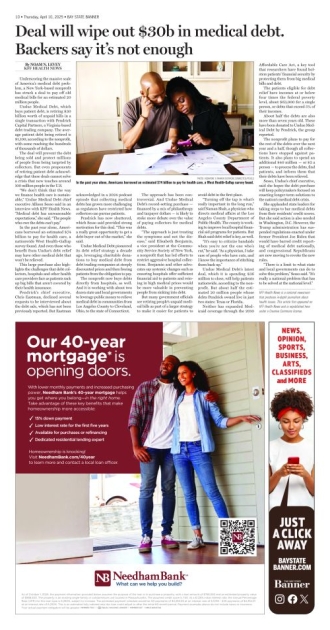
In the past year alone, Americans borrowed an estimated $74 billion to pay for health care, a West Health-Gallup survey found. Underscoring the massive scale of America’s medical debt problem, a New York-based nonprofit has struck a deal to pay off old medical bills for an estimated 20 million people.
Undue Medical Debt, which buys patient debt, is retiring $30 billion worth of unpaid bills in a single transaction with Pendrick Capital Partners, a Virginia-based debt trading company. The average patient debt being retired is $1,100, according to the nonprofit, with some reaching the hundreds of thousands of dollars.
The deal will prevent the debt being sold and protect millions of people from being targeted by collectors. But even proponents of retiring patient debt acknowledge that these deals cannot solve a crisis that now touches around 100 million people in the U.S.
“We don’t think that the way we finance health care is sustainable,” Undue Medical Debt chief executive Allison Sesso said in an interview with KFF Health News. “Medical debt has unreasonable expectations,” she said. “The people who owe the debts can’t pay.”
In the past year alone, Americans borrowed an estimated $74 billion to pay for health care, a nationwide West Health-Gallup survey found. And even those who benefit from Undue’s debt relief may have other medical debt that won’t be relieved.
This large purchase also highlights the challenges that debt collectors, hospitals and other health care providers face as patients rack up big bills that aren’t covered by their health insurance.
Pendrick’s chief executive, Chris Eastman, declined several requests to be interviewed about the debt sale, which has not been previously reported. But Eastman acknowledged in a 2024
podcast episode that collecting medical debts has grown more challenging
as regulators have restricted how collectors can pursue patients.
Pendrick
has now shuttered, which Sesso said provided strong motivation for this
deal. “This was a really great opportunity to get a debt buyer out of
the market,” she said.
Undue
Medical Debt pioneered its debt relief strategy a decade ago,
leveraging charitable donations to buy medical debt from debt trading
companies at steeply discounted prices and then freeing patients from
the obligation to pay.
The
nonprofit now buys debts directly from hospitals, as well. And it is
working with about two dozen state and local governments to leverage
public money to relieve medical debt in communities from Los Angeles
County to Cleveland, Ohio, to the state of Connecticut.
The
approach has been controversial. And Undue Medical Debt’s
record-setting purchase — financed by a mix of philanthropy and taxpayer
dollars — is likely to stoke more debate over the value of paying
collectors for medical debts.
“The
approach is just treating the symptoms and not the disease,” said
Elisabeth Benjamin, a vice president at the Community Service Society of
New York, a nonprofit that has led efforts to restrict aggressive
hospital collections. Benjamin and other advocates say systemic changes
such as ensuring hospitals offer sufficient financial aid to patients
and reining in high medical prices would be more valuable in preventing
people from sinking into debt.
But
many government officials see retiring people’s unpaid medical bills as
part of a larger strategy to make it easier for patients to avoid debt
in the first place.
“Turning
off the tap is what’s really important in the long run,” said Naman
Shah, a physician who directs medical affairs at the Los Angeles County
Department of Public Health. The county is working to improve local
hospital financial aid programs for patients. But Shah said debt relief
is key, as well.
“It’s
easy to criticize bandaids when you’re not the one who’s cut,” he said.
“As a physician, I take care of people who have cuts, and I know the
importance of stitching them back up.”
Undue
Medical Debt’s latest deal, which it is spending $36 million to close,
will help patients nationwide, according to the nonprofit. But about
half the estimated 20 million people whose debts Pendrick owned live in
just two states: Texas or Florida.
Neither has expanded Medicaid coverage through the 2010 Affordable Care Act, a key
tool that researchers have found bolsters patients’ financial security
by protecting them from big medical bills and debt.
The
patients eligible for debt relief have incomes at or below four times
the federal poverty level, about $63,000 for a single person, or debts
that exceed 5% of their incomes.
About
half the debts are also more than seven years old. These have been
donated to Undue Medical Debt by Pendrick, the group reported.
The
nonprofit plans to pay for the rest of the debts over the next year and
a half, though all collections have stopped against patients. It also
plans to spend an additional $40 million — or $2 a person — to process
the debts, find patients, and inform them that their debts have been
relieved.
Sesso,
Undue’s chief executive, said she hopes the debt purchase will keep
policymakers focused on enacting longer-term solutions to the nation’s
medical debt crisis.
She
applauded state leaders for taking steps to bar medical debts from
their residents’ credit scores. But she said action is also needed in
Washington, D.C. However, the Trump administration has suspended
regulations enacted under former President Joe Biden that would have
barred credit reporting of medical debt nationally, and congressional
Republicans are now moving to revoke the new rules.
“There
is a limit to what state and local governments can do to solve this
problem,” Sesso said. “It’s really a national problem that has to be
solved at the national level.”
KFF
Health News is a national newsroom that produces in-depth journalism
about health issues. This article first appeared on KFF Health News and
is republished here under a Creative Commons license.