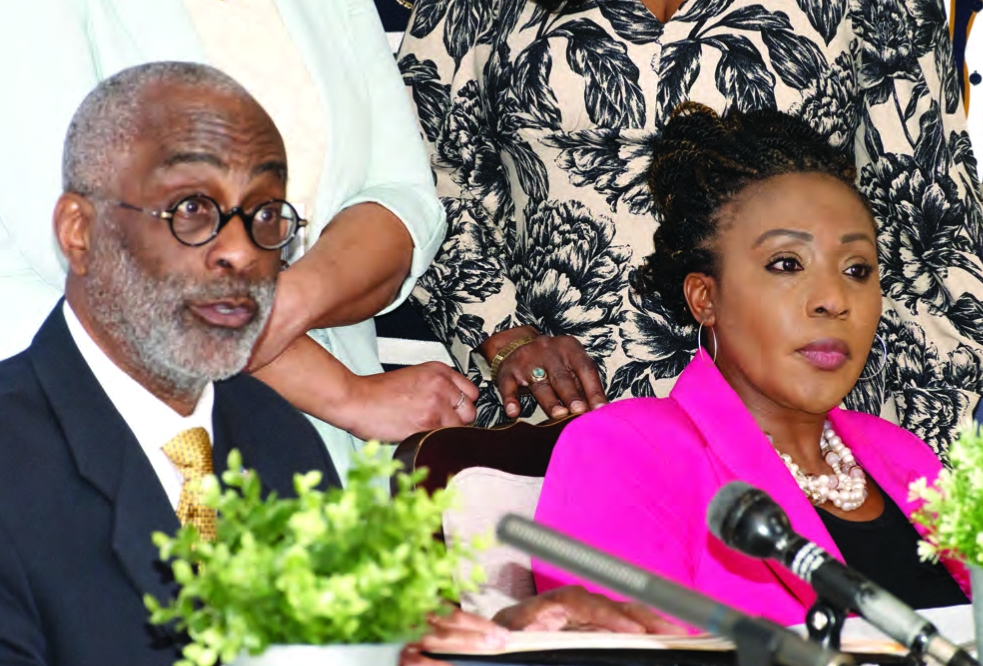
Joseph
Feaster (left) receiver at the Edgar P. Benjamin Healthcare Center, and
Delicia Mark, the facility’s administrator, at a press conference at
the center, March 6. The two have been trading allegations as the center
announces financial limitations that, without an infusion of money, may
precipitate a buy-out or closure.
New reports from the receiver at the Edgar P. Benjamin Healthcare Center cast doubt on the center’s ability to continue long-term operations in its current form.
At a hearing on the receivership on April 2, Joseph Feaster, who was appointed by the court to oversee operations at the Mission Hill facility, said that per a budget drawn up by the center’s administrator, the center will see an estimated monthly deficit of at least $420,000 per month, with an estimated total shortfall of $5 million.
In a report filed with the court on March 24, Feaster said that without a major infusion of money, as receiver, he will likely have to consider closure of the facility or a buyout to another operator. Multiple companies, he said, have reached out looking to provide estimates.
But Justice Christopher Belezos, who presided over the April 2 status conference, said that the future of the facility should be worked out soon.
“We can’t keep going in this fashion,” he said at the hearing.
The long-term operations of the facility have been a lingering question since the court-ordered receivership in April 2024 pushed out former administrator Tony Francis, who announced plans in February 2024 to close the center by the summer, citing insurmountable financial difficulties.
A key question raised at the status conference on the receivership on April 2 was that of the mortgage on the building.
It had long been reported to be mortgage-free. In the late 1990s, when the facility was then in danger of closing after falling behind on mortgage payments, the center’s administrator Myrna Wynn and board chair Perry Smith reportedly got support from then- Rep. Joseph Kennedy II, who pressured Prudential Insurance, which held the mortgage, to tear up the document.
The
supposed lack of a mortgage had been presented as a key piece of
leverage for the center as the state has sought to not have to provide
funding to support the facility’s receivership costs, accounting fees
and legal costs to pursue a civil lawsuit against former administrator
Tony Francis, who current leadership at the facility allege stole and
embezzled over $3 million during his 10 years leading the Edgar
Benjamin.
The
state has asked not to have to pay for those efforts, which Edgar
Benjamin has been seeking through Mass- Health advances. Feaster and the
attorney for the guardians of residents at the facility who first sued
for the receivership argued that if the state has concerns about the
advances, it should place a lien on the facility to make sure any
payments are later recouped. That plan was tied to the status of the
facility as being mortgage-free.
“This
is a very significant liability,” Belezos said. “The presence or
absence of it may make the difference between long-term viability.”
Feaster and his attorney said that they were tracking down information on the mortgage.
Another question about the center’s prospects of long-term stability is the number of beds available at the facility.
Feaster
and center administration have long cited those numbers as 91 licensed
beds — though the facility had 164 beds before COVID-19-era guidelines
required that a room only hold two beds.
As of March, the center had 79 residents.
But, in an affidavit filed with the court, Stephen
Davis, director of the state Department of Public Health’s Division of
Health Care Facility Licensure, said that he confirmed at the end of
March with Delicia Mark, the center’s administrator, that the center
should actually have 122 available beds, using only double-occupancy
rooms.
Moreover,
following the release of the guidelines, several care facilities in the
state filed a civil action against the Department of Public Health
leading to a system where facilities can file waivers to be exempt from
the double-occupancy requirements.
Davis,
in his affidavit, said that no one from the Edgar Benjamin’s leadership
has filed a waiver seeking permission to continue three- and four-bed
rooms, nor had they informed the department they were permanently
reducing the facility’s licensed bed quota.
The financial concerns come as elements of the receivership face levels of opposition both from within the facility and without.
In
a letter handed to the court before a hearing on March 19, Mark alleged
that Feaster, alongside Diane Wilkerson, who serves as his executive
assistant as receiver, has created a hostile working environment at the
center. A second letter from Mark was given to the judge before the
April 2 hearing.
A
separate document, from an unknown number of anonymous staff members at
the facility, which was given to the judge at the same time as Mark’s
first letter, alleged Wilkerson improperly hired family members to work
at or do jobs for the Edgar Benjamin.
In
affidavits filed with the court on April 2, Feaster and Wilkerson
denied the allegations and, in turn, alleged that Mark had demonstrated
an inability to do her job properly. Her allegations against them,
Feaster said in his affidavit were “retaliation from a disgruntled,
underperforming employee.”
Mark declined to comment.
The questions of the allegations and bed quota will be revisited in court in another hearing on April 16.
Feaster asked that those allegations be dealt with quickly, as the letters have complicated operations at the center.
“I’m ready to go,” Feaster said. “I’m ready because it is destabilizing.”
Separately,
since last year, the Massachusetts Attorney General’s Office has pushed
back on requests from Feaster and the Edgar Benjamin to pay advances
through MassHealth to fund the facility’s receivership costs, accounting
fees and legal expenses, as the facility pursues a lawsuit against
former administrator Tony Francis, alleging he stole and embezzled over
$3 million during his decade-long tenure heading the center.
Feaster has said that if the facility has to fund those efforts itself, it will put the center in financial jeopardy.
The
state, meanwhile, has argued that the law that creates the processes to
establish a receivership for nursing homes calls for expenses to be
paid out of the facility’s own finances.
In December, Superior Court
Justice Anthony Campo ruled that the state should continue paying the
advances. The attorney general’s office asked to modify that decision in
a request last month.
At
a March 19 hearing, Belezos told the Edgar Benjamin to hold off on
making new requests for advances to fund those measures. At the April 2
hearing, when Mary Freeley, assistant attorney general, requested that
the decision be made retroactive — to exempt the commonwealth from
paying any fees that were requested between Campo’s decision and the
pause — he declined.
“I
don’t think it’s fair that the receiver, in good faith, goes out and
obtains services, with this court order backing those services up, that I
should go back and reverse that court order after efforts have been
taken to obtain paid services,” he said.
If
the attorney general’s office considers the December order wrong, he
said, he encouraged them to appeal it, instead of asking him to modify
it.
Feaster has said that he feels the state has not been supporting his efforts to keep the facility running.
“I
want the [Department of Public Health] and the attorney general to work
with us to resolve the situation,” Feaster said during the hearing.
“But that’s not what I’m feeling or sensing throughout this entire
process — from the inception and even the comments today.”
Both
the Department of Public Health and the attorney general’s office
ultimately signed onto the request for the receiver, but only after
guardians of residents at the Edgar Benjamin sued for it. The process
established under state law allowed either body, first, to request a
receivership, though neither initially did.
Alongside
his concerns around the funding, Feaster took aim at a series of new
visits from a Department of Public Health Monitor, who has shown up at
the center unannounced, suggesting the monitor’s new presence — and
limited communication with him as a receiver — was disrespectful.
Freeley,
from the attorney general’s office, refuted the claim, citing that the
Department of Public Health, as the state agency that oversees nursing
homes and long-term care facilities, has an obligation to check in on
the facilities it licenses, especially those facing internal concerns
and allegations like the Edgar Benjamin is.
“It
is incumbent upon the Department of Public Health, which licenses
nursing homes, to get in there and to do inspections and surveys,”
Freeley said. “And they do that without notice to the facility to see
what the operations are. That happens in every nursing home across the
commonwealth, so there’s no disrespect to intended to the receiver.”
Freeley
said the state has the primary goal of ensuring patient and resident
safety, with secondary and tertiary goals of greater transparency from
the receiver and a successful emergency from the receivership.
As
the discussions proceeded, Belezos encouraged all parties not to lose
sight of the big picture: viability and continued care of residents.
“Some courtesy between the [attorney general’s office] and the receiver could go a long way,” he said.