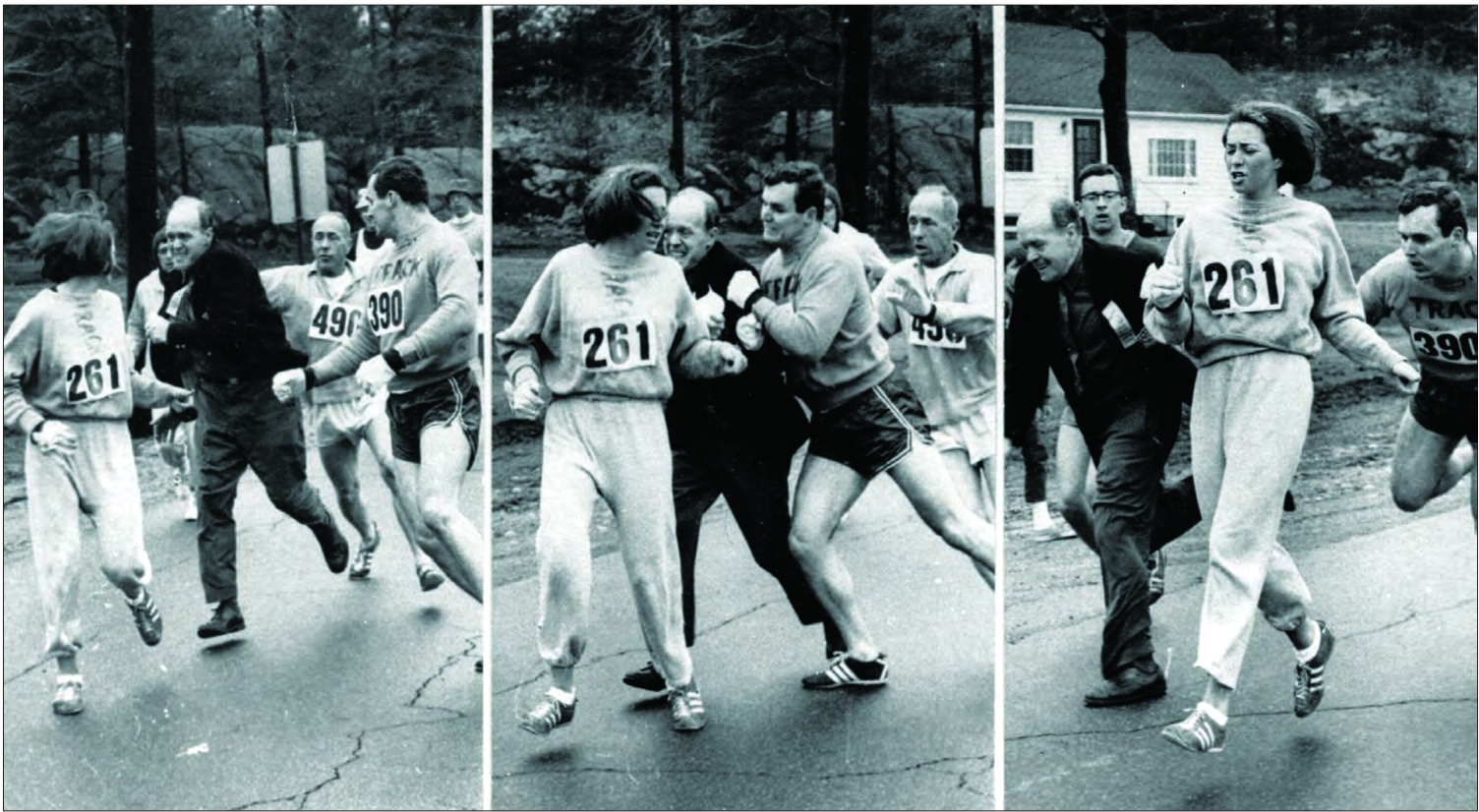
Katherine
Switzer being assaulted by race manager, Jock Semple, while running the
Boston Marathon in 1967. Switzer was the first woman to run the Boston
Marathon as a registered competitor.
Women’s weight room for the 2021 NCAA Basketball Championships.

Men’s weight room for the 2021 NCAA Basketball Championships.
As you enjoy the excitement, athleticism and aesthetic grace and beauty of this year’s NCAA Division 1 Women’s Basketball March Madness event, take a moment to look back at history to see how this all came into being.
The year was 1972, which is too far back in history for most of today’s young female athletes to comprehend. They would likely have to ask their mothers and grandmothers about the significance of Title IX.
For the record, Title IX of the Education Amendments of 1972, enacted by the U.S. Congress, is a landmark federal civil rights law prohibiting sex-based discrimination in any educational program or activity receiving federal funding.
Title IX ensures that no person in the United States is excluded from participation, denied the benefits of, or subjected to discrimination based on sex in any education program or activity receiving federal financial assistance. This civil rights legislation applies to all educational institutions, including schools, colleges, universities and other educational programs that receive federal funding.
Title IX hit the sports landscape like a giant bomb. College administrators’ reactions —
many claiming that there was insufficient money to fund men’s and
women’s sports programs —were also echoed in the high school and
lower-level sports programs. History has shown that the early opposition
to Title IX was entirely off base.
It
has enormously impacted high school, college and university sports.
Without it, women’s sports would not exist as we know them today.
Even
with Title IX legislation in place, its implementation has faced
significant legal challenges. Over the last 53 years since Title IX
became the law of the land, there have been many lawsuits filed for
Title IX violations in admissions, counseling and financial assistance,
among other areas.
But despite setbacks, Title IX has survived the test of time while opening doors to women’s athletics,
which were closed for many years. But the road to true equality with
men’s sports has not been realized. Over the past decade, the glaring
disparities in travel accommodations and training facilities and the
second-class treatment compared to men’s athletics in other areas have
let women know that their battle for equality is far from over.
As
recent as 2021, during the COVID-19 pandemic, the law wasn’t fully
realized, given disparities in facilities and amenities provided to
women’s and men’s basketball teams during the NCAA basketball
tournament, particularly regarding weight room access and other
resources.
A photo of
the women’s weight room at the San Antonio, Texas facility says it all.
Stanford women’s performance coach Ali Kerstner, the photographer of the
facility, said, “While the men’s weight room featured every
piece of equipment imaginable, the women’s weight room — if it can even
be called that — consisted of merely six pairs of dumbbells and a stack
of yoga mats.”
The
NCAA apologized and said, “When it is personal, it is as real as it can
get. It hurts. And when people passionately care about something — in
this case, women’s basketball — it is our responsibility to give them a
great championship experience and one they can be proud of.”
After
years of wrangling and coming off of a record-setting viewership for
last year’s women’s Final Four, the women’s tournament will have a
revenue-sharing payout structure. 18.7 million viewers watched the
championship game between Iowa and South Carolina, which gave momentum
to the revenue-sharing model.
According
to Sports Illustrated, “The men’s NCAA basketball tournament has paid
out ‘units’ for each spot in the bracket for more than 30 years. Those
payments are equivalent to a portion of annual television revenue, with
the money going to conferences, which eventually redistribute the cash
to schools.”
A total of $15 million will be paid out to the women’s teams. This means about $100,000 per women’s game in the tournament.
The pool will increase to $25 million by 2027.
It
is a long way from the day that Katherine Switzer made national news
when she was snatched out of the 1967 Boston Marathon by race manager
Jock Semple. Switzer was officially registered to run in the marathon
and finished despite Semple’s efforts. The Amateur Athletic Union took
the archaic stance of banning women from running against men until 1972,
when Title IX became law.
Switzer’s
courage and intestinal fortitude was a victory for women’s sports.
Title IX moved the progress needle higher. However, it must be pointed
out that with the current political climate in America threatening civil
rights and affirmative action, it won’t be long before Title IX comes
under fire. When that day arrives, women across America should again
march on Washington and make their voices heard. These are thoughts to
keep in mind as we enjoy the current NCAA Division 1 Women’s Basketball
March Madness competition. Thanks to Title IX, I can only think of how
many more young girls can dream of being the next star players in
sports.
You cannot
underestimate the impact of Title IX on today’s female pro and amateur
athletes. Sports are so much better because of it.