Dearborn
STEM Academy is one of two Roxbury schools that will have solar arrays
repaired and optimized using funding from the state’s Green Communities
Grant program. The funds, part of a $189,000 award to the city of
Boston, is one of the first under the 15-year-old program used to repair
green technology rather than install it.

Two Roxbury schools will get improved solar panels using state funding aimed at improving energy efficiency in municipal buildings.
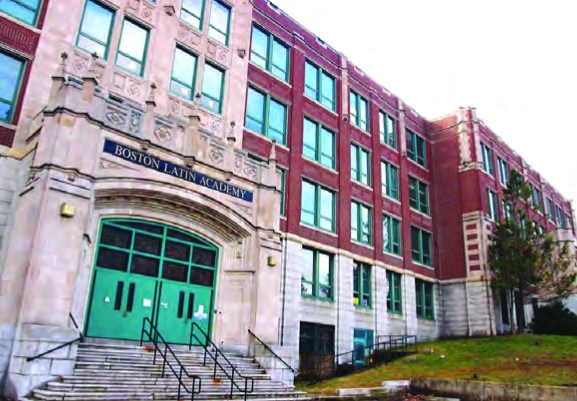
Solar systems at Dearborn STEM Academy and Boston Latin Academy will see repairs and improvements of their arrays as part of a $189,000 grant through the Massachusetts Department of Energy Resources’ Green Communities Grants program, which supports towns and cities across the state.
“We’ve got municipalities across the commonwealth that are really focusing in on how can they improve the building health and energy use of municipal buildings but also demonstrate to their constituents or citizens about what can be done, what’s feasible and what delivers results,” said Elizabeth Mahoney, commissioner of DOER.
The repairs — which will replace failed inverters, rewire panels and update software at the arrays on both schools, as well as the city’s archive building in West Roxbury — are expected to increase solar production by nearly 177,500 kilowatt-hours.
According to the U.S. Energy Information Administration, in 2022 the average home used about 10,800 kilowatts-hours per year.
According to DOER, the city plans to engage students from Madison Park Technical Vocational High School to learn about and be involved in the repairs as part of an effort to encourage them to enter the renewable energy jobs field.
The award of $189,000 directed toward the city is part of more than $7.2 million in grants from the Department of Energy Resources to 42 cities and towns across the state in this round of funding. The program generally has two rounds of funding per year, with approximately $15 million expended overall, Mahoney said.
State officials celebrated the progress on energy reduction initiatives that the program supports.
“Cities and towns are slashing their energy bills and leading the fight against climate change,” Energy and Environmental Affairs Secretary Rebecca Tepper said in a statement. “We’re proud to invest in their leadership.”
Officials said the grants will support projects that reduce reliance on fossil fuels and more broadly lower energy demand.
“These projects will ultimately save people, businesses and municipalities money and will help Massachusetts achieve energy independence,” Gov. Maura Healey said in statement.
In this round of funding, the Department of Energy Resources touted the role that the grants are slated to have toward fuel-switching projects — replacing fossil-fuel-fired HVAC or water heating systems with air- or ground-source heat pumps. Seventeen of the projects funded through the grants will tackle those efforts, reducing greenhouse gas emissions by an estimated 283 tons annually.
While the state funding will not support heat pump efforts in Boston, the technology has
been a recent hot topic. Mayor Michelle Wu, in her 2025 State of the
City address, announced an agreement between the city and Eversource and
National Grid to set shared goals of installing at least 5,000 heat
pumps across the city from 2025 through 2027 in an effort to increase
efficiency and lower energy costs for residents.
The
grant program directs money to communities across the state to fund
projects aimed at reducing energy use in municipal operations. The state
has run the program since 2010.
The
funding program is an important way of getting energy reduction efforts
out in a way that communities will interact with them, Mahoney said.
“Municipalities
are really on the front line of providing services to citizens,” she
said. “We know that residents and businesses use municipal buildings.
They send their children to school; seniors are going to Council on
Aging; public meetings are being held at town halls. We want to make
sure that the buildings that our public is going into is healthy, that
they are using the most efficient use of energy in the buildings and
that, ultimately, we’re reducing costs to operate these buildings.”
The funding also can help make initiatives like the solar efforts in Boston more accessible, even when budgets are tight.
“We
know that municipal budgets are stretched so thin and that any help we
can give them to reduce their energy costs throughout the year filters
down to everybody,” Mahoney said. “By investing in these projects, we’re
hopefully investing in communities.”
To
be eligible for the program, municipalities must meet criteria set out
by the state law that established it in 2008 — including requirements
around zoning and permitting of renewable energy infrastructure,
increasing hybrid and electric vehicle use and reducing energy use in
municipal buildings and facilities by 20%.
Currently
297 of the state’s 351 municipalities qualify as green communities.
Mahoney said the state is hoping to the 300 mark this year.
Those
criteria were the most pertinent ones in 2008, when the program was
created, Mahoney said, as some of the clean-energy areas that were most
lacking or challenging for municipalities.
They’re
still important, she said, as “maybe some of the key pillars on the
focus on clean energy, netzero and decarbonization across the board.”
But the Department of Energy Resources is also looking to grow the
state’s programming and support municipalities that have already met the requirements to qualify as a Green Community.
The
Climate Leader Communities program, which the department launched in
following new goals outlined by a 2021 law and the state’s 2022
Massachusetts Clean Energy and Climate Plan for 2025 and 2030, turns
focus from energy reduction to greenhouse gas reduction.
To
qualify for that program, municipalities must be state-recognized green
communities, as well as meet other requirements, like having a local
committee focused on clean-energy activities, making and working toward a
decarbonization commitment and prioritizing zero-emissions vehicles.
“We’re trying to evolve while also still providing this really terrific program for our 351 communities,” Mahoney said.
But
there’s also change within the Green Communities Grant program updating
it and helping it better serve communities across the state, Mahoney
said.
In receiving
this grant, Boston is one of the first — alongside Norfolk — to be able
to access the funds for the maintenance and improvement of existing
green energy technology.
That shift makes Boston’s award this round exciting, Mahoney said.
“Because
we have been doing this program for so long, we know that there’s going
to be a second wave of attention on buildings and clean-energy systems
in these municipalities,” she said.
These kinds of repairs are a new allowable use under the grant program that other communities can use moving forward.
“We’re
really excited that communities are taking a fresh look at what they
have on their buildings and that we can provide the help to make those
systems better,” Mahoney said.


