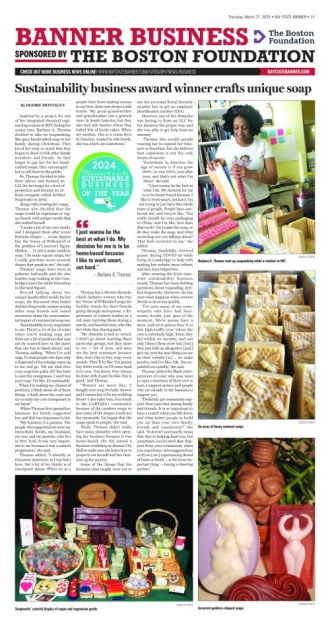
Barbara A. Thomas took up soapmaking while a student at MIT. 
An array of honey oatmeal soaps

Assorted goddess-shaped soaps
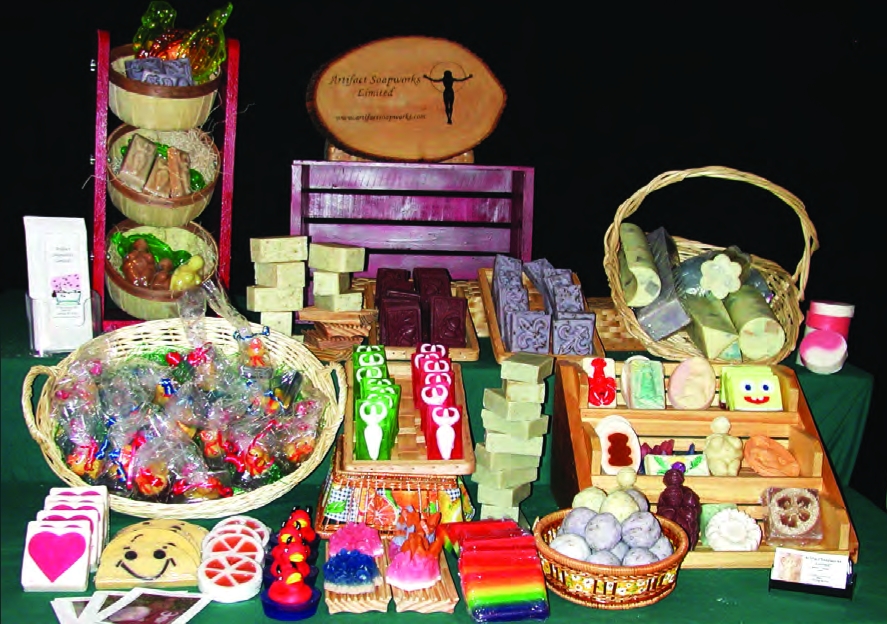
Soapworks’ colorful display of vegan and vegetarian goods
Inspired by a project for one of her integrated chemical engineering courses at MIT during her senior year, Barbara A. Thomas decided to take on soapmaking. She gave handcrafted soap to her family during Christmas. They loved her soap so much that they began to share it with other family members and friends. As they began to pay her for her handcrafted soaps, they encouraged her to sell them to the public.
So, Thomas decided to take their advice and formed an LLC for her soaps for a level of protection and became an official company called Artifact Soapworks in 2002.
Along with creating her soaps, Thomas also decided that the soaps would be vegetarian or vegan-based, with unique molds that she crafted herself.
“I make a lot of my own molds, and I designed them after iconic feminist shapes … iconic figures like the Venus of Willendorf or the goddess of [ancient] Egypt, Hathor. … [I also] make rainbow soap. I do make square soaps, but I really gravitate more towards shapes that speak to me,” she said.
Thomas’ soaps have been in galleries nationally and she also teaches soap making at the Cambridge Center for Adult Education in Harvard Square.
Beyond talking about her unique handcrafted molds for her soaps, she discussed what makes Artifact Soapworks unique among other soap brands and raised awareness about the environmental impact of commercial soap use.
“Sustainability is very important to me. There’s a lot of use of water when you’re making soap and there are a lot of products that may not be sourced here in the states that one has to think about,” said Thomas, adding, “When I’ve sold soap, I’ve had people who have only a fingernail of knowledge come up to me and go, ‘Oh my God does your soap have palm oil? You have to save the orangutans. I can’t buy your soap.’ I’m like, it’s sustainable. … When I’m making my choices of products, I think about all of those things. I think about the costs and try to make the cost transparent to my buyer.”
When Thomas first opened her business, her family supported her, and this was important to her.
“My business is a passion. The people who supported me were my immediate family, my husband, my son, and my parents, who live in New York. It was very important to me because it was a natural progression,” she said.
Thomas added, “I identify as Guyanese American, so I was born here, but a lot of my family is of immigrant status. When we as a people have been making
money in our lives, there was always a side hustle. My great-grandmother
and grandmother ran a general store in South America, but they also had
side hustles where they baked lots of lovely cakes. When my mother, who
is a nurse here in America, wanted to side hustle, she was a kick-ass
seamstress.”
Thomas
has a diverse clientele, which includes women who buy her Venus of
Willendorf soaps for fertility rituals for their friends going through
menopause, a department of women studies in a red state carrying them
during a march, and bearded men, who like her white disc shaving puck.
“My clientele is just so varied.
I
didn’t go about reaching those particular groups, but they came to me —
lot of men, and men are the best customers because they don’t like to
buy soap every month. They’ll be like ‘I’m gonna buy $300 worth, so I’ll
come back next year.’ You know, they wanna be done with it and I’m
like, this is good,” said Thomas.
“Women
are more like, ‘I bought your soap for baby shower and I wanna buy it
for my wedding favors’ I also cater very, very much to the LGBTQIA+
community because of the rainbow soaps or just some of the shapes [such
as] the mermaids. I’m happy that the soaps speak to people,” she said.
While
Thomas didn’t really have many obstacles when opening her business
because it was home-based, she did attend a business workshop at Boston
City Hall to make sure she knew how to properly set herself and her
business up for success.
Some
of the things that the business class taught were not to use her
personal Social Security number but to get an employer identification
number (EIN).
However,
one of her obstacles was having to form an LLC for her business the
proper way, and she was able to get help from an attorney.
Thomas
also recalls people wanting her to expand her business or franchise,
but she believes that expansion is not the only means of success.
“Sometimes
in America, the sign of success is if you grow 100%, or over 100%, year
after year, and that’s not what I’m about,” she said.
“I
just wanna be the best at what I do. My decision for me is to be
home-based because I like to work smart, not hard. I’m not trying to
just have this whole team of people. People have contacted me, and
they’re like, ‘You really should do your packaging in China,’ and I’m
like, how does that work? Do I make the soap, or do they make the soap,
and what sweatshop are you talking about? That feels incorrect to me,”
she added.
Thomas,
thankfully, received grants during COVID-19 while living in Cambridge to
help with making her website more robust, and they have helped her.
After
winning the 2024 statewide sustainability business award, Thomas has
been fielding questions about expanding Artifact Soapworks. However, she
has seen what happens when owners decide to do so too quickly.
“I’ve
seen many of my counterparts who have had businesses decide, just spur
of the moment, ‘We’re gonna have a store, and we’re gonna have it in
this high-traffic area’ where the rent is extremely high. Then, they
fail within six months; and not only [does] their store fail, [but] they
just fold up altogether [and] give up, and the next thing you see on
their website [is] ... we make jewelry, and I’m like, OK. You expanded
too quickly,” she said.
Thomas’
advice for Black entrepreneurs of color who may want to open a business
of their own is have a support system and people who are already in the
business to support you.
“Definitely
get community support. Run your idea among family and friends. It is so
important to have a crutch when you fall down, and what better people
to build you up than your own family, friends and community?’ she said.
“It doesn’t necessarily mean that they’re helping fund you, but
sometimes you do need that. Support from your community when you
experience microaggressions or if you [are] experiencing denial of loans
or funds ... is the most important thing — having a cheering section.”