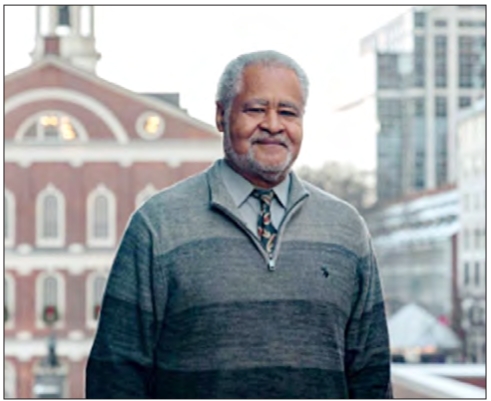
Robert “Bob” Terrell IIIRobert “Bob” Terrell III, an educator, lifelong public servant and advocate of fair housing for Boston residents, passed away on Jan. 29 at 73.
Terrell was born in Boston on June 12, 1951, to Robert L. Terrell II and Mildred A. Terrell. He graduated from Boston Latin School in 1970 and earned a bachelor’s degree in government and sociology from Bowdoin College in 1974.
From 1998 to 2007, Terrell served as executive director of the Washington Street Corridor Coalition, where he was responsible for overseeing the daily administrative operation of a multi-neighborhood coalition representing Chinatown, the South End, Roxbury, Jamaica Plain, Dorchester and Mattapan to advocate decent replacement transit service along the Washington Street Corridor after the Boston El came down.
Terrell was awarded a master’s in public policy from Tufts University in 2012 and lectured part-time in its Department of Urban and Environmental Policy and Planning.
In 2020, Terrell was the architect of the first-in-thenation fair housing zoning ordinance in the city of Boston.
In January 2023, he was appointed executive director of Boston’s Office of Fair Housing and Equity, which
works to enforce local, state and federal fair housing laws in Boston,
protects renters and buyers from discriminatory practices, and ensures
equitable access to Boston’s housing stock.
“Any
time you take money from HUD, one of the things you have to promise is
that you will uphold the Fair Housing Act, and you will use those funds
in a way to create more inclusive communities and to fight
discrimination and segregation in our housing market,” Terrell said in
2023. “We made sure that the Office of Fair Housing and Equity would be
the city agency that would monitor and oversee the implementation of
that assessment of fair housing.”
Terrell
looked upon civil rights and fair housing work as a sacred trust and
assured everyone in Boston that he would do his utmost to combat housing
discrimination in whatever form it took.
“If
you’ve ever been unjustly denied housing because of the color of your
skin, the language you speak, the country you come from or whom you
choose to love, our office is here to stand with you,” he said. “We will
enforce our fair housing laws justly, uphold the rights of our
protected classes, and we pledge to do so under all conditions and at
all times.”
“As
executive director, Bob led our Office of Fair Housing and Equity the
only way he knew how,” said Mayor Michelle Wu on Feb. 13, “with a fierce
love for the people of the city that raised him, and a quiet conviction
to knock down anything that stood in the way of all of us thriving.”
“That was his life’s mission,” added Wu. “And he
lived it — from his leadership on the Roxbury Neighborhood Council and
the Washington Street Corridor Coalition, to the Citizens Housing and
Planning Association and the Boston Branch of the NAACP.”
Prior
to working as executive director of Boston’s Office of Fair Housing and
Equity, Terrell served as the fair housing, equity and inclusion
officer for the Boston Housing Authority’s Office of Civil Rights, where
he helped develop the BHA’s Racial Equity and Social Justice
Initiative.
Terrell
also previously served as the executive director of the Fair Housing
Center of Greater Boston and spent five years working in Boston City
Hall — three of which at the Fair Housing Commission (FHC) as manager of
the affirmative marketing program. He was tasked with getting the FHC’s
substantial equivalency legislation through the Boston City Council and
the Massachusetts Legislature, permitting the Commission to exercise
the same powers and remedies that the Department of Housing and Urban
Development does.
Terrell
held numerous leadership positions in other local organizations as
well, such as the Roxbury Neighborhood Council (formerly the Greater
Roxbury Neighborhood Authority), the Madison Park Development
Corporation Board of Directors, the Citizens Housing and Planning
Association (CHAPA), and the Boston Branch of the NAACP, among others.
And he received many awards for his exemplary service, including CHA-
PA’s Public Policy Award in 2021, bestowed on a member who represents
leadership in ending housing discrimination and ensuring that people
have meaningful choice where they live, and Tufts’ Graduate Alumni
Outstanding Career Achievement Award in 2023.
Dwayne
Watts, deputy director of the Boston Fair Housing Commission and a
close friend and mentee of Terrell, said, “Bob was a titan. When it came
to civil rights, he was about that life. He loved Roxbury, was a true
defender of Roxbury residents and wanted the most for Roxbury.”
Roxanne
Chandler-Hook, who describes herself as “Bob’s sister of the heart,”
said he was “monumental in fair housing in the city of Boston.”
“Bob
really didn’t realize the effect he had on the community. He just did
the work. He was very humble, yet very direct,” said Chandler-Hook,
adding, “He would keep immaculate notes and everything he did had a
meaning. He also was a lover of books and would always say, ‘I’m just a
humble servant.’”
Penn
Loh, a close colleague and good friend of Terrell, began working with
him in the late nineties. He said, “Bob was someone who really
represented what our department at Tufts was about, someone who had big
ideas and a big vision and was doing the hard work to get us there. Loh
described Terrell as “a consummate gentleman who was always so poised
and well spoken. It was very hard to get him off his game.”
“To
me, he was such an inspiration and led by example,” said Loh. “He would
plant seeds in people’s heads. He would say, ‘Hey, what about this?
What about that?’ He had that way of guiding and directing folks without
making them feel like he told them to do it.”
“We
always talked about how to move Black Boston forward,” said Zakiya
Alake, another friend and colleague. “Bob would invite me to be a part
of the activities he was working on, like the Black Political Task
Force.
“He got his own
weekly talk show,” Alake added. “Bob was one of the first of us
community activists to use the media as a platform to teach people about
zoning regulations and how to protect Roxbury from zoning, and he
connected it to political organizing. If we elected the right people,
they could push an agenda forward, craft an agenda and push it forward. I
don’t think there are many activists who have done that successfully.”