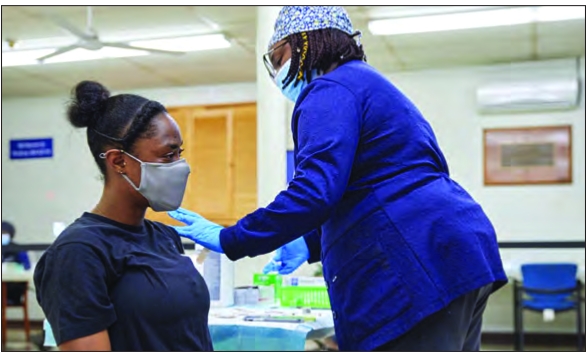
Communities of color and vulnerable populations were most at risk of contracting COVID-19 and dying.When Americans rang in the new year in 2020, most had heard little about a mysterious virus with pneumonia-like symptoms sickening — and killing — people in Wuhan, China. A little more than three months later, on March 11, 2020, the World Health Organization declared a “Public Health Emergency of International Concern.” Two days later, on March 13, 2020, President Trump declared a national emergency. Millions of Americans contracted the virus, and more than 1 million died.
Amid the chaos of searching for hand sanitizer and toilet paper, the misinformation and disinformation about masking and vaccines, and the crushing loss of life, Black communities fought to protect themselves and their loved ones. As was heavily reported, communities of color and vulnerable populations were most at risk of contracting the virus and dying. In the first 12 months of the pandemic, Black people died at 1.4 times the rate of white people. By Sept. 2023, the official COVID-19 death toll was 1,147,000 Americans, with Black Americans making up 157,169 deaths.
In a February report by the Pew Research Center, the think tank surveyed thousands of U.S. adults on the five-year impact of COVID- 19. American adults, regardless of political affiliation, are more likely to say people in the community would do a better job of handling a future health emergency than the public health system. And most Americans feel we would do better or about the same in response to a future health emergency.
Do Black folks who were on the front lines during the
height of the pandemic agree? We wanted to know what it was like for
these health care workers as the pandemic unfolded. Five people told us
how it reshaped their lives, careers and perspectives. Their stories,
edited for clarity and brevity, reveal the toll of the pandemic and the
resilience it demanded.
Dom Donnay, 22, Charlotte, North Carolina
Public Health Graduate Student
I
was in my senior year of high school. I remember the exact day, it was
Friday, March 13, 2020, when they said to stay home for the rest of the
school year.
I already
had my plan to attend college right after I graduated. I always knew I
wanted to become a physician. COVID really took away that undergraduate
experience. We had to transition back to in-person classes the fall of
2021. I wasn’t ready for that transition.
In
2021, I started my career in emergency medical services, and prior to
that I was working as a pharmacy technician. It might sound crazy, but
going to work was my stress reliever. Everything that I was dealing
with, I was able to put behind me and focus on my patients.
I
felt like I didn’t want to finish my degree at Syracuse University. But
at the same time, I knew I needed this education to become a physician.
The
feeling of gratitude that I get when I’m able to help somebody and make
someone’s day better — that helped me get through it. I was able to
change a life. And I’ve always been able to reach out to friends and
family for support.
I
think we have a lot of work to do to repair the health care system.
There was a lot of burnout and a lot of people left. Even now, we talk
about in our public health classes, we don’t know what the future is
going to look like. DEI in health care and in education is under attack.
We don’t know what type of opportunities are going to be out there.
We’re all applying for doctoral programs, jobs and fellowships — but all
we see is funding being rescinded because of the current
administration.
Ayrenne Adams, 36, New York City
Primary Care Physician
I
first started hearing about COVID in winter 2019. I was in the last
year of residency training in Boston. In February or March, I was doing a
shift in the emergency department, and it was weird. Usually, patients
come to the emergency department for everything, but the first week it
was so quiet. And then we started getting these patients who were really
sick. In residency, in your third year, you kind of know what to do.
But we didn’t know a lot. There was a lot of uncertainty.
There
were times when the attending physician didn’t want to go into the
patient’s room, so they had the resident go in — in a time where we
didn’t always have enough protective equipment, so we were reusing
masks. They were sending the lowest powered person into the room.
Other
members of the hospital were able to say they don’t feel comfortable or
to ask for more protection, but as residents we weren’t afforded that.
It just showed that health care is very much like a business. I was very
replaceable. That was a huge wake-up call for me.
As
COVID became more prevalent, you saw the patients we were caring for
shift to becoming more Black and brown patients. Despite our hospital
being in a predominately Black and brown community, that was not our
predominant patients in our hospital before COVID. It was a physical and
visceral representation of the inequities of who was getting COVID.
I’ve
always been very focused on health inequities and vulnerable patient
populations. It was really hard for COVID to coincide with the racist
police murders of Black men and Black women and the public recognition
and acknowledgment of that.
I’ve
learned that systems and people can say a lot about what they support
and what they want to happen, but is there money and budget to further
racial equity?
Now, I
think it’s scary that we’re moving away from acknowledging racism. When
the other pandemic comes, because that’s what pandemics do, I worry
we’ll see the same disproportionate effect. Having been on the front
lines, it’s just sad.
Tyesha Brower, 29, Maryland
Health Care Analyst
I was in one of my health classes at Towson University when my professor made the announcement.
That
following week, we all went remote. As a student majoring in health
care management, I was inundated with information from every possible
channel, leaving little time to fully process everything
On
the health side of things, it made me realize how it’s so important as a
health care professional to be flexible and to adapt. I worked at a
skilled nursing home and assisted living facility during COVID.
It was a lot of uncertainty, but I was never afraid. It taught me the importance of having a backup plan.
I thought about what I can do.
So,
I started my nonprofit. I went back to where my parents are from, in
Guyana. I donated medical supplies, masks and hand sanitizers.
I
went on to get my master’s with a focus in health care management. But
it did take a toll. The isolation aspect of it, and seeing patients pass
away, even friends and family dying. I was trying to balance this
entire sense of loss while trying to graduate.
It
was overwhelming. I used to walk a lot to free my mind. I tried to stay
connected with friends and family. We still had Zoom calls. It was very
important for my sanity.
Moving
forward, I would know what to do if we have another pandemic again.
Everything that happens teaches me something or equips me with something
I will need in life and in my future.
Kaéche Liburd, Palo Alto, California
Writer
There is pre-COVID me and post-COVID me. As a Black woman who presents with tightly coiled,
kinky, short hair and a nose that rivals a church bell, I am very much
aware that my phenotype has always had a certain distress placed upon
it.
In 2020, COVID
made me an official steward of my health. It forced me to be the
authority of my own health, because there were so many conflicting
messages.
I had to tap into intuition, and sometimes intuition doesn’t seem logical.
However,
our people have a very tattered past dealing with health institutions.
So, I think so many things were accelerated with the pandemic of our
lifetime.
I was
working at University of California Los Angeles hospitals and clinics,
on the operations side. I was masked in the clinic and in my house,
because I had roommates. When I wasn’t satisfied with the precautions of
my roommate, I found an apartment on my own. So, I spent most of the
pandemic solo.
I did
not want to be a patient in the health care system. I grew up watching
my grandmother manage chronic conditions. In the U.S. Virgin Islands,
most of our providers look like us. But I just knew that institutions
were not necessarily built to function to our health needs.
In L.A. there’s always a siren and traffic but during COVID you could see blue skies and the clouds instead of shades of gray.
Pre-COVID I had a certain hustle that wasn’t always rational but was very urgent.
It
persisted until I had to stop everything. When all these superficial
things fell away, I had a mini-identity crisis. That was fracturing in a
way.
We’re still
navigating a pandemic of social sorts. I often think about this question
moving forward: How will we wage this socioeconomic fight in a way that
will render both our ancestors and our progeny safe and proud?
This article first appeared on WordinBlack.com