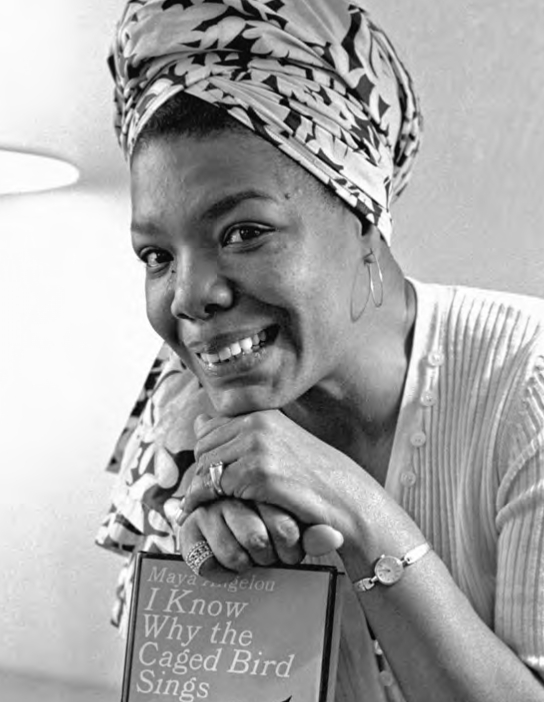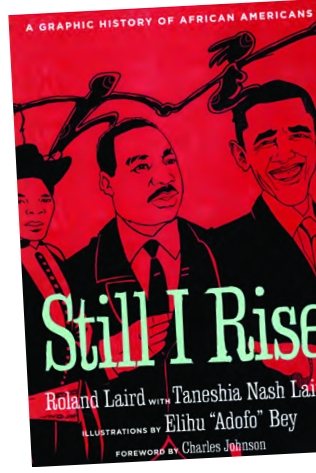
Maya Angelou with a copy of her book “I KNow Why the Caged Bird Sings,” 1971. As I reflect on Black History Month 2025, I’m reminded why my late husband, Roland, and I wrote “Still I Rise: A Cartoon History of African Americans,” followed by our updated edition “Still I Rise: A Graphic History of African Americans.” With artwork by our collaborator Elihu “Adofo” Bey, our fully illustrated narrative histories sought to tell the story missing from traditional American history texts by centering the Black experience using stories and perspectives often excluded from mainstream accounts. While both editions are out of print, our literary mission feels more urgent today than ever. The past isn’t just static history; it’s context for our present and guidance for our future.
Roland and I documented not just the systematic obstacles our community faced — from chattel slavery to Jim Crow to redlining and more — but we also celebrated our ancestors’ creativity and fortitude in overcoming these seemingly insurmountable barriers.
Inspired by Maya Angelou’s poem “And Still I Rise,” our title was about celebrating how the Black community has historically responded to pushback against progress by creating our own pathways to excellence and finding joy as a form of resistance.
Our books traced how skilled African Americans who bought out their indenture contracts faced a white backlash that led to the institutionalization of slavery yet still found ways to preserve their humanity and build community. From the mutual aid societies of the 1800s to the Civil Rights Movement’s grassroots organizing, Black Americans have consistently turned adversity into opportunity through collective action.
Our first book ended with the Million Man March. When Sterling Publishing asked us to create an updated edition in 2008, extending the narrative through Barack Obama’s historic presidential campaign, it reinforced what we already knew — that our history continuously unfolds. Now, as conservative forces work to erase this factual information from classrooms and deny the lasting impact of structural inequality, our mission of documenting Black resistance and celebrating Black resilience becomes increasingly crucial.
Just as our books sought to fill crucial gaps in historical documentation, this living history continues to be chronicled through essential community institutions that carry forward the same mission. The Bay State Banner, founded in 1965 during the height of the Civil Rights Movement, exemplifies our tradition of preserving and amplifying Black stories. Like the illustrated narratives we created to make Black history more accessible, the Banner has spent six decades ensuring our community’s voices are heard and our stories are told by us, for us.
So, as we conclude our celebration of Black History Month 2025, let’s remember that our history is a living blueprint for navigating present challenges. Whenever someone claims that efforts to create inclusive spaces are divisive, we can point
to countless examples of how diversity has strengthened institutions and
enriched our nation. When they say equity initiatives are unnecessary,
we need only look at the persistent racial wealth gap. The needle hasn’t
moved significantly in the decade since the Federal Reserve Bank of
Boston found that the median net worth of a white family in Greater
Boston was $247,000, while the median net worth of a Black family was
just $8. In fact, studies show that nationally the gap is widening, a
direct legacy of centuries of policies and practices that systematically
denied Black Americans the opportunity to build and transfer wealth
across generations.
Looking
forward, our task is clear. Let’s continue to document our stories,
celebrate our achievements, and maintain the networks of support that
have always been our strength. The attacks on programs promoting
fairness and inclusion aren’t new. They’re just the latest chapter in a
long history of resistance to progress. But like those who came before
us, we’ll respond not with despair but with determination, not with
retreat but with renewal and, most importantly, with joy.
Throughout
our history, this spirit of determination has always manifested in
practical, community-based action. From building independent financial
systems to establishing networks of civil rights organizations, our
community has consistently turned bold visions into tangible change.
Today, we have the opportunity to continue this legacy of turning
inspiration into action.
Our determination and joy must take tangible form through our actions. Just as our ancestors built mutual aid societies
and grassroots movements, we, too, must create practical pathways to
progress. Here are some concrete ways we can do that: First, commit to
supporting Black media and cultural institutions. While the Banner is
free to ensure broad community access, we can help ensure its legacy
continues through advertising support. Become a member of the Museum of
African American History of Boston and Nantucket, which preserves and
shares the rich legacy of African Americans in New England. Support
organizations digitizing Black archives and oral histories. Second,
invest directly in economic empowerment. Black Owned Boston maintains a
free directory of 1,600 Black-owned businesses across Massachusetts,
with a focus on Greater Boston. Use it to intentionally redirect your
spending. Third, engage in documentation and education. Record your
family’s oral histories. Volunteer with programs teaching Black history
in schools. Share Black-authored books with young people in your life.
As
“Still I Rise” illustrates through its pages, the story of Black
America is one of beauty and spiritual endurance. But this story
requires each of us to be active participants, not just celebrating our
history but consciously acting in ways that ensure future generations
thrive. Today, we continue to rise not just through abstract concepts of
joy and community, but through deliberate, sustained action to preserve
our stories, build our economic power and defend our right to teach our
full history.
Taneshia
Nash Laird is the executive director of Project REAP, a nonprofit
dedicated to advancing opportunities for professionals of color in
commercial real estate through education and industry engagement.
Leveraging her extensive career developing and operating cultural
facilities, she also serves as an associate professor in the Africana
Studies Department at Berklee College of Music where she teaches
“Entrepreneurship in Black Creative Expression.”