On the second floor of the Metropolitan Museum in New York, within the Contemporary and Modern Art wing, I noticed a sphinx’s nose displayed on a shelf in the gift shop. Nearby, ten rooms were dedicated to “Flight into Egypt,” offering a distorted yet compelling lens into the history of Egyptophilia within Black America and across the global African diaspora. I studied the nose with interest: I couldn’t tell if I was intrigued or disgusted.
A Nas lyric swam into the forefront of my consciousness: “Shot off their nose to impose, what basically/still goes on today, you see.” In a later conversation, a colleague reflected, “There are tens, if not hundreds, of conversations happening within the exhibition.” What I saw on the shelf in the gift shop, a disembodied and decontextualized nose, reflected a deep ambivalence to the very real stakes faced by Black artists and communities reaching for Africa, from the time of Meta Warrick Fuller through to contemporary artists like Eric N. Mack and Lauren Halsey. This tension calls to mind the precarious position of early 19th-century Black scholars and artists who dared to claim ancient Egypt as their inheritance at a time when Egypt stood as both a beacon of Black excellence and a cornerstone of the white cultural imagination of civility.
By foregrounding the
19th-century engagement with Egyptology, we can see how notions of Black
Power — often associated with militancy, separatism, and Afrocentrism —
have always contained intellectual, cultural and historical dimensions
that stretch across time and geography.
African
Americans turned to Egyptology in the 19th century as a means of
intellectual and cultural reclamation, positioning ancient Egypt as both
a symbol of Black greatness and a refutation of white supremacist
narratives. For Black thinkers like David Walker and Martin Delany, the
grandeur of Egypt was not merely an abstract source of pride; it was a
strategic intervention in an ongoing historical dispute.
To
claim Egypt was to challenge not only the dehumanizing narratives of
American slavery but also the very foundations of Western
historiography, which sought to erase African contributions from world
history.
This ideological struggle would reverberate across time,
shaping the intellectual foundation of later movements for Black
self-determination — including Pan-Africanism, the New Negro Movement,
and ultimately, Black Power. This re-narrativization replaces Africa
from the margins to the center of history, and places Black people at
the center of our own world — a world in which we could claim membership
amongst both royalty and laborers; a world in which we stood, and
stand, as people with a past, and thus a future; a world in which power
and movement were ours to hold.
At
the same time, white scholars and institutions were engaged in their
own ideological project, severing Egypt from the rest of Africa to
absorb it into a Eurocentric vision of history, claiming that Egyptians
phenotypically, socially, and culturally did not belong to the group
Europeans had racialized as “Black.” Egypt became a battleground for
racial meaning: To white historians, it was proof of Western
civilization’s timeless superiority (circularly: because it was not
Black, it was great; and because it was great, it was not Black); to
Black
intellectuals, it was evidence of Africa’s historical grandeur and a
counterpoint to the racist assumption that Blackness was synonymous with
primitiveness and servitude.
This
dynamic can still be seen today. While Egypt is prominently featured in
Western museums and academic institutions, it is often presented in a
context that distances it from the rest of the continent. Meanwhile,
contemporary Black artists and scholars continue to wrestle with the
legacy of Egypt as both a site of inspiration and contested heritage.
The struggle over history, identity and ownership is not merely
academic. It has real stakes in how we Black people understand ourselves
and our futures.
“Black
Power” is often reduced to a set of easily recognizable figures —
Malcolm X, the Black Panther Party, or the speeches of Kwame Ture.
However, its
ideological breadth stretches beyond these familiar icons. The movement
was not just about militancy or separatism; it was about sovereignty,
labor radicalism and political independence. Three lesser-known case
studies — the Republic of New Afrika, the Dodge Revolutionary Union
Movement, and the National Black Independent Political Party —
illustrate the range of Black Power’s ambitions.
The
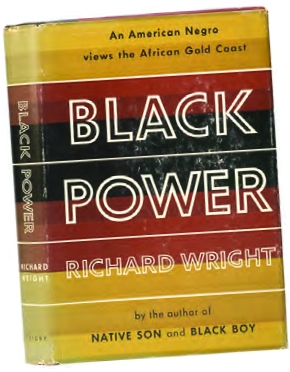
first recorded use of the term “Black Power” in a political context
dates back to 1954, when Richard Wright, the renowned novelist,
published his book Black Power, a travelogue and analysis of
decolonization in Ghana.
Wright
used the phrase to describe the process of African nations asserting
self-determination in the face of European colonial rule. However, his
use of the term did not carry the same militant, grassroots connotations
that it later would in the U.S.
For
more, including a connection of this argument to the stakes of
historicizing Black Power, read the full piece via the Boston Ujima
Project’s Ujima WIRE www.ujimaboston.com/blog
Cierra
Michele Peters is an artist and writer. Her practice includes video,
installation, writing, and experimental publishing. She is the Director
of Communications, Culture & Enfranchisement at the Boston Ujima
Project, a cooperative business, arts, and investment ecosystem built by
and for Boston’s working-class communities of color.