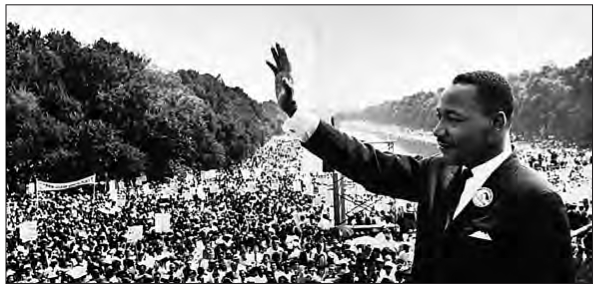
As we enter this Black History Month, we find ourselves in a moment of sharp contrast. In the morning, we celebrate Dr. Martin Luther King Jr. and his “I Have a Dream” speech — a call for racial equity and unity. By midafternoon, President Trump has already reversed as much racial progress as possible within his first hours back in office, making it clear where his priorities lie.
President Trump took what is called, “an all of government approach” to dismantling DEI going back to a Lyndon Johnson initiative. What this means is he wants every part of government to focus on eliminating DEI in government. We must applaud Trump’s honesty. He is saying as clearly as possible, “I do not believe in diversity, I do not believe in equity, and I do not believe in inclusion.” The Department of Defense issued a memo, “Identity Months Dead at DoD.”
The memo says, “Going forward, DoD Components and Military Departments will not use official resources, to include man-hours, to host celebrations or events related to cultural awareness months, including National African American/Black History Month, Women’s History Month, Asian American and Pacific Islander Heritage Month, Pride Month, National Hispanic Heritage Month, National Disability Employment Awareness Month, and National American Indian Heritage Month. Service members and civilians remain permitted to attend these events in an unofficial capacity outside of duty hours.”
The only “DEI” that is to exist is for white people, for all of those who have opposed “quotas,” “affirmative action” and the misuse of DEI, because hiring and promotion should be merit based and “We should simply hire the best person for the job,” in a color-blind manner. That is why President Trump nominated Matt Gaetz to be attorney general, Pete Hegseth, to be secretary of defense and Robert Kennedy Jr. to be secretary of Health and Human Services, right. They were far from the best America had to offer, but they had what many Blacks don’t have — a connection with the employer.
When we learned about the college admissions scandal, Operation Varsity Blues, where wealthy parents paid Rick Singer to falsify athletic credentials and cheat on standardized tests to secure their children’s admission to elite universities like Yale, Stanford, USC and Georgetown, we discovered legacy admissions, wealthy donor preferences, and dean’s “special” admits — advantages that overwhelmingly benefited wealthy, white applicants. We realized that Blacks were the only ones playing by the rules and were truly getting admitted, hired and promoted based on what Elon Musk says is merit, excellence and intelligence, or MEI versus DEI. While we’re speaking of unqualified hires, since Trump became president with CORIs and convictions, does that mean we can remove the CORI box from Dunkin’ Donut job applications?
What I meant when I said DEI was only for white people, is best exemplified by the Fearless Fund lawsuit. Less than 1% of venture capital goes to Black women. Two Black women established a fund to change that and one thing they did was provide a $20,000 grant for Black women. A group, the American Alliance for Equal Rights (AAER) sued, saying the grant program discriminated and violated 42 U.S.C. Section 1981, which prohibits racial discrimination in contract formation or enforcement. Fearless Fund settled the lawsuit and agreed to end the program. Like the song by Sister Rosetta Tharpe, “99 1/2 Won’t Do.”
President Trump and his anti-DEI crusade are not new. In American history, any time there is Black progress, there is backlash.
Following the murder of George Floyd in May 2020, corporate America embarked on an unprecedented wave of DEI commitments. Companies pledged an estimated $50 billion or
more to address systemic racism, promote equity, and support
marginalized communities. These efforts included donations, internal
diversity programs, investments in Black-owned businesses, and
partnerships with nonprofits advocating racial justice.
However,
this “racial awakening” soon faced mounting opposition from a coalition
of conservative groups, politicians and media figures, culminating in a
widespread backlash against DEI initiatives. The resistance to DEI has
been driven by a network of organizations, ideologies and individuals
seeking to challenge these initiatives politically, legally and
culturally.
Right-wing
advocacy organizations, such as the Heritage Foundation, criticized DEI
as ideologically biased “wokeism” and harmful to business efficiency.
Groups like the National Center for Public Policy Research pressured
corporations to abandon DEI through shareholder activism and campaigns
against environmental, social and governance (ESG) policies.
Under
pressure from this coalition, several corporations have scaled back
their DEI commitments. Walmart reduced its DEI training programs and
public initiatives after facing backlash from conservative consumers and
policymakers. McDonald’s took a more cautious approach to DEI
programming following lawsuits alleging reverse discrimination. Twitter,
under Elon Musk, dismantled its DEI team as part of broader efforts to
curb perceived ideological influence. Disney downsized its DEI division
after political clashes, particularly in Florida, and Google
significantly cut its DEI staff in 2023, citing budget concerns.
After progress is backlash.
That’s
the pattern. After emancipation and Reconstruction, which brought the
13th, 14th, and 15th Amendments — abolishing slavery, granting
citizenship and extending voting rights to Black men — a backlash
emerged in the form of Jim Crow laws. These laws enforced segregation
and disenfranchisement in the late 19th and early 20th centuries, often
justified by Christians citing the Bible. Groups like the Ku Klux Klan
viewed themselves as “Bible-believing” Christians, using scripture to
uphold white supremacy. After Brown v. Board of Education ruled
segregation unconstitutional, ministers like Rev. Carey Daniel wrote
“God the Original Segregationist,” opposing integration on biblical
grounds.
Having
Christians use the Bible to oppose our progress is nothing new as
Christian slaveholders said it was God’s will for us to be slaves.
Christian leaders like George Wallace and Bob Jones used Christianity to
justify segregation.
In
modern times, the politics of many white conservative Christians
continue to mirror this history of opposition. After President Barack
Obama’s administration, over 80% of white evangelicals backed Donald
Trump, viewing him as a “modern-day King Cyrus,” chosen to fulfill God’s
purpose. His survival of an assassination attempt only strengthened
this belief. Under Trump, conservative Christians pushed to end
diversity, equity, and inclusion (DEI) initiatives, critical race theory
and “wokeness,” calling them threats to American values. After the
election of Biden, these efforts intensified, culminating in Trump-led
reversals of anti-racism policies.
Whenever
Black Americans have demonstrated self-sufficiency and economic
success, the response has been destruction. When people hear “Black Wall
Street,” they usually think of Tulsa, Oklahoma, but the destruction of
thriving Black business districts was not isolated to one city. Across
the country, from Atlanta to Richmond, Detroit to Los Angeles, dozens of
Black Wall Streets were built, flourished, and were then systematically
dismantled — often through violence, government policies and economic
suppression.
While
Black Wall Streets were business hubs within larger cities, Freedom
Colonies were rural, self-sufficient Black settlements built by formerly
enslaved people after the Civil War. These communities were designed
for safety, land ownership and independence — far removed from white
economic control. At one time there were over 1,000 of them. Yet, like
Black Wall Streets, Freedom Colonies faced destruction through systemic
racism, land theft and economic displacement.
Finally,
beyond racial violence and land theft, Black business districts were
systematically dismantled through urban renewal and highway
construction. Between the 1940s and 1970s, hundreds of thriving Black
economic centers were demolished in the name of “progress.” Highways
were deliberately routed through Black neighborhoods, eminent domain was
used to seize and demolish Black businesses, and redlining policies
blocked Black homeownership and business expansion.
President
Trump and the anti-DEI forces will slow our progress, but it won’t stop
it. Not even the most powerful person ruling the most powerful country
can do that.
Ed
Gaskin is the Greater Grove Hall Main Streets executive director and a
graduate of MIT’s Sloan School of Management. Ed also holds a Master of
Divinity from the Gordon Conwell Theological Seminary. He is an author
of several books and articles on a wide range of topics.