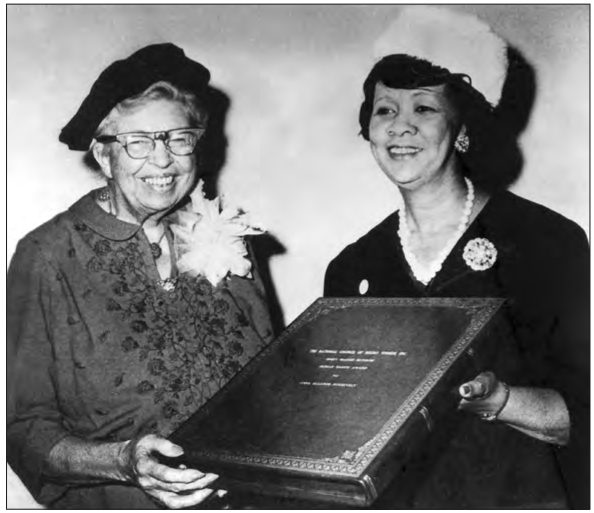
Dorothy Height (right) with Eleanor Roosevelt 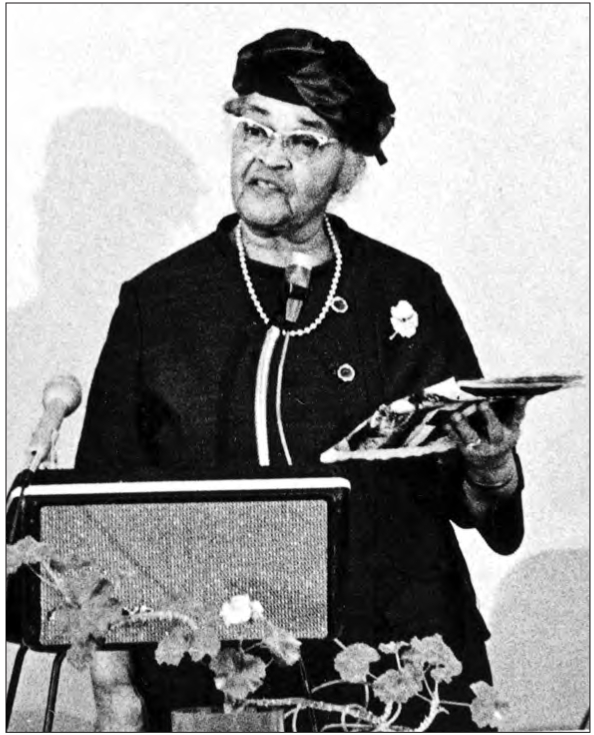
Melnea Cass, the “First Lady of Roxbury”
The power of Dorothy Height’s words, “I want to be remembered as one who tried,” strikes at the heart of Boston’s Black legacy. We are here because of all the ancestors who tried, those whose triumphs were blocked, those who persisted and those who succeeded. As a Black woman during the Civil Rights Movement fighting racism and sexism as the president of the National Council for Negro Women for over 40 years, Height did more than just try. Today, we must do more than try. We must fiercely protect the progress our community has fought so hard to achieve while boldly pushing forward. Every hard-won victory, every breakthrough, every door opened by previous generations must be safeguarded and expanded for those who follow. As president of the Boston City Council, and as a Black woman, I stand on the shoulders of people like Dorothy Height and our local leaders.
From the historic streets of Roxbury to the vibrant streets of Mattapan where I grew up, from the neighborhoods of Hyde Park, where I now live, to the communities of Dorchester, our ancestors built more than just homes and businesses — they planted seeds of Black culture, homeownership, education and economic power that we must preserve and expand on at all costs. We cannot allow gentrification, economic pressures, or systemic barriers to erode what generations of Black Bostonians sacrificed everything to build. That’s why we on the Boston City Council are working hard to preserve homeownership and put money in programs that support anti-displacement measures and economic empowerment in our neighborhood corridors.
Professor James Blackwell didn’t just become the first Black tenured professor at the University of Massachusetts Boston. He fought relentlessly to establish a Black Studies Department, understanding that our stories must not just be told, but institutionalized and passed down. Melnea Cass, our “First Lady of Roxbury,” didn’t just fight for civil rights, she created enduring systems of community empowerment that we must strengthen and expand. That’s why we on the Boston City Council have been advocates for better information about early voting and working with community to introduce Ranked Choice Voting for a healthier democracy. We won’t allow anyone, not even a sitting U.S. president, trample on our democracy without a fight.
Despite redlining and discrimination, our community’s entrepreneurs built businesses that became more than commercial enterprises. They were sanctuaries of Black culture and organizing. These neighborhood anchors — our barbershops, restaurants, bookstores and markets — must be protected and supported so they can continue serving as gathering spaces for generations to come. This is one of the many reasons why we fought so hard on the Boston City Council for grant programs like ReFresh to help businesses still struggling post-COVID, and why we fought so hard to support more liquor licenses for our local restaurants and community spaces to build vibrancy in our neighborhoods.
Our veterans returned from serving their country to build businesses and lead movements for change. Names like Enoch “Woody” Woodhouse and Haywood Fennell and veteran advocate Lillian O’Neal all come to mind. Their patriotism and sacrifice demand that we fight to ensure their children and grandchildren have access to every opportunity they deserve. The progress they made through their courage cannot slip away. That’s why we honor our Black veterans every year at a brunch in partnership with our Office of Veterans Services and have honored a number of Black veterans on the Boston City Council.
The battle for educational equity that Dr. Martin Luther King Jr. elevated as he marched with the community from Roxbury to the State House continues. Parents and educators fought tirelessly for our children’s future. Now we must defend these crucial gains that center equity and student support, while pushing for full educational justice. Every Black child deserves access to excellent education in a school that sees their dignity and their potential. That’s why we on the Boston City Council are fighting for better school buildings, more counselors for our students and more tutoring and support services.
Our religious institutions — bedrock churches like the historic Charles Street AME Church
and Twelfth Baptist Church — have been more than spiritual centers.
They’ve been headquarters for social justice and community preservation.
They remind us to choose faith and courage over fear and despair,
especially important in these moments where anti-Blackness masked as
anti-diversity, equity and inclusion is front and center.
The
Black medical professionals who established community health centers
and fought health care disparities didn’t do this work for it to be
undone. Their progress in improving community health outcomes must be
defended and expanded, especially as new health challenges emerge and
threaten our community’s well-being.
Our
political power, built through decades of organizing and activism, must
be wielded purposefully to protect our communities and expand
opportunities for future generations.
Every
elected official, every policy victory, and every seat at the
decision-making table was earned through collective struggle and must be
used to secure our community’s future.
The
unnamed heroes, parents working multiple jobs, activists organizing
rent strikes, teachers spending their own money on supplies, community
members creating mutual aid networks, didn’t make these sacrifices for
their efforts to be in vain. Their legacy demands that we not only
preserve what they built but strengthen it for the next generation.
As
we look to the future, we are tasked to celebrate and elevate our
history. We must empower our young people with the confidence to make
the attempt— so that it is worth it for them to do what Dorothy Height
did, and what we are all trying to do — which is try.
Every
small business we save, every student we support, every family we help
secure housing, and every leader we elect strengthens the foundations
our ancestors built and creates new opportunities for those who will
follow. As poet Gwendolyn Brooks, the first African American person to
receive a Pulitzer Prize, beautifully stated, “We are each other’s
harvest, we are each other’s business. We are each other’s magnitude and
bond.” Our greatest strength comes when we support each other, share
resources and knowledge, celebrate each other’s successes, and help each
other learn from setbacks.
The
story of Black Boston is not just one of persistence and triumph — it’s
an ongoing battle to protect what we’ve won while pushing for more. Our
history is American history, and it must live on in thriving Black
communities, institutions and traditions that continue to shape our
city’s future. Success is not guaranteed, but may we all be remembered
as people who tried.
Is
a City Councilor At-Large in her second term and is Boston City Council
President. Born and raised in Mattapan and Hyde Park to Haitian
immigrants, Ruthzee’s journey is deeply rooted in the fabric of Boston.
As a City Councilor At-Large, Ruthzee chaired the Committee on Civil
Rights and Immigrant Advancement, she stood up for the rights of our
LGBTQ+ siblings, and Ruthzee successfully led the redistricting process
to pass a new map.


