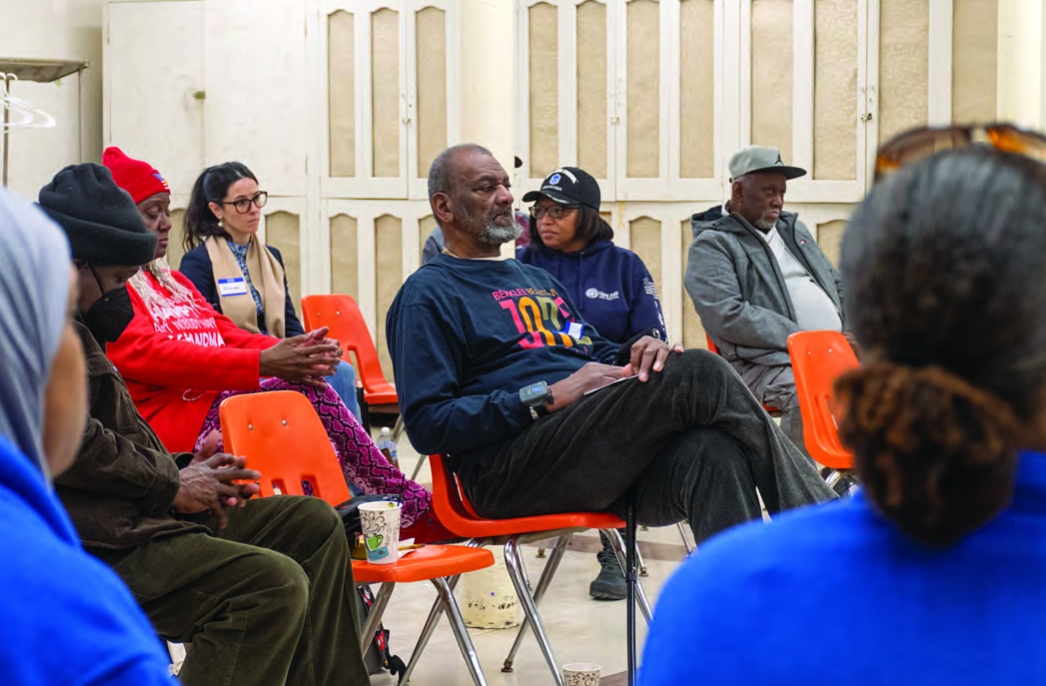
Attendees listen at a Veteran Lunch and Learn event hosted by the Harvard Street Neighborhood Health Center’s Veteran Outreach Center, Feb. 20. The event explored a new veteran benefits estimator tool, released by the state, aimed at connecting veterans with more benefits, part of a statewide effort to increase support for the community.A new online tool launched by the state Feb. 14 lets veterans estimate how much they can receive in financial benefits.
That new MassVets Benefits Estimator makes what can be a complicated process a little smoother, said Kathryn King, program director of the Veterans Outreach Center at the Harvard Street Neighborhood Health Center.
“My hope is that it does make the process easier,” she said.
The launch of the tool comes on the heels of a state announcement to increase annuity payments to disabled veterans — or their parents or surviving spouses — from $2,000 to $2,500 annually last month.
King said the tool is a great way to give more autonomy to veterans looking to see if they’re eligible for financial benefits in the state.
“It allows people to at least know, one, if they’re eligible; two, if they are eligible, how much they would receive,” she said.
In the tool, veterans input information about things like family status, income and housing costs to receive a high and low value for potential benefits they could receive under the Chapter 115 Safety Net Program, which provides financial assistance to veterans looking to pay for things like daily living expenses, medical costs and rent assistance.
Numbers given are a “rough estimate,” said Noah Coolidge, director of housing, outreach and expansion at the Executive Office of Veterans Services, who spoke at a Feb. 20 Lunch and Learn event hosted by King’s outreach center.
That estimate gives a jumping-off point to go to a veterans’ service organization or City Hall to enroll.
Massachusetts Veterans Services Secretary Jon Santiago said the tool should help connect veterans with the support they need.
“With
a more accessible and user-friendly benefit estimator, we are ensuring
that no veteran in need is left without access to critical financial
assistance,” he said in a statement.
King
said she expects it to be a great tool, but sees some potential
challenges with limited digital literacy or access to computers.
“There’s
a huge digital divide in the urban community,” said King, whose
outreach center runs six-week programs to connect veterans with basic
tech skills.
But where it is successful, King said she expects it to bring peace of mind to veterans trying to manage their finances.
“People
have anxiety about putting a roof over your head. There’s anxiety about
keeping food on the table and clothes on your back,” King said.
“Hopefully this will help reduce some of that anxiety.”
Also,
she said, it will bring clarity for veterans who might currently be
guessing if they’re eligible based on what others they know have
received — something that often isn’t accurate.
“Some
folks assume that across the board, everyone will receive the same
benefits, but each veteran’s situation is different, which will
determine the eligibility,” King said.
Benefit
awards can vary depending on a number of factors, she said, including
things like if someone was in active duty, how long they served and in
what capacity.
“It can
be very confusing, trying to understand what you might be eligible
for,” King said. “The more guidance that veterans can receive, the
better.”
The tool,
along with the increase in annuity for disabled veterans, is part of a
broader statewide push to better support veterans.
Many
of the efforts stem from the Honoring, Empowering and Recognizing Our
Servicemembers and Veterans — or HERO — Act, which was passed by the
Legislature last summer and signed by Gov. Maura Healey in August. The
state hailed the act as the most comprehensive veterans’ welfare package
in Massachusetts history.
The
increase in disabled veteran annuity was part of that legislation, as
were other actions like expanding access to behavioral health
treatments, increasing flexibility for veteran property tax exemptions
and a $2,500 tax credit for small businesses aimed at encouraging them
to hire veterans, launched in October.
And supporters are hopeful the changes will bring prominent impacts for veterans across the state.
“It
means that it’s going to have a lot more opportunities for all veterans
as a whole,” said Linda Blackwell, a support services for veteran
families case manager at Clear Path for Veterans New England.
For
veterans who rely on the annuity payment, the increase could be key,
said King. She said that the additional $500 could mean the difference
between staying housed or becoming homeless, or being able to make a car
payment.
“Every little penny counts,” she said.
The
increase, which was announced at the end of January, pushed out an
initial payment of $1,250 to annuity recipients earlier this month.
Beginning in August and then each year after, the state will pay annual
payments of $2,500.
The
expanded benefits will make personal financial margins more
comfortable, said Haywood Fennell, a Vietnam veteran and community
advocate.
“Sometimes
when you get the money that the government gives you, less the $500,
you’re stretching,” Fennell said. “Now, you don’t have to stretch as
much.”
As the country
faces growing inflation rates, increasing the amount of financial
support veterans receive is an important step, Fennell said.
“All
the prices are going up; nothing’s going down. There’s no
considerations for veterans in terms of reduction in cost for living,”
he said. “And hey, just look: they might be able to buy more eggs, if
they eat eggs.”
Santiago said he was proud to deliver tangible support to the state’s veterans through the expansion.
“This increase is more than just a financial adjustment — it’s a promise kept to those who have given so much,” he said.
Those
benefits will impact veterans in more than just their economic
stability, Fennell said. Shows of support, like the increased annuity
and benefits tool, will also help their morale.
“The
veterans are an overlooked population. They raise their hands to serve
the country [but] is the country serving us?” Fennell said. “I think
that this is the right direction for our government and for our
veterans.”