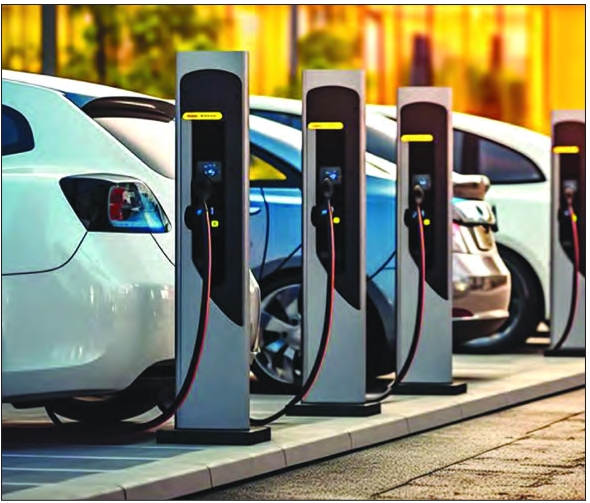
Electric cars at charging stations. New EVs aren’t the only driving factor here. Sales figures for used EVs soared in 2024, growing 61.3% year over year in November, while sales of new EVs rose by 13.6% within a similar time frame.
The General auto insurance agency analyzed Cox Automotive and Kelley Blue Book data to explore this trend and share what consumers need to know before buying a used electric vehicle, as well as what EV sales growth means for the auto industry.
Though many factors determine EV purchases, cost plays a major role. According to Cox Automotive, average listing prices for used EVs have fallen by roughly 10% year over year as of November 2024. Additionally, leading EV manufacturer Tesla slashed prices multiple times in 2024.
The EV market has expanded significantly due to these lower costs, as The New York Times reported in June 2024. “We’re seeing younger people,” Alex Lawrence, a used EV dealer in Salt Lake City, told the Times. “We are seeing more blue-collar and entry-level white-collar people. The purchase price of the car has suddenly become in reach.”
New regulations are boosting the movement, too. The Biden administration’s Inflation Reduction Act provides up to $4,000 in clean vehicle tax credits for used EV purchases, a consumer incentive that may be in jeopardy under the Trump administration.
Beyond the price tag, many consumers purchase EVs because of sustainability concerns. A survey published by Rare in April 2024 found that both current EV drivers and potential buyers were interested in electric vehicles because of environmental benefits.
Examining the battery concerns of potential EV converts
Since
batteries are essential to EVs, prospective customers should keep a few
factors top of mind when considering an electric vehicle.
First,
range: Drivers accustomed to stopping on any corner for gasoline may be
wary of the comparative lack of battery charging infrastructure. As of
April 2024, the U.S. has one fastcharging EV station for every 15 gas
stations. But ubiquitous lithium-ion batteries are fast becoming more
energy-dense and cost-effective, and IRA incentives have spurred car
companies to further invest in EV battery development.
Vital
infrastructure is also coming online, with thousands of new charging
stations opening every year. In December 2024, there were 194,427 EV
chargers available to the public, including 49,604 DC fast chargers — a
10.5% rise from June 2024. Plus, according to a 2024 study from
Recurrent, the average American EV driver uses only 8% to 16% of their
available range daily, suggesting that fears of running out of juice may
often be unfounded.
Beyond
range, some EV critics have also raised concerns about the relatively
fast depreciation of these cars. A 2024 analysis from Wired found that
certain EVs lose up to 50% of their value within a year of purchase.
Additionally, most EV batteries only last around 12 to 15 years, or
eight to 12 years if used often in extreme conditions.
That said, most EVs will still save consumers money in the
long run. Charging an EV at home typically costs a fraction of filling
up a car with gas at the pump. No engine means no oil changes or many of
the other tune-ups necessary for gas-powered vehicles, saving EV owners
well over $1,000 annually on maintenance, according
to some estimates. And while new batteries are expensive, warranties
protect consumers from high replacement costs; the majority of EV makers
cover batteries for up to eight years or 100,000 miles.
Manufacturers switching gears to meet EV demand
Despite
the factors in electric vehicles’ favor, the auto industry has been
slow to adapt to the EV revolution. In 2024, for example, manufacturers
including Tesla and Ford pushed back plans to make more EVs. Concerns
regarding the volatility of lithium and the United States’ reliance on
imported batteries also persist.
But
volume has continued to rise. Honda and General Motors collectively
sold 78,951 more EVs in 2024 than they did in 2023, according to Cox.
EVs are expected to make up almost 10% of vehicle sales in 2025, with
25% of all cars sold likely to
be electrified in some way. This increase in market competition hasn’t
been good for everyone, though. Tesla has long been the #1 EV seller in
the U.S., but in 2024, the company sold 37,854 fewer vehicles than it
had in 2023.
Going
forward, the federal government’s EV stance under President Donald Trump
will form another piece of this puzzle. As of January 2025, the Trump
administration has paused funding for the Inflation Reduction Act (IRA
)and may eliminate tax credits for EV purchases.
No
matter what happens, drivers still seem keen to make the switch to
electric transportation. And as costs come down further and technology
progresses, EVs will become even more attractive. By 2030, EVs are
expected to be cheaper than gas guzzlers, and advancements like U.S.-
made sodium-ion batteries will likely make EVs even more ecofriendly,
reducing the production of heat-trapping gases that harm human health
and cause increasingly frequent extreme weather events.
Indeed, those who care about the environment are strongly motivated to go down this road.
Story
editing by Cu Fleshman. Additional editing by Elisa Huang. Copy editing
by Tim Bruns. Photo selection by Ania Antecka. This story originally
appeared on The General and was produced and distributed in partnership
with Stacker Studio.


