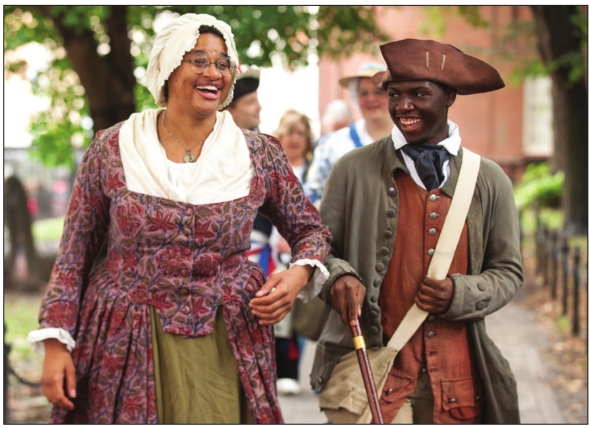
The special African American Patriots tour runs weekends during Black History Month.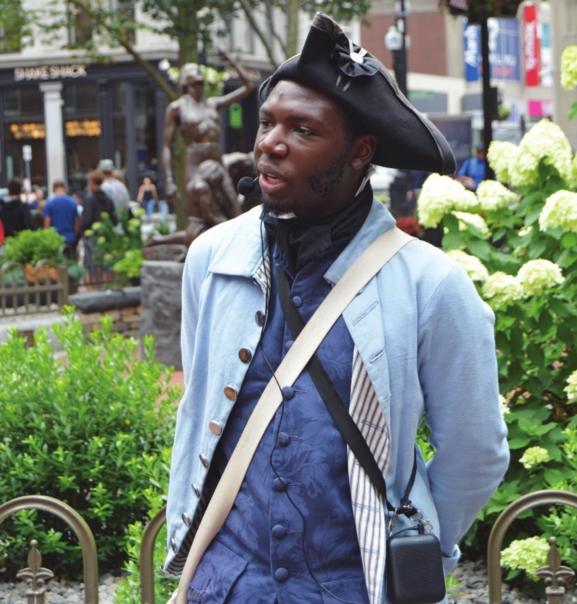
Actors portraying historical Black figures serve as tour guides on the African American Patriots tour.
Popular walking tour returns for month of February
The Freedom Trail Foundation recently announced the return of their African American Patriots tour for the month of February. It will run every weekend in February.
The 90-minute walking tour will begin in the Boston Common with historic icon guides like Crispus Attucks and Phillis Wheatley as well as other 18th-century-inspired tour personages leading the way. Along with the added whimsy of the tour being led by a historical figure, the 2.5-mile trail features 16 historic sites that speak to the depth of Boston’s Black history.
“I think Boston and Massachusetts are really unique places in the way that they highlight African American history. Our organization is really known for focusing on the time around the American Revolution, and there are a lot of Bostonians, Black Bostonians, who
lived and were active during the American Revolution,” said Catherine
Benjamin, the foundation’s program manager. “So, we talk about Phillis
Wheatley and how during that time her book of poetry was published, with
one of our guides portraying Phillis Wheatley.”
The
African American Patriots tour highlights Black individuals who
championed equality and civil rights throughout the commonwealth,
illuminating the points of Black history that aren’t traditionally
taught in mainstream history curriculums.
“Another
of our guides portrays Crispus Attucks, who is most well known for
being the first person killed during the Boston Massacre. His movements
started around him being the first martyr of the American Revolution in
many people’s eyes. So, Crispus Attucks is a big figure in Boston’s
history,” Benjamin said.
In
addition to Attucks, others who are featured on the tour include Prince
Hall and George Middleton. Hall, a former enslaved man, was an early
abolitionist who founded Black Freemasonry in the United States. Hall
lobbied for free and enslaved Black men to serve in the American
colonial
forces during the Revolution. Middleton was one of the African American
soldiers who served on the Patriot side of the war. The house he built
on Pinckney Street in Beacon Hill still stands and is one of the
highlights of the tour.
The
tour also enlightens participants about the role that the North,
specifically Massachusetts, played in the transatlantic slave trade and
domestic slavery. Many people are led to believe that the North was
exclusively free for people of color during the Revolutionary War.
However, that is a common misconception.
“There’s misconceptions
around the institution of slavery in Boston as it existed and a lot of
people who maybe traveling from other areas or have different access to
education about American history might come to this area thinking that
slavery wasn’t as prevalent in the North or it wasn’t really happening
here,” said Benjamin, “and so something that we want to try to emphasize
on these tours is breaking apart those misconceptions and bringing to
light the fact that this actually was going on. Slavery was still very
much a part of the timeline in Boston. Even though we’re amongst the
earlier states to abolish slavery, the economic and social impact of it
is still felt.”
Although
Massachusetts, in 1783, was the second state to abolish slavery
(following Pennsylvania’s decision in 1780), the commonwealth still
participated in the slave trade. The first ship of enslaved Africans
arrived in Boston 1638 and by 1641, Massachusetts was among the first
English colonies to legalize slavery.
The
abolition of slavery in the North does not negate the history of Boston
and the role that the city played in the institution of slavery.
However, Boston’s involvement in slavery and the Revolutionary War is
why the African American Patriots is informative and different.
Although
the African American Patriots tour is only offered in February, the
Freedom Trail has a myriad of other tours available throughout the year.
The foundation’s traditional Walk Into History tours are offered seven
days a week from 11 a.m. to 1 p.m. all year, and if requested, each tour
can be modified to place specific emphasis on Black history.
The
Freedom Trail Foundation also offers, upon request, the Revolutionary
Women tour, the Historic Pub Crawl Private Tour, the Walk into History
Reverse Tour, the North End Tour, the Historic Holiday Stroll, the
Rainbow Revolutionaries Tour and the Lantern Tour.
As
February, Black History Month, marks the return of the African American
Patriots tour, the Freedom Trail Foundation looks forward to
highlighting the rich Black history that originated in Boston by
bringing Boston’s Black history to life.
“We
are hoping that we’ll have great attendance for this tour. We’d
encourage folks who are interested in booking the African American
Patriots tour at other times of the year to reach out to us. If we see
or hear from people that there is more demand for it as a more frequent
tour, we’d love to try to meet that demand,” Benjamin said.