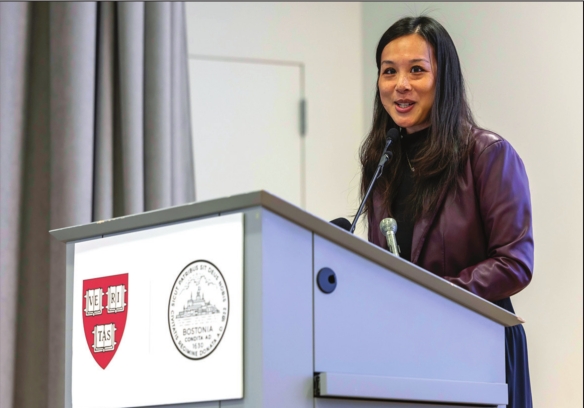
Tiffany
Chu, Mayor Michelle Wu’s chief of staff, speaks at an event, Jan. 22,
announcing over $64 million in affordable housing supports across the
city.
A new affordable housing development in Upham’s Corner that will combine homeownership opportunities with new facilities for the area’s public library branch was one of 12 projects for which the city announced housing funding.
The support is part of $64.2 million in affordable housing funding announced at an event at the Harvard Ed Portal in Allston, Jan. 22. The funding will support the development or preservation of 637 new units of mixed-income housing for residents to rent and buy.
“These housing awards will strengthen our communities, enhance affordability, and continue making progress for Boston as a home for everyone,” Mayor Michelle Wu said in a statement.
City officials touted the projects — which will be located in eight neighborhoods across the city — as a way to not just house residents but improve the fabric of the communities they’re in. Four of the projects will be in Dorchester, Roxbury and Mattapan.
“As Boston grows, ensuring access to affordable housing is vital to maintaining Boston’s diverse neighborhoods. Affordable housing isn’t just about providing homes, it’s about fostering stable neighborhoods and driving economic development,” said Catherine Hardaway, chair of the Neighborhood Housing Trust, in a statement.
The Neighborhood Housing Trust is one of the three sources of funding the city is pulling from to support the projects.
The 12 developments were selected out of a pool of 21, through a process launched in the fall.
For
the Upham’s Corner project, the city funding will support the creation
of 33 units for affordable homeownership and the new Upham’s Corner
branch of the Boston Public Library.
“From
my perspective, there’s no better opportunity for a future resident
than having a community center and library on the ground floor,” said
Taylor Bearden, a partner at Civico Development, which is working on the
project.
In a city
like Boston, with its high housing prices, that kind of combination and
the larger impact its developers and supporters hope it will provide is
important, said Kit Binns, an Upham’s Corner resident who has lived in
the area for 46 years.
“Especially
in commercial districts like this, we shouldn’t just be putting one- or
two-story buildings up. We need to be putting up housing,” Binns said.
“This is a great opportunity — a very synergistic opportunity — to
combine the two.”
Elsewhere, in Chinatown and the West End, work is ongoing to create projects combining housing and library space.
For
the team, the funding means that the project can really dig in and
advance the design, as well as bring it back to residents for another
public meeting.
“I really consider this to be the beginning of the development process,” Bearden said.
The work could only go so far, he said, without knowing that there was funding to keep it moving.
But it’s not the beginning of the work to get this project happening, he said. That effort has been ongoing for almost 10 years.
“It
takes long time to do this work, but now, because of the support of the
city, it unlocks us actually realizing that vision, and that’s going to
be very meaningful to a lot of people in this community who have been
stakeholders,” Bearden said.
Work
to get a new Upham’s Corner branch of the library has been ongoing for
decades, said Binns, who called the current building “quaint and cute”
but not the most useful library. The current branch library is one of
the oldest in the network.
Prominently, all the units at the Upham’s Corner project will be for homeownership, something Binns said is key.
“The
whole concept now is wealth building,” Binns said. “For people who have
not had the opportunity to have wealth-building — particularly in
communities of color — this is an opportunity to try to break through a
little bit on that.”
Across
the city, the projects are all targeted at decreasing carbon emissions.
Each of the 12 projects that received support in this round of funding
are required to meet the city’s requirements for a Zero Emissions
Building, under design standards released by the Mayor’s Office of
Housing in August.
Those standards require that the new developments use electricity and on-site solar panels as their sole fuel source.
Making
affordable housing greener has been a priority for the city, as well as
the state of Massachusetts, with city officials touting it as an
element of the city’s Green New Deal, as a way to address environmental
harms for those who have felt more of a burden historically.
The
funding comes as a continued push from the Wu administration to expand
affordable housing construction in the city. In a press release
announcing the funding, the city touted the statistic that in the first
three years of the Wu administration the city has supported the
construction of more affordable housing than any other three-year period
dating back to 1988.
“By
supporting these 12 developments, we are not just creating housing. We
are strengthening neighborhoods, preventing displacement and ensuring
that residents have the stability they need to thrive,” said Boston
Chief of Housing Sheila Dillon. These funds build on the historic
investments in housing made by the Wu administration over the last three
years, reflecting our continued commitment to addressing Boston’s
housing challenges head-on.”