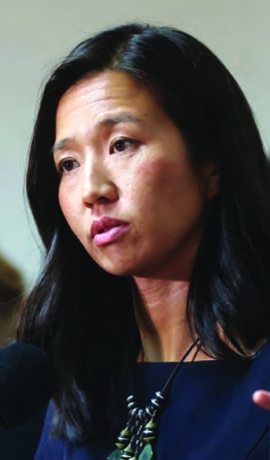
Mayor
Michelle Wu may face a challenger. For much of 2024, nonprofit
executive Josh Kraft has been testing the waters for a mayoral run. Mayor Michelle Wu kicked off 2024 with what seemed like a surplus of political strength. Also beginning the year in a position of strength was at-large Councilor Ruthzee Louijeunne, who began her second term on the body as its president.
The more contentious version of the Council was in the rear-view, with two of its most progressive members and two of its most conservative members no longer serving on the body — all four replaced by candidates endorsed by Wu, three of whom were her former employees.
The reconfigured Council made for a more quiet year, although the year kicked off with two controversial Wu administration initiatives at play: the proposed lease of White Stadium to a professional women’s soccer team and the proposed move of the John D. O’Bryant School of Mathematics and Science from its current Roxbury location to the campus of the former West Roxbury High School near the city’s border with Dedham.
Wu had sought no community input for either of those decisions before they were announced and received significant blowback for both — a lawsuit and demonstrations against the leasing of White Stadium and enough pressure from O’Bryant students, teachers, parents and alums that her administration dropped the proposal in February.
Much of the political coverage Wu garnered in 2024 centered around her efforts to increase the tax rates for commercial properties in the city to lower the residential rate — an attempt to forestall what was projected to be a substantial increase for homeowners. The increase, Wu argued, could have a devastating impact on homeowners and renters at a time when the city’s real estate market has become increasingly unaffordable for longtime Boston residents.
Wu was able to cut a deal with real estate industry representatives, securing their support for a modest adjustment to the tax rates, and secure the support of House members. But her efforts hit a block in the Senate, with 1st Suffolk District Sen. Nick Collins using procedural maneuvers to delay and ultimately scuttle a December vote on the tax rate change.
The
conflict underscored tensions between Wu and the real estate industry,
which has in recent decades enjoyed significant influence in City Hall
and at the State House. The unravelling of the tax plan also directed
attention to Collins’ campaign coffers, which received $17,200 from real
estate industry contributors in November alone.
The
battle likely did little to endear Boston voters to the Legislature,
which exercises control over important city decisions ranging from
liquor licenses to real estate taxation — a dynamic that has its roots
in an era where the Yankee-dominated lawmakers were presumed to be less
corrupt that the Irish American dominated Boston mayor and City Council.
Lawmakers
themselves came into voters’ cross hairs during the November election,
with state Auditor Diana DiZoglio’s ballot measure authorizing her
office to conduct audits of the Legislature — a measure supported by
71.6% of voters. The state’s Legislature is consistently ranked among
the least transparent in the nation.
A sleepy electoral season
In
February, presidential politics came to Massachusetts, with voters
heading to the polls for the primary. Yet with incumbent Joe Biden the
sole major candidate on Democratic ticket, balloting in Boston was a
sleepy affair, drawing just 17.6% of registered voters to the polls —
just shy of 55,000 Democrats and 18,700 Republicans.
With
the state’s rock-solid reputation of delivering the Electoral College
vote to the Democrats, neither party spends time or money in
Massachusetts, a dynamic that makes for sleepy presidential-year
politics in Massachusetts. None of the all-Democratic Congressional
delegation faced serious challengers, save for Sen. Elizabeth Warren,
who went on to win 77% of the vote against John Deaton, a little-known,
Michigan-born attorney and crypto currency crusader.
Perhaps
the most heavily contested local battle facing Boston voters was a race
for one of the more obscure posts: a vacant seat at the Office of Clerk
of the Supreme Judicial Court for Suffolk
County.
Allison Cartwright, an attorney and administrator with the state’s
Committee for Public Council Services faced off against atlarge City
Councilor Erin Murphy.
While
Murphy had no legal experience and little in the way of administrative
experience, she would presumably benefit from name recognition garnered
during the 2021 and 2023 election seasons.
Low
turnout primaries in Boston have traditionally favored white candidates
over candidates of color and conservative-leaning candidates over
progressives. Yet Cartwright,
a political unknown, went on to secure 58.9% of the vote in the
September Democratic Primary to Murphy’s 40%, defying expectations of a
close contest.
By
April, local legislative races began to take shape, with several
challengers taking on incumbents in Boston’s Black community. Yet
despite an initial flurry of filings and announcements, few challengers
filed the signatures necessary to secure a spot on the Ballot.
In
the 6th Suffolk District, incumbent Russell Holmes faced two
challengers yet managed to secure 73% of the vote. In the 7th Suffolk,
incumbent Chynah Tyler ran unopposed after two would-be challengers
apparently failed to make the ballot.
November election
By
the time the Nov. 5 general election rolled around, there were no
surprises in the Democrat-dominated Bay State. Democratic nominee Kamala
Harris won 61% of the statewide vote, Sen. Elizabeth Warren won
reelection with 60% of the vote. In Boston, Democratic incumbents and
nominees went largely uncontested.
In
addition to DiZoglio’s ballot initiative authorizing her office to
conduct audits of the legislature, two other initiatives passed in
November: a measure ending the use of the MCAS exam as a high school
graduation requirement that passed with 59% of the vote and a measure
allowing ride share drivers to form a union that passed with 53% of the
vote.
What stood out perhaps the most in the November election was what initially appeared to be a significant gain for
Trump supporters over the 2016 and 2020 elections, with Harris winning
Massachusetts by a 24.5-point margin, down from President Joe Biden’s
34-point margin in 2020.
Those
numbers, however, reflected a statewide decline in Democratic turnout.
In Boston, turnout dropped from 295,297 in 2020 to 265,413 in 2024 —
reflecting what some say is a growing dissatisfaction among Democratic
voters with the party’s loyalty to corporate interests while the
majority of Americans face cost of living increases that have vastly
outpaced their earnings. The federal minimum wage of $7.25 hasn’t budged
since it was last increased in 2009.
Going into 2025, Mayor Michelle Wu may face a challenger.
For
much of 2024, nonprofit executive Josh Kraft has been testing the
waters for a mayoral run as has City Councilor Ed Flynn. While Kraft
could potentially bring the vast wealth of his family to a campaign —
his father, Robert Kraft, has a net worth estimated at $11.8 billion —
Flynn is sitting on a campaign war chest that reported a balance of
$792,496 in December.
In
2024, Wu managed to negotiate a contract with the Boston Police
Patrolman’s Union that included significant reforms (and increase the
department’s budget by $69 million to $474 million), vetoed the City
Council’s proposed cuts to the Police and Fire Department budgets and
has, so far, managed to keep her plan to lease White Stadium to the
soccer team going.
Will
Wu’s moves on taxes, bike and bus lanes or policing leave enough of an
opening for a mayoral challenger? Stay tuned for Banner coverage in
2025.


