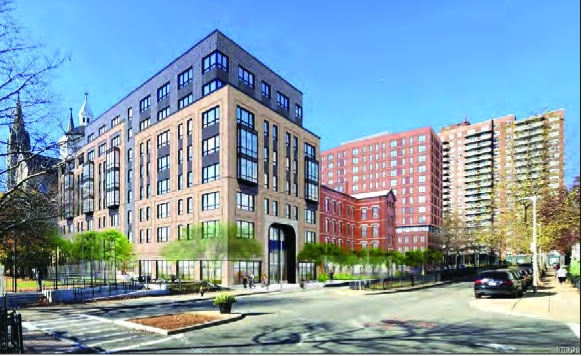
A rendering of the proposed apartment building at 80 Smith St. in Mission Hill. Cites neighborhood opposition to proposed development
Boston’s planning board on Thursday declined to approve a proposal to build 218 apartments on what are now vacant lots in Mission Hill, telling the developer it needs to win more community support.
The Boston Planning and Development Agency board of directors greenlit several other residential projects, including plans from Fenway Community Development Corp. and a nonprofit affiliate of the Archdiocese of Boston to turn a Fenway rooming house into 86 units of income-restricted housing. The meeting was the board’s first to be held in-person since early 2020.
In a rare move, the board tabled the proposal from Boston-based Weston Associates to put two buildings totaling just over 200,000 square feet at 80 and 100 Smith St. in Mission Hill. The complex would go where the St. Alphonsus performance hall and a former convent once stood. Those buildings were demolished a year ago. An office building at 90 Smith St., currently home to offices for Harvard University’s school of public health, would stay.
Opposing approval were City Councilor Sharon Durkan, who represents the neighborhood, and At-Large Councilor Henry Santana. Boston Housing Authority boss Kenzie Bok asked the board to table the project for further discussions. The sites are next to BHA’s Mission Main complex.
Durkan told board members that neighborhood residents felt disrespected and excluded by the development team and that she wanted changes including more income-restricted units. Right now, 15% of the units are income-restricted.
Joseph Hanley, a McDermott Quilty Miller & Hanley LLP partner representing Weston, said that the team first began engaging with the community on the latest version of the project four years ago.
The developer has made
several changes in response to feedback from Durkan and others, he said,
including adding speed bumps to slow traffic. Some neighbors appear
immovable on topics such as density, he said.
Hanley
told board members that the project was at a “breaking point” when it
comes to affordability. At the time the project was proposed, the
minimum requirement in Boston was 13% of units, but the city often
negotiated higher percentages with developers. The requirement for newer
projects is now 20%.
“We… know that the city has 30,000 units that are sitting there not being built because
folks made deals that don’t work today, and so the balance that we were
trying to strike, is to increase that as aggressively as we can, but
also do it in a responsible way so that we can build this project,”
Hanley said.
Ultimately, board members
were not comfortable with the level of opposition to the project today.
One member, Kate Bennett, said she had “never seen such universal
opposition coming from many corners” for a project since joining the
board more than a year ago.
“I
think that you’re really close, but I do want to say… somehow trust
needs to be rebuilt here,” BPDA board chair Priscilla Rojas said.
“Change kind of moves at the speed of trust.”
The
vote to table the proposal was unanimous with the exception of Raheem
Shepard, who said he was “very torn” and voted present.
The
six approved residential projects would create a total of 273 homes in
Fenway, Allston, Brighton, East Boston, Mattapan and South Boston. No
primarily commercial projects were on the docket this month.
The board meeting was the first since Kairos Shen returned to City Hall to run the planning department.
Greg Ryan is senior reporter for the Boston Business Journal