A
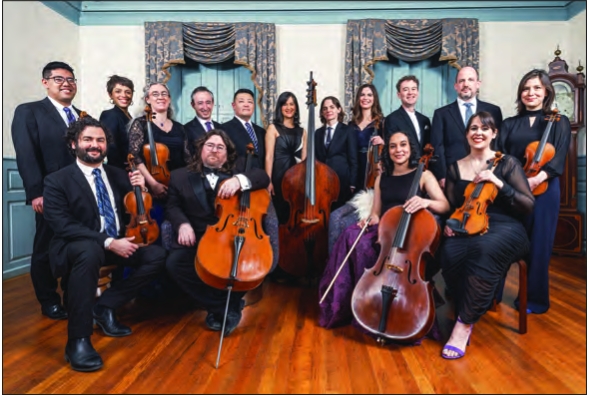
Far Cry members Francesca McNeely (sitting, second from right), Megumi
Stohs Lewis (standing, center) and Sarah Darling (standing, third from
left) collaborated with opera singer Davóne Tines to create the
programming for “CODED.”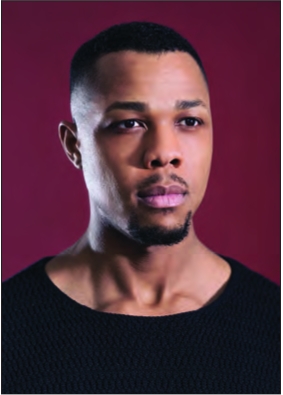
Opera singer Davóne
Tines partners with chamber orchestra A Far Cry to explore the legacy of
African American spirituals in “CODED” at Jordan Hall, Oct. 11.
Whenever Francesca McNeely heard “Wade in the Water” as a young girl, she simply thought the African American spiritual was an upbeat song. It’s an easy mistake to make, she said.
“If you don’t actually know the meaning behind the songs, sometimes they just sound like beautiful tunes, right?” said McNeely, a cellist and member of A Far Cry, a Boston-based collaborative chamber orchestra. “You might not realize … the deeper, darker message,” she added.
In the case of “Wade in the Water,” the message is about “instructing people to go hide in the water so the dogs that are chasing you can’t smell you anymore” which is “really dark,” she said.
But the genius of spirituals lies in how they were composed.
“Because it’s been coded in this sort of typical upbeat
fashion, you could sing it in more public places without drawing
attention to the origin of it … so I think there’s a bit of that layered
in, too,” McNeely said. “The fact that these songs had to be encoded in
a way in order to be transmitted to people for help was sort of a part
of why they existed in the first place.”
This notion of embedding meaning into music is the crux of “CODED,” a concert from A Far Cry to be held Oct. 11 at
the New England Conservatory’s Jordan Hall. In collaboration with opera
singer Davóne Tines, A Far Cry will offer up a night that honors the
legacy of African American spirituals, including a rendition of
Frederick Tillis’ “Wade in the Water” arranged by McNeely and novel
music from award-winning composer Tyshawn Sorey.
The
program also highlights the works of Harry T. Burleigh, who composed
African American music classically, and his relationship with Czech
composer Antonín Dvorák, who was influenced by African American music.
Sarah
Darling, a violinist and member of A Far Cry, said “String Quartet No.
12,” a wellknown piece by Dvorák, would not exist had it not been for
his relationship with Burleigh. And for
Burleigh’s part, when he began rearranging African American spirituals
with piano accompaniments, thus changing them to suit a classical
audience, the songs were “given entrance” into classical music
environments and celebrated, she said.
“The
question I think that’s playing with was this idea of … what do these
songs become when you dress them up in this way?” Darling said. She
added, “What remains? What is lost?”
The
name “CODED” came to be as violinist Megumi Stohs Lewis, Darling and
Tines thought about code-switching, the act of shifting one’s language —
tone, vocabulary — to match the audience. The idea, said Tines, comes
from W.E.B. Du Bois’ concept of double consciousness from “The Souls of
Black Folk,” in which he outlines the experience of most people of color
or minorities.
“The
music allows us an opportunity to feel that, and to maybe even cause
empathy through the act of feeling what this complication or this
layering might actually be,” Tines said. He added, “W.E.B. Du Bois put
it into words, and we’re essentially trying to put it into music.”
The
concert will offer different perspectives on spirituals, honoring their
origins while asking how they might be done differently today,
contrasting the “modern lens” with the “root,” Tines said. He leaned
into this push and pull because he wanted to make the audience feel
comfortable first, by presenting what they might be familiar with,
before dropping the floor beneath them “so they feel something new or
different,” he said.
Stohs
Lewis said the concept for the concert was also inspired by “growing up
in America and hearing spirituals or the musical traditions that have
been influenced by spirituals, whether it’s in church or in classical
music” and realizing “just how widespread it is in the fabric of
American music.”
The A
Far Cry team wants the concert to be a “wonderful sonic experience,”
she said, that will also shift audience members’ mindsets.
“I’m
hoping that people will open themselves up to new perspectives, like
hearing something in a new context,” Stohs Lewis said. “And I’m hoping
that they will [be thinking about] their own experiences and also
thinking about the experiences of others around them.”
ON THE WEB
Learn more at afarcry.org/all/coded-concert


