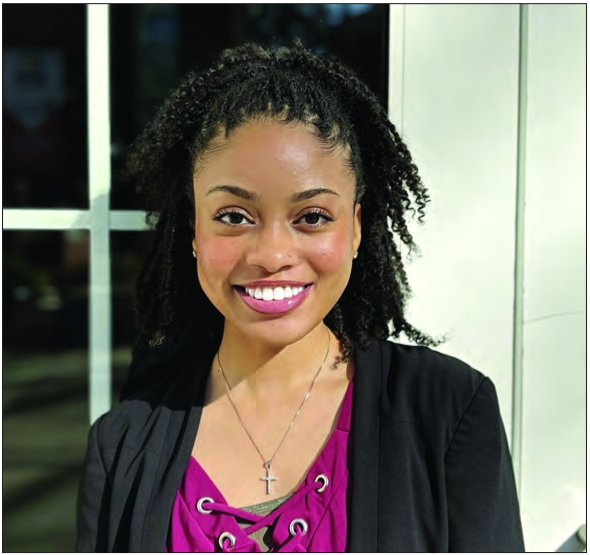
Kai Dickerson, Spellman College student and W. E. B. Du Bois Scholar at Harvard. Harvard University has officially welcomed the inaugural cohort of the W. E. B. Du Bois Scholars Program, a groundbreaking initiative designed to promote social justice, racial equity and inclusion within academia and society as a whole. Named in honor of William Edward Burghardt Du Bois, the esteemed sociologist, historian and civil rights activist, the program is now fully operational and has begun its mission to support scholars committed to addressing issues of race, inequality, and social justice.
The first group of Du Bois Scholars consists of a diverse and talented group of emerging scholars from various disciplines, including sociology, history, law, public health and education. These scholars were selected through a highly competitive process and are recognized for their commitment to advancing research that addresses systemic racism, economic disparity, and other critical social issues.
For Kai Dickerson, a student at Spellman College, the journey to Harvard began on Instagram. “I was on a social media cleanse for a couple of months, but one day I decided to log back into Instagram. I saw a post on the Spelman research page about the W. E. B. Du Bois Scholars Program at Harvard. Immediately, I knew it was something I needed to explore,” she shared.
The launch of the W. E. B. Du Bois Scholars Program reflects Harvard’s commitment to addressing the historical and ongoing challenges of racial inequity.
The university has acknowledged its responsibility to create an academic environment that not only values diversity but also actively works to dismantle barriers to inclusion.
The program’s mission resonated deeply with Dickerson. “The initiative was dedicated to ensuring that HBCU students have quality research experiences, and the fact that it was named after W. E. B. Du Bois, a prominent African American sociologist, made it all the more significant. I knew this was not only going to be beneficial for my academic growth but also impactful on a broader scale,” she explained.
The W. E. B. Du Bois Scholars Program is expected to attract a diverse range of applicants from across the country and around the world. Harvard anticipates that the program will become a cornerstone of its efforts to address social justice issues and will serve as a model for other academic institutions committed to similar goals.
While her academic journey has been marked by various accomplishments, one constant has been her passion for mental health. From a young age, Dickerson has been driven by a desire to understand and address mental health issues, motivated by her own experiences with anxiety and a strong commitment to community well-being.
“When I became more aware of the disparities and social injustices surrounding mental health, I wanted to do everything I could to make sure others didn’t have to face those challenges alone,” she said.
This passion led her to pursue a focus on holistic psychiatry, where she aims to understand the comprehensive ways in which mental health issues develop and are exacerbated. “I want to do something on both the community and individual level to ensure that communities are well, healthy and can thrive,” she added.
Her time at Harvard has allowed her to explore these interests further. Under the mentorship of Dr. Rebekka Lee, she delved into research on under-accruing studies — specifically those that struggle to meet their enrollment requirements, particularly in terms of diversity. “I focused on
the role of physicians in recruiting patients into clinical trials,
exploring how the physician-patient relationship can be optimized by
researchers,” she explained.
Dr.
Lee, who worked closely with the student, had high praise for her
contributions. “Kai was an absolute joy to work with this summer! She
exemplified what I hope for the future of public health and medicine —
an unwavering commitment to equity and curiosity that pushes those
around her.
She and
her fellow cohort member, A’Nyah Williams, collaborated with our team to
strengthen our approach to supporting researchers in increasing
diversity in their studies,” Dr. Lee remarked.
Transitioning
from the nurturing environment of Spelman College in Georgia to the
bustling academic world of Harvard was a significant shift, but one for
which she felt well prepared. “Spelman provided a great foundation for
me. I felt confident in my placement and was able to lean on the
learning I received both inside and outside the classroom to navigate
Harvard,” she noted.
Boston,
too, has been a welcoming environment. “As someone from Michigan,
Boston feels familiar as another northern state, so I wasn’t too
uncomfortable. It’s been a great experience overall,” Dickerson said.
In
addition to Dickerson’s work at Harvard, she recently participated in a
study abroad program in Cape Town, South Africa, where she conducted a
comparative analysis of healthcare systems in the U.S. and South Africa.
“We looked at the political climate, history, and the diverse
personalities of the city to understand how these factors influence
health outcomes,” she said. This experience allowed her to apply the
holistic lens she values, considering the broader context in which
health issues arise.
As
she looks to the future, Dickerson is determined to continue her
education with a focus on public health. “Once I realized I wanted to
pursue holistic psychiatry, I knew I had to be intentional about my
education. I want to understand community health comprehensively,
addressing issues like food insecurity and social determinants of health
before heading to medical school,” she said.
Dickerson’s
ultimate goal is to make a broader impact on the world, not just as a
psychiatrist helping individuals, but as a public health advocate
working to create healthier, more equitable communities. “Education was
always emphasized in my household, not just for personal achievement but
as a tool to help others. I want to use my platform to ensure people
feel okay enough to want to live and thrive,” she emphasized.
Her
experience as a W. E. B. Du Bois Scholar at Harvard has been a pivotal
step in that journey, reaffirming her commitment to her chosen path and
equipping her with the tools to make a difference.
“I’m
incredibly grateful for this opportunity. If it weren’t for Spelman, I
wouldn’t be here at Harvard. I’m thankful for my home institution and
everything it has done to prepare me for this moment,” she concluded.


