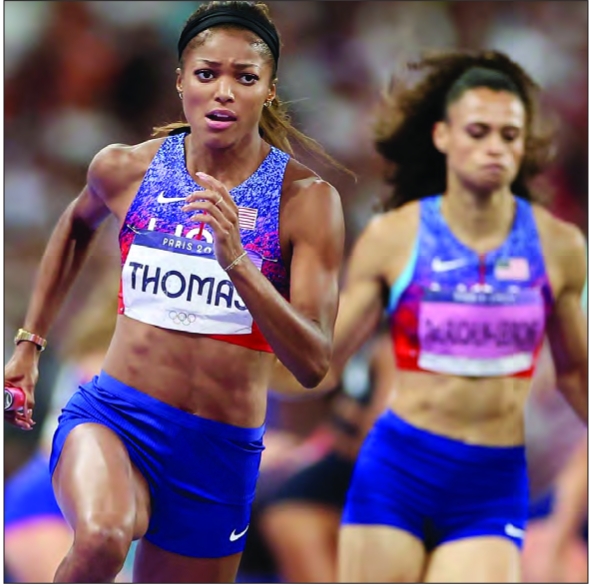
Gabby Thomas on her way to her third gold medal in the Olympics. 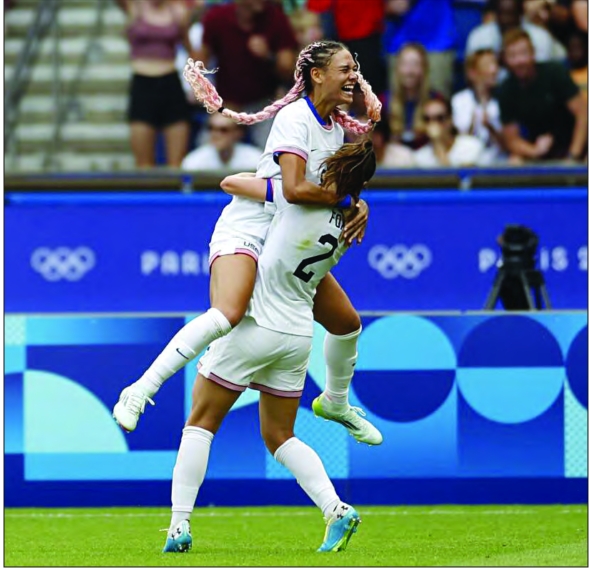
U.S. Women’s Soccer teammates Trinity Rodman and Emily Fox celebrate a goal.
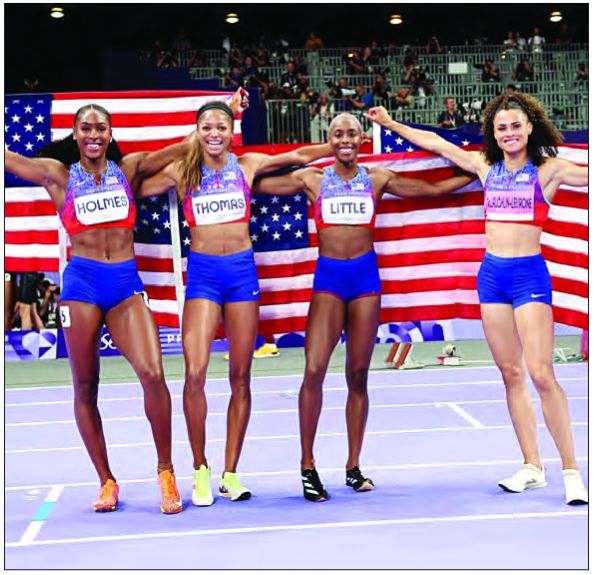
USA women’s 4 x 400 team (from left) Alexis Holmes, Gabby Thomas, Shamier Little and Sydney McLaughlin-Levrone
The final week of the 33rd Olympic Games was a spectacular and failing moment for the United States. Topping the former list was the show-stopping performance of Gabby Thomas, who won three gold medals.
Thomas, raised in Northampton, Massachusetts, rose to fame at the Williston Northampton School in Easthampton, Mass., where she excelled in cross country, basketball and soccer during her prep years. Significantly influenced by her parents Jennifer and Desmond’s passion for education and hard work, Gabby graduated from Harvard University in 2019, majoring in neuroscience and global health.
Her athletic career skyrocketed at Harvard, where she broke multiple school records on her way to becoming an NCAA Champion in the 200 meters. Her breakout moment came in the 2020 Tokyo Olympics, where she won a bronze medal in the 200 meters and a silver medal in the 4x100 relay, setting the stage for her ascendancy to triple gold medal status in the Paris Olympic Games.
After winning gold in the 200 meters, she rose to Olympic royalty with two more gold medals as part of the U.S. women’s 4x100 and 4x400 relay teams.
Teaming
with Sha’Carrie Richardson, Melisa Jefferson and Twanisha Terry, Thomas
and her teammates overcame rainy conditions to win the gold medal with a
season-best 41.78 seconds. Her coup de grace moment came when her
teammates Shamir Little, Sydney McLaughlin-Levrone and Alexis Holmes
brought home gold in the 4x400 relay event.
While
the Paris Olympic Games marked the first time Gabby Thomas would win
gold medals, they also placed a golden crown on Sydney
McLaughlin-Levrone’s head.
McLaughlin-Levrone, who successfully defended her 2020 Tokyo Olympic gold medal title with a record-setting 50.37
in the individual 400-meter hurdles event, broke her world record in
the Paris Games. She also ran the second leg of the 4x400 relay in a
blistering time of 47.70 to give the American team a massive lead before
handing off to Gabby Thomas. Thomas followed with a 49.30 split before
anchor Alexis Holmes glided to the finish line. The team clocked a U.S.
record time of 3:15:27, just a tenth of a second off the world record
set in 1988, which seemed untouchable until now. McLaughlin-Levrone and
her relay teammates hinted that that record could soon fall. The U.S.
women have dominated the 4x400 relay, winning eight straight gold medals
in the event.
Men’s relay woes
It
was a different story for the U.S. men’s 4x100 sprint relay team, which
was disqualified in the final due to a mistimed baton handoff between
Christian Coleman and Kenny Bednarek. Bednarek appeared to start early,
resulting in a delayed exchange that pushed the team out of contention.
The U.S. wound up finishing seventh before being disqualified for a
pass-zone violation. This disqualification is the latest in a string of
mishaps that have plagued the U.S. men’s 4x100 sprint relay team in
recent Olympic Games, including 2008, 2016 and 2020.
The last time the U.S. men reached
the podium in the 4x100 sprint relay race was in 2004, when they won a
silver medal. The current failure of the 4x100 relay team was
exacerbated by the absence of Noah Lyles, the 100-meter gold medalist
who withdrew from the relay team after testing positive for COVID-19.
Criticism
of the 4x100 relay team has come from many circles, including harsh
words from Olympic great Carl Lewis. The nine-time Olympic Gold medalist
has called for significant changes within USA Track & Field.
Lewis’s social media comments criticized the organization for
prioritizing relationships over winning.
He calls for a complete overhaul of the relay program to prevent future failures.
The
U.S. men’s 4x400 relay restored some sense of order by capturing gold
in an Olympic record time of 2:54:43, nearly a full second faster than
his countrymen did at the 2008 Olympics in Beijing, China. The U.S. team
of Chris Bailey leading off, followed by Vernon Norwood, Bryce Deadmon
and Rai Benjamin running the anchor leg, was able to hold off a strong
finish by Leslie Tobogo, the 200-meter gold medal winner of Botswana.
His time of 43:18 enabled him to cross the finish line 0.10 ahead of
Tobogo.
Quincy
Wilson, the 16-year-old high school student from Maryland, became the
youngest track and field athlete in U.S. history to compete and win a
gold as part of the 4x400 relay team.
Americans Masai Russell and Grant Holloway were gold winners in the 100-meter hurdles.
In
a story that deserves special mention, Sifan Hassan of The Netherlands
won the women’s marathon. Her Olympic performance was made all the more
spectacular by the fact that Hassan had won bronze medals in the 5,000-
and
10,000-meter runs before taking on the challenge of running the
26.2-mile marathon, where she was victorious over Ethiopian Tigst
Assefa, the defending Berlin marathon champion. In all, Nassan ran over
40 miles to achieve her history-making goal.
Women’s soccer
The
United States women’s national soccer team returned to glory with a 1-0
victory over Brazil in the gold medal contest. Mallory Swanson scored
the game-winning goal in the 57th minute to provide the margin of
victory. Outstanding goaltending by U.S. netminder Alyssa Naeher made
the difference as the U.S. women’s soccer contingent returned to the top
of the Olympic podium. Trinity Rodman, the daughter of NBA Hall of
Famer Dennis Rodman, along with Sophia Smith and Namoi Girma played
starring roles for this young U.S. team that was not expected to win
gold this soon.
Credit
recently appointed U.S. coach Emma Hayes for her brilliant work of
molding this young team together in just 10 games, a gold medal Olympic
championship team. It is the first Olympic gold medal for the U.S.
women’s national soccer team since 2012.
Bronze controversy
The
Paris Olympic Games had controversial moments, with the Jordan Chiles
situation gaining significant headlines. The U.S. Olympic gymnast was
stripped of her bronze medal for the individual floor exercise because a
U.S. protest was not received in time. Chiles was the final participant
in her event and was given one minute to protest a scoring ruling to
lodge her protest. Video evidence, which was unavailable at the time,
clearly shows that Chiles’ coach, Cecile Landi, submitted an inquiry
into Chiles’ score within the allowed one-minute time frame, precisely
47 seconds after the score was posted.
This
evidence directly contradicts the earlier ruling by the Court of
Arbitration for Sports (CAS), which stated that the inquiry was four
seconds too late, leading to the decision to reduce Chiles’ score and
award the bronze medal to Ana Barbosu of Romania.
USA
Gymnastics has submitted the newly discovered video evidence and a
formal letter to CAS requesting that they reinstate Chiles’ original
score of 13.766 and she retain her bronze medal. USA Gymnastics
emphasized that this video was unavailable during the initial tribunal
decision and needed to be presented earlier.